



2 FTUs: How Much Face Cream to Use Without Guessing
Use about two fingertip units of face cream for the face alone, roughly 2 FTUs if you’re covering the neck too. That’s a strip of product from the fingertip crease to the tip, which usually lands somewhere between a pea and a nickel in size depending on the tube’s nozzle. Richer creams need less volume than gels, and most people find a slightly heavier application at night helps overnight repair without needing more product in the morning.
TL;DR:
- Most people should use around 2 to 2.5 fingertip units of face cream for the face and neck, with the exact amount depending on skin type and product richness.
- Applying cream in gentle, upward strokes and pressing it into the skin improves absorption and hydration, especially after waiting a minute before SPF or makeup.
- Seasonal and situational factors, such as winter dryness or long flights, may require increasing the amount or switching to a richer formula temporarily.
- Over-application causes greasiness, congestion, and long-term skin issues like clogged pores, while under-application results in tightness and flaky patches.
- Choosing a formula suited to your skin and measuring accurately with a dispenser prevents waste and ensures consistent, effective hydration.
Table of Contents
- How much face cream is right: FTU, pea and nickel amounts by texture and skin type
- How to apply face cream correctly for better absorption
- When should you use more or less face cream?
- Signs you’re using too much or too little face cream
- Matching your face cream amount to the right M-shop product
- How to measure and dispense the exact amount every time
- Does the amount of face cream affect how long a jar lasts?
- Should you use more face cream as you get older?
- What conventional moisturiser advice gets wrong
- Where to find the right texture without the trial and error
- Sources
- FAQ
How much face cream is right: FTU, pea and nickel amounts by texture and skin type
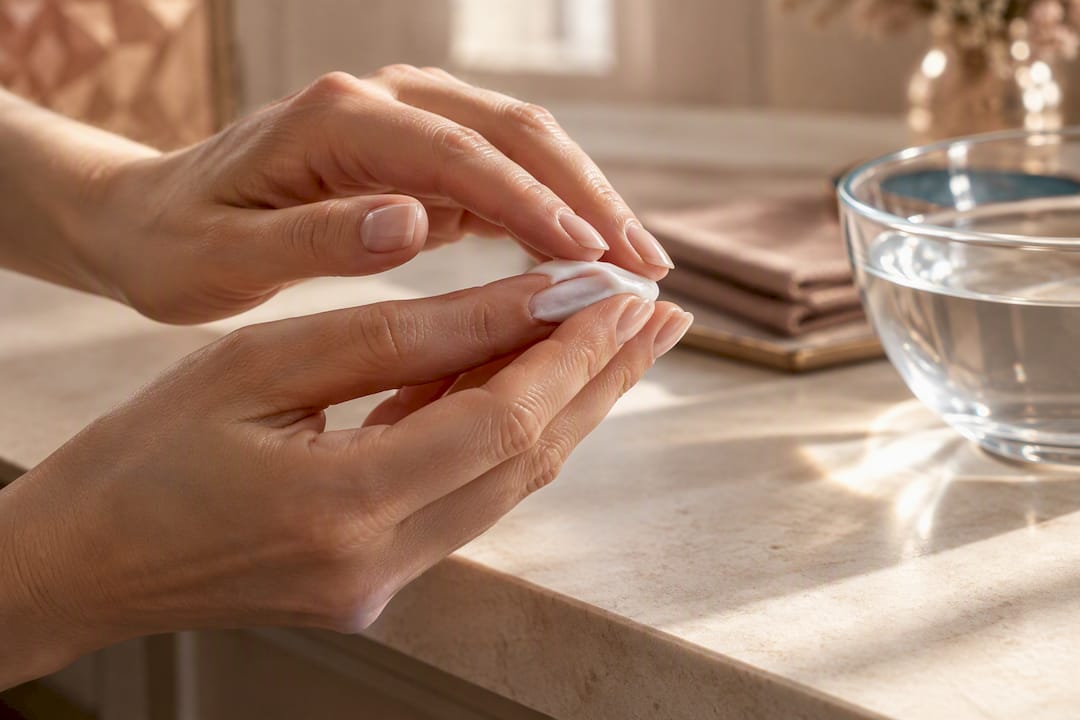
Dermatologists measure moisturiser with the Fingertip Unit (FTU), a squeeze of product from the tip of the index finger to the first crease. One FTU is roughly 0.5 grams, and it’s become the standard because it scales naturally with the size of your hand and the width of the tube nozzle, unlike a vague “pea-sized amount,” which varies wildly depending on who’s holding the pea. DermNet NZ’s guidance on the fingertip unit puts the face-and-neck figure at around 2 to 2.5 FTUs, and that number holds up whether you’re using a £6 supermarket tub or a premium jar.
If FTUs feel too clinical, the visual shortcuts work almost as well:
- Pea-sized amount: fine for lightweight lotions or for people with oily, breakout-prone skin who want minimal shine.
- Nickel-sized amount: the more realistic baseline for normal to combination skin using a standard cream.
- 2 to 2.5 FTUs: the precise version of the above, and the one worth learning if you tend to under-apply.
Texture changes the maths. A budget-friendly face oil or lightweight gel spreads across a much larger surface area per drop, so you’ll often need less than the FTU guide suggests. Dense, emollient-rich creams and balms are concentrated by comparison. A smaller dab does the same job because the oils and occlusives sit on the skin rather than sinking in instantly. Skin type matters just as much as formula. Oily and acne-prone skin generally does better on 1.5 to 2 FTUs of a lighter lotion, according to guidance from The Deconstruct’s FTU breakdown by skin type, while dry or mature skin can comfortably use the full 2.5 FTUs of a richer cream, particularly at night.
A simple test for coverage: if the cream disappears within a minute and leaves skin feeling tight again soon after, you’ve under-applied. If it’s still visibly sitting on the surface after ten minutes, scale back next time.
How to apply face cream correctly for better absorption
Order matters as much as amount. The standard sequence is cleanser, then any serum, then your face cream, then SPF if it’s daytime. Give a serum thirty seconds to a minute to settle before layering cream on top, otherwise you’re just diluting both products against each other.
- Dot the cream in five points: forehead, both cheeks, chin, and nose.
- Spread outward and upward in gentle strokes rather than rubbing hard in circles.
- Press the last of the product into the skin with your palms instead of continuing to rub it in.
- Wait roughly a minute before applying SPF or makeup so the cream has time to settle rather than sliding around under a foundation brush.
- At night, you can afford a slightly thicker layer since there’s no makeup to disrupt and skin does more repair work while you sleep.
Pressing rather than rubbing matters more than people assume. Vigorous rubbing warms the skin and speeds evaporation of the water content, which works against the hydration you’re trying to lock in.
Pro Tip: Warm the product between your fingertips for a few seconds before applying. It softens dense creams and balms so they spread further with less pulling on the skin. This is especially useful with rich, collagen-based formulas.
When should you use more or less face cream?
The baseline amount isn’t fixed all year. Central heating and cold, dry air in winter both strip moisture faster than warm, humid summer conditions, so many people need a richer texture or slightly more product from around October through to March, then can drop back down when the weather turns.
Short-term events call for a temporary bump too:
- A long flight, which dries skin through low cabin humidity.
- Windburn after a day outdoors in cold or blustery conditions.
- Starting a retinoid, exfoliating acid, or any other active that increases dryness while your skin adjusts.
The better habit is to read your skin rather than follow a fixed schedule. If it feels tight an hour after applying, that’s the signal to add a touch more product, or switch to a richer formulation, before assuming you simply need a bigger dollop. Change the texture first, then the quantity. Swapping a lightweight lotion for a proper cream often solves the tightness without needing to double the amount you’re using.
Signs you’re using too much or too little face cream
Too much shows up fast. Skin that still feels greasy or slick fifteen minutes after application, product that “balls” under your fingers instead of absorbing, or makeup that slides rather than sets are all signs you’ve overdone it that day. Dermatologists interviewed for Women’s Health’s piece on moisturiser overuse note that piling on a heavy cream several times a day, regardless of need, tends to cause congestion rather than better hydration.
Longer term, overuse tends to show up as clogged pores, milia around the eyes, or a dull, thickened look to the skin. Underuse looks different: persistent tightness, flaky patches around the nose and jaw, and skin that reacts more easily to products it previously tolerated fine.
Quick fixes:
- Switch to a lighter, non-comedogenic formula if you’re seeing congestion.
- Cut back to 1.5 FTUs for a week and reassess before removing moisturiser altogether.
- Add a richer cream at night only, rather than increasing your daytime amount.
- See a dermatologist if flakiness or breakouts persist beyond a couple of weeks despite adjustments.
Matching your face cream amount to the right M-shop product
The amount rules above only work if the formula suits your skin. M-shop carries a spread of textures precisely because one FTU count doesn’t fit every jar. For oily or blemish-prone skin, the Pharmaceris T anti-acne day cream is built to be used sparingly, around 1.5 to 2 FTUs, thin enough to sit comfortably under makeup without adding shine.
For drier or more sensitive skin needing daily SPF protection, the Pharmaceris A moisturising face cream SPF 20 works closer to the full 2 to 2.5 FTU range, since it’s doing hydration and sun protection in one step.
- Richer night formulas, like the Eveline Hyaluron Clinic B5 Concentrated Anti-Wrinkle Cream 60+, suit the slightly heavier evening application many dermatologists recommend for repair.
- The range includes a selection of Polish skincare formulas sourced directly to ensure quality, with discounts appearing regularly across the range.
- Full ingredient lists and usage information are provided on product pages for customers seeking details before purchase.
How to measure and dispense the exact amount every time
Guessing by eye is the main reason people either drown their skin in product or leave it under-fed. The fingertip unit solves most of that, but only if you actually use it consistently rather than eyeballing “some cream” onto your hand.
A few practical habits make FTU dosing second nature. Pump or tube dispensers are easier to control than open jars, since a jar invites scooping with two or three fingers at once, which almost always overshoots. If your cream comes in a jar, use a small spatula or clean fingertip to portion it onto the back of your hand first, then measure the FTU length from there before applying to your face. That extra ten seconds stops the unconscious habit of piling on more “just in case.”
For gels and thinner lotions, a pump dispenser that releases a set amount per press is genuinely useful, since it removes the guesswork entirely; one or two pumps typically approximates 2 FTUs once you’ve checked the size of a single pump against the fingertip guide.
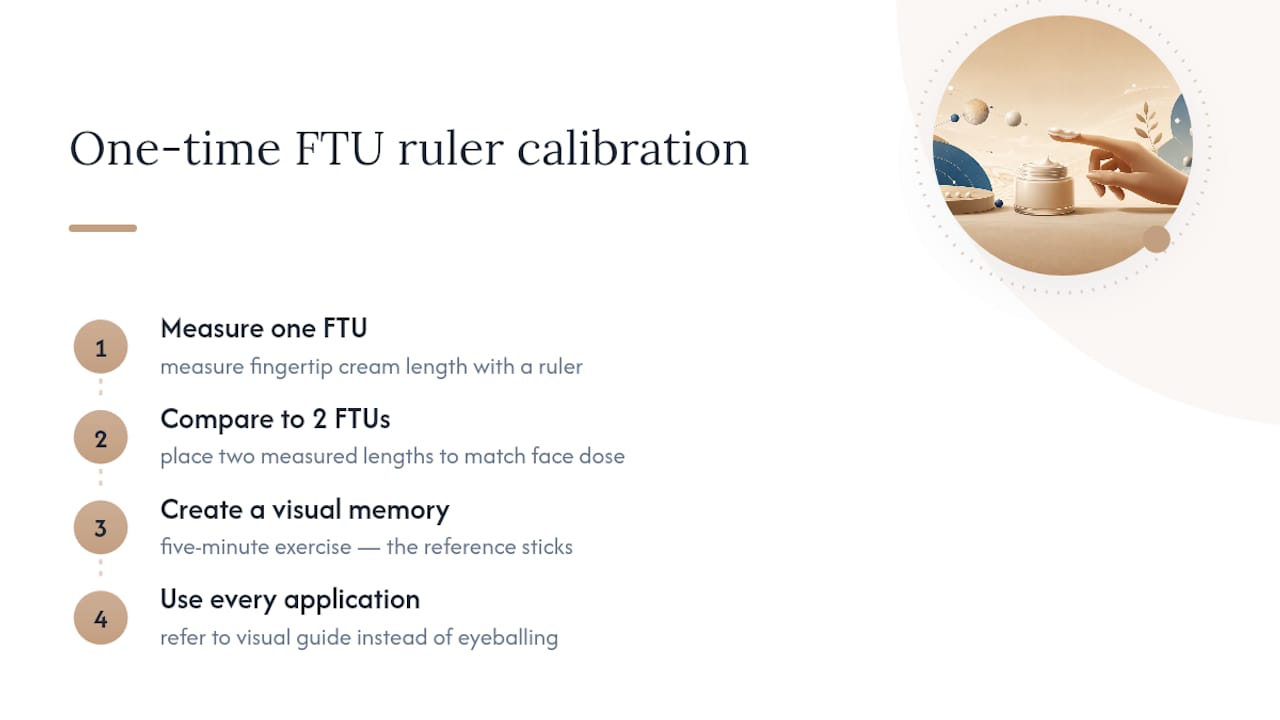
Some people find it easier to measure once with an actual ruler against their finger to calibrate what “one FTU” looks like on their own hand, since finger length varies enough between adults that a mental estimate can be off by a third or more. Do that calibration once, and the visual memory sticks for every application afterwards. It’s a five-minute exercise that fixes months of either under or over-applying without you noticing.
Does the amount of face cream affect how long a jar lasts?
Yes, directly and predictably. A working estimate is around 0.5 ml per application for a standard face cream, which means a 50 ml jar used morning and night lasts roughly 50 days if you’re dosing consistently at the recommended 2 FTUs.
That figure shifts fast with habits. Someone applying closer to a tablespoon each time, well above what dermatologists recommend, can burn through the same 50 ml jar in under three weeks. That’s not just wasteful; it’s often the exact behaviour behind the greasy, congested skin described earlier in this guide.
Richer, more concentrated creams tend to offer better value per jar even at a higher shelf price, because the correct dose is smaller. A 30 ml jar of a dense night cream used at 1.5 FTUs can outlast a 50 ml jar of a thin lotion applied at 3 FTUs because someone assumed “watery” meant “use more.” Checking texture against your actual FTU need, rather than judging by jar size alone, is the more reliable way to work out genuine cost per use. It also explains why two products with wildly different price tags can end up costing roughly the same per week once application size is accounted for.
Should you use more face cream as you get older?
Often, yes, though it’s less about age itself and more about what’s happening to the skin barrier. Skin tends to produce less of its own oil from the late thirties onward, and cell turnover slows, both of which make dryness and fine dehydration lines more noticeable. That’s usually the point where people shift from a lightweight lotion to a proper cream rather than simply applying more of the same thin formula.
The more useful adjustment is texture before volume. Someone in their twenties with resilient, oil-producing skin might do fine on 1.5 FTUs of a gel cream. The same person in their fifties, with a slower-repairing barrier, often needs the full 2.5 FTUs of a genuinely emollient cream, sometimes with actives like collagen peptides or hyaluronic acid built in to support firmness. Collagen-based creams tend to show hydration improvements within days, with firmness changes taking closer to 8 to 12 weeks to become visible, so patience matters as much as the amount applied.
Skin condition swings matter too, independent of age. A flare of eczema, a bout of dehydration from illness, or a period of high stress can all temporarily demand more product or a richer formula regardless of how old you are. Treat those as short-term adjustments and drop back to your usual amount once skin settles, rather than assuming the higher dose is now permanent.
What conventional moisturiser advice gets wrong
Most skincare content treats “how much” as a footnote to “which product,” when it’s genuinely the other way round. A brilliant cream applied at half the amount it needs does very little, and a mediocre one overapplied just sits on the skin causing congestion. The measurement should come first, the product choice second.
The bigger blind spot is treating FTU guidance as static. Skin condition changes week to week, sometimes day to day, and the fixation on a single “correct” number ignores that a dose right for humid August is often wrong for a heated flat in January. What the research actually supports is a habit of checking in with your skin rather than following a rule blindly.
If there’s one thing worth prioritising above all else, it’s texture matching before volume tinkering. Reaching for more of a lotion that’s fundamentally too light for your skin wastes product and patience. Reaching for a properly formulated cream, applied at the amount your skin actually needs, tends to solve most of the tightness or dullness people try to fix by simply piling on more.
— Krzysztof
Where to find the right texture without the trial and error
Picking the correct FTU amount only gets you halfway; the formula still has to suit your skin, and that’s where a lot of people waste money guessing across three or four half-used jars before finding the right one. M-shop is a family-run source for Polish skincare brands, which means the range is chosen directly rather than filtered through a generic distributor, and it covers the full texture spectrum this guide has walked through, from lightweight gels to richer night creams.

Browse the full face care range to match texture to your skin type, or go straight to the Pharmaceris T anti-acne day cream if oily or blemish-prone skin is your main concern.
Sources
- DermNet NZ — Fingertip unit
- Are you using too much moisturizer? Dermatologists reveal the signs — Women’s Health
FAQ
Should you rub in face cream or let it sit?
Press it in gently rather than rubbing vigorously; rubbing generates heat that speeds up water evaporation from the skin’s surface. Give it about a minute to settle before applying SPF or makeup on top.
How much does face cream typically cost per use?
Cost per use depends on both the price of the jar and how much you apply each time, since a 50 ml jar used at the recommended 2 FTUs per application lasts roughly 50 days on a twice-daily routine. M-shop’s Pharmaceris and Eveline ranges are priced on the shop’s product pages, with regular discounts during sales.
What happens if you don’t moisturise your face?
Skin loses water through the barrier faster than it can replace it, leading to tightness, flaking, and increased sensitivity to products you’d normally tolerate. Over time, an under-hydrated barrier also struggles to buffer against irritants, making breakouts and redness more likely.
What should you do before applying moisturiser?
Cleanse first, and apply moisturiser onto slightly damp skin rather than fully dry skin, since damp skin helps the product lock in more water at the surface. If you’re using a serum, let it absorb for around thirty seconds to a minute before layering cream on top.