



8–16 Week Brittle Nails Treatment Plan With Biotin Lab Test Warning
The most reliable brittle nails treatment is not a single product but a routine, protect nails from repeated wetting and drying, moisturise daily with an occlusive balm, and get correctable causes like low iron or thyroid disease checked before reaching for long-term supplements. Expect improvement to take weeks to show and months to complete, since a nail has to regrow rather than repair overnight.
TL;DR:
- Protecting nails from repeated wetting and drying, along with daily moisturising using occlusive balms, is more effective than relying on supplements alone.
- Systemic causes like low ferritin, thyroid disease, fungal infections, and medications should be ruled out before starting long-term treatments or supplements.
- At-home care involving cuticle oils, gloves for wet tasks, and gentle filing techniques can show improvements within a few weeks, with months needed for full recovery.
- Supplements like biotin and iron only help when deficiencies are present, and high-dose biotin can interfere with blood tests, so testing should precede supplementation.
- Professional nail treatments should focus on proper removal and protection, avoiding repeated harsh removal methods that damage the nail plate.
Table of Contents
- What causes brittle nails?
- At-home treatments that work: moisturise, protect and repair
- Do nail-strengthening supplements actually work?
- When should you see a clinician about brittle nails?
- What professional interventions help, and what should you avoid?
- A practical 8 to 16 week recovery plan you can follow
- Why the “just take biotin” advice misses the point
- Building your at-home nail repair routine
- Sources
What causes brittle nails?
Most brittle nails come down to water, not vitamins. Repeated wetting and drying, from washing up, frequent handwashing, or hospital and hairdressing work, strips the nail plate’s natural lipids faster than it can replace them. Acetone-based polish removers and aggressive salon removal compound the damage by breaking down the layers that hold the nail together.
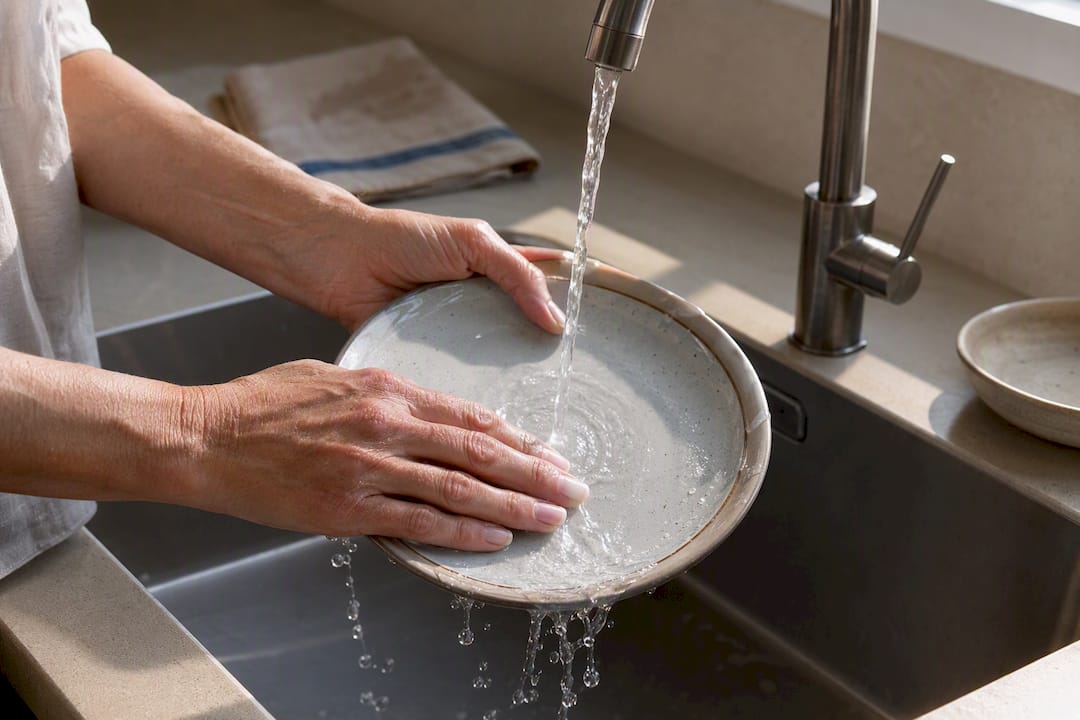
Age plays a role too: nail growth slows over time, and up to 20% of people report brittle nails at some point, most commonly women over 50. Genetics also set a baseline for how resilient your nails are regardless of care.
Then there are systemic causes worth ruling out before blaming ageing or bad luck:
- Iron deficiency, particularly low ferritin stores
- Thyroid disease, both underactive and overactive
- Inflammatory skin conditions such as psoriasis or lichen planus
- Fungal infection of the nail plate
- Certain medications, including some chemotherapy and retinoid drugs
Because the external and internal causes overlap so much, working through them in order, starting with what you can control at the sink, usually makes more sense than guessing.
At-home treatments that work: moisturise, protect and repair
Nail-care technique matters as much as any product you buy. Get the daily habits right first, and most mild brittleness starts improving within a few weeks.
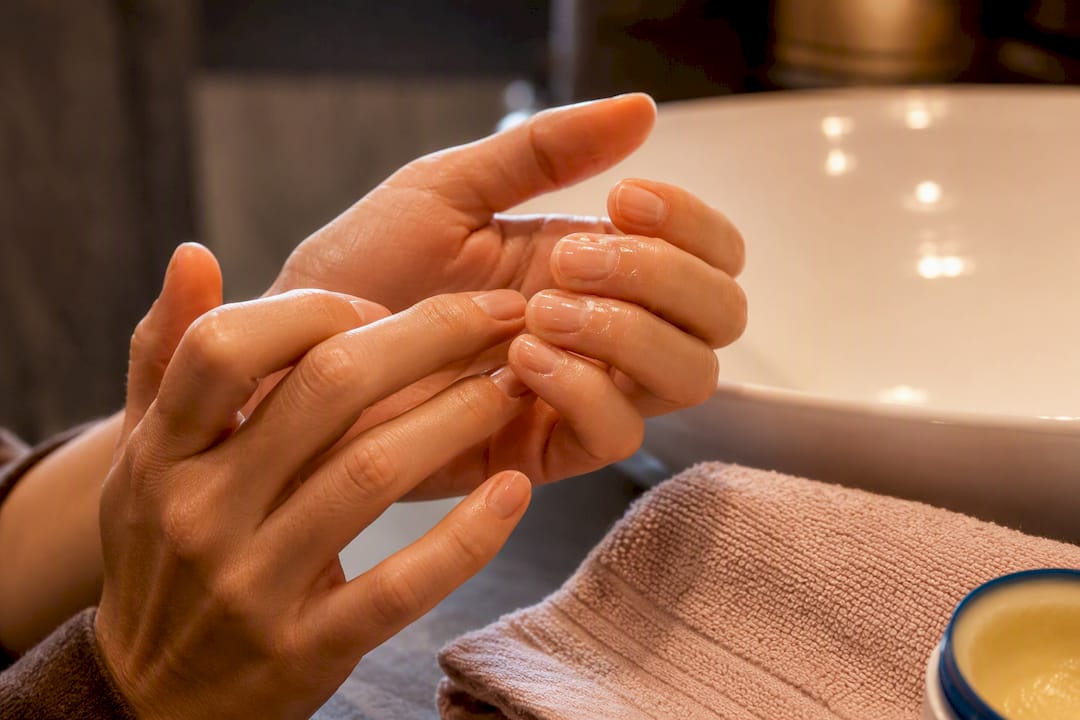
- Moisturise immediately after water exposure. Apply an occlusive balm containing petrolatum or lanolin straight after washing hands or bathing. This single habit is cited as one of the most effective at-home treatments for brittle nails, because it locks moisture into the nail plate before it evaporates.
- Work cuticle oil into the nail folds twice daily. Jojoba oil or vitamin E oil, massaged in morning and night, keeps the surrounding skin supple and slows moisture loss from the nail itself.
- Wear gloves for wet or chemical tasks. Washing up, cleaning, and hair colouring all accelerate wetting and drying cycles. Cotton-lined rubber gloves cut that exposure dramatically.
- Cut back on acetone and harsh removers. If you wear polish, switch to non-acetone remover and space out reapplications rather than stripping and redoing nails weekly.
- File in one direction, keep nails short, and leave cuticles alone. Sawing back and forth weakens the free edge, and cutting or picking at cuticles invites infection and splitting.
- Pause heavy salon treatments while nails repair. Gel and acrylic removal, if done roughly, thins the nail plate exactly where it needs to thicken.
Nail hardeners deserve a caution of their own. Formaldehyde-based hardeners can genuinely help during a short repair cycle of two to four weeks, but using them continuously tends to make nails stiffer and more prone to snapping rather than more resilient. Alternate them with a non-formaldehyde strengthening base rather than relying on one product indefinitely.
Pro Tip: Keep a small tub of balm by the kitchen sink and another by the bathroom basin. The habit only sticks if the product is there the second your hands are dry.
Do nail-strengthening supplements actually work?
Supplements help in specific circumstances, not as a blanket fix. The evidence is strongest when a deficiency is present and weakest when nails are otherwise healthy but simply fragile.
- Biotin: clinical reviews report improvement in nail firmness using doses commonly studied at 2.5 to 10 mg per day, typically taken for three to six months. Many dermatology sources lean towards the 5 to 10 mg end of that range for idiopathic brittle nails.
- Iron: worth considering when ferritin runs low, with deficiency often flagged below roughly 10 ng/mL. Pairing iron with vitamin C improves absorption.
- Zinc: studies use doses around 20 to 30 mg per day, but the benefit only shows up in people who are actually deficient.
- Collagen peptides and biomineral formulations: some trials show modest benefit as an adjunct, not a standalone fix, so keep expectations realistic.
High-dose biotin carries a real caveat: it can interfere with laboratory assays, including troponin and thyroid tests, and may produce false results. Tell any clinician you’re taking it before you have blood drawn.
Diet matters underneath all of this. Nails are built largely from keratin, and Cleveland Clinic guidance recommends aiming for around 45 g of protein daily to support healthy growth, regardless of which supplement you’re weighing up.
When should you see a clinician about brittle nails?
Most brittleness responds to home care within a couple of months. Some signs mean it’s worth booking an appointment rather than waiting it out.
- Sudden pain, swelling, or pus around the nail fold
- Rapid change in nail shape, thickness, or colour
- Discolouration that spreads or darkens under the nail
- Brittleness alongside fatigue, hair thinning, or unexplained weight change
- No improvement after eight to twelve weeks of consistent home care
Clinicians investigating persistent brittle nails commonly order a ferritin level and full blood count, thyroid function tests, and a fungal swab, culture, or PCR if there’s any scaling or discolouration suggesting infection. Finding a systemic or infectious cause changes the plan entirely. Iron-deficiency brittleness responds to iron replacement rather than nail oil, and fungal infection needs an antifungal, not a strengthening lacquer, since the two problems can look almost identical on the surface.
What professional interventions help, and what should you avoid?
Salon choices can either speed recovery or set it back months. The damage usually happens at removal, not application.
- Insist on proper soak-off removal for gel or acrylic, and ask the technician to keep e-file pressure light.
- Avoid repeated acetone soaks and forced peeling, which strip layers off the nail plate that took months to grow.
- BIAB (builder in a bio-gel) overlays can act as a protective shield while the natural nail grows out underneath, provided removal is handled professionally rather than picked off at home.
- Some professional topical lacquers, including hydroxypropyl chitosan (HPCH) formulas, have trial evidence for improving nail structure; topical cyclosporine emulsion has limited evidence in select difficult cases and would sit with a dermatologist, not a salon.
Pro Tip: If a technician resists doing a slow soak-off and reaches for a metal pusher to force product off, that’s your cue to find a different salon.
A practical 8 to 16 week recovery plan you can follow
Nails grow roughly 3 mm a month on average, which is why any real recovery plan runs in months rather than days.
- Weeks 1 to 4: wear waterproof gloves for wet tasks, start a nightly occlusive moisturiser, apply cuticle oil twice daily, keep nails short, and file in one direction only.
- Weeks 4 to 8: check progress. If nails are still splitting or peeling with no improvement, book a clinician appointment for ferritin and thyroid tests rather than adding supplements blindly.
- Weeks 8 to 16: keep up the protective routine, reassess growth, and consider a BIAB overlay or professional repair lacquer if you need mechanical protection while the healthier nail grows out.
| Timeframe | Focus | What to expect |
|---|---|---|
| Weeks 1 to 4 | Protection and moisture | Less splitting at the edges, softer cuticles |
| Weeks 4 to 8 | Assessment | Clearer picture of whether a cause needs testing |
| Weeks 8 to 16 | Reinforcement and regrowth | Visibly stronger new growth at the base |
Why the “just take biotin” advice misses the point
The internet’s default brittle nails treatment is a biotin bottle, and that’s exactly what worries me about how this topic gets covered. Biotin has genuine trial support, but it’s being handed out as a first response when it should be a second or third step, after someone has actually ruled out low ferritin, thyroid disease, or a fungal infection hiding under a coat of polish.
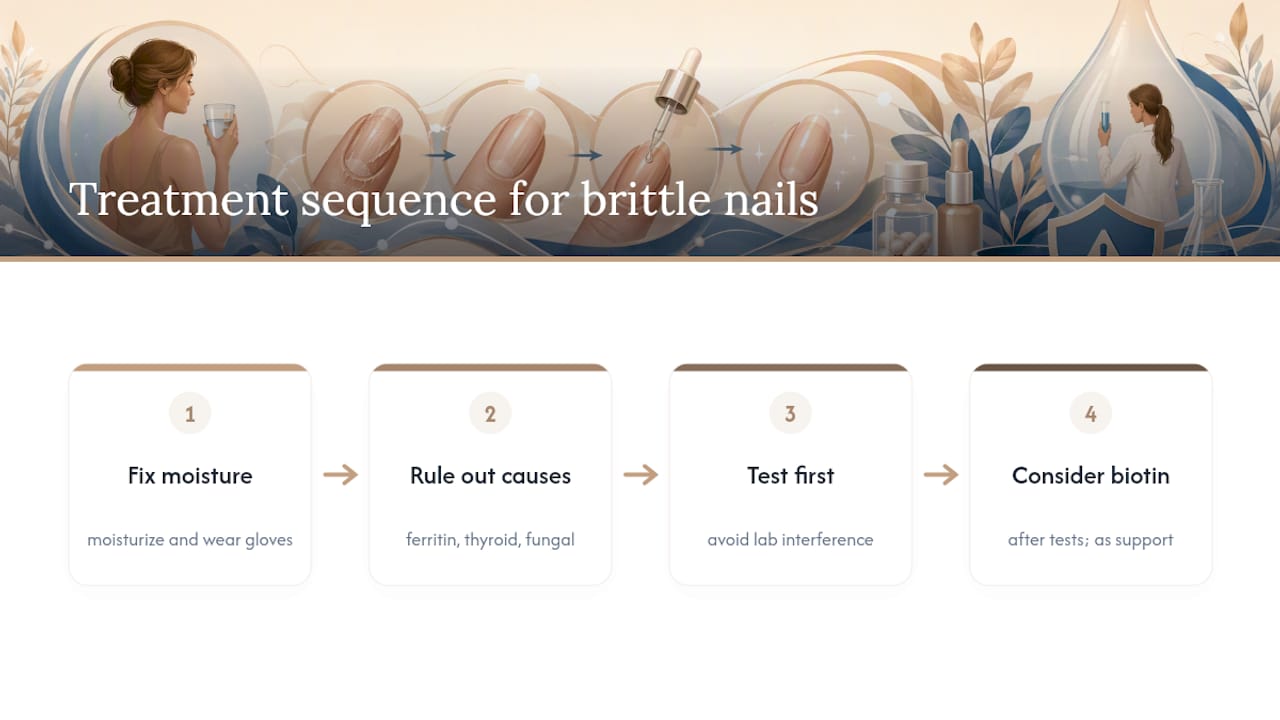
The biotin lab-interference issue is the part almost nobody flags, and it should worry anyone self-dosing at 10 mg a day before a routine blood test. It’s not dangerous in itself, but a falsely elevated or suppressed result can send a clinician chasing the wrong diagnosis for weeks.
My honest read: the moisturising and glove habits do more for the average person than any pill, because most brittleness is a water problem wearing a vitamin-deficiency disguise. Fix the wet and dry cycle first, test before you supplement, and treat anything you buy, including biotin, as support for a routine rather than a substitute for one.
— Krzysztof
Building your at-home nail repair routine
There’s a reasonable case for combining several remedies at once, and a stronger case for doing it with products actually built for the job rather than whatever’s left in the bathroom cabinet. As a skincare specialist, products are chosen for natural, ingredient-led standards applied across the skincare range, which makes matching product to routine straightforward.

For the nightly repair step in your recovery plan, Paese Nail Repair targets splitting and brittle nails directly, while the Regenerum regenerating nail serum suits the twice-daily cuticle treatment stage. For daily hydration, Eveline Nail Therapy nail oil covers the cuticle-oil habit, and the Eveline SOS paraffin mask works well as an overnight occlusive treatment for hands and nails together. If your hands need broader barrier support alongside the nail routine, this guide to restoring the skin’s moisture barrier is worth a read, and a rich hand cream such as the Celia Collagen + Algae moisturising cream pairs naturally with the gloves-and-balm habit described above.
Patch test any new oil or lacquer on a small area first, check the ingredient list against any known sensitivities, and remember that these products support the routine described here. They don’t replace a ferritin or thyroid check if your nails aren’t improving after two months. Browse the full nail care range to build a routine around what your nails actually need.
Sources
- Amino acids: what they do and why you need them — Cleveland Clinic
- Just add water to care for brittle nails — Nails Magazine
This article is general information, not a substitute for advice from a qualified doctor. Consult a qualified healthcare professional about your own circumstances before acting on anything here.