



When to skip soap: 4 situations an intimate wash helps
For most people, warm water alone is enough to keep the vulva clean and comfortable. A pH-balanced, fragrance-free intimate wash is a reasonable, optional extra for external use, particularly during a period or after heavy exercise, but it is never a necessity. Regular bar soap or fragranced shower gel is the one to avoid, and nothing should ever be washed inside the vagina.
TL;DR:
- Washing inside the vagina is unnecessary and may increase the risk of bacterial imbalance and sexually transmitted infections.
- Plain water and gentle, fragrance-free external products are sufficient for vulvar hygiene, with no need for daily washes.
- If using an intimate wash, choose one with a mild acid pH, short ingredient list, and no fragrances or harsh preservatives, and never insert it.
- Regular soap’s alkalinity and fragrances can cause irritation, whereas water alone does not alter the vaginal microbiome’s natural acidity.
- Routine internal washing or over-washing the external area can compromise skin and microbial health, making clinical advice essential for persistent symptoms.
Table of Contents
- Intimate wash vs soap starts with an anatomy question
- Comparing water, soap and intimate wash on skin and pH
- What the clinical evidence actually says
- When an intimate wash helps, and how to use one safely
- Ingredients and claims worth questioning on the label
- How M-shop chooses the intimate washes it stocks
- Where to find a suitable intimate wash on M-shop
- A publisher’s note on evidence versus marketing
- Sources
- FAQ
Intimate wash vs soap starts with an anatomy question
The confusion around intimate wash versus soap usually starts with a mix-up over anatomy, and that mix-up matters more than most people realise. The vulva is the external skin, hair-bearing folds and opening you can see and touch. The vagina is the internal canal, and it is not something that needs cleaning at all.
Left alone, the vagina cleans itself. It maintains its own ecosystem of bacteria, dominated by Lactobacillus species, which keep the environment acidic (typically a pH around 3.8 to 4.5). That acidity is a defence mechanism: it makes it harder for harmful bacteria and yeasts to take hold. Wash inside the vagina, whether with water, soap, or a “feminine” product marketed for the job, and you disturb that balance.
This is why douching and other forms of internal washing carry a documented downside. Reviews of the clinical literature show internal washing is associated with higher rates of bacterial vaginosis, and some analyses link it to increased susceptibility to sexually transmitted infections, because disrupted vaginal flora and pH create an opening for less-friendly organisms to move in.
The vulva is a different story entirely. It is skin, subject to the same rules as skin anywhere else on the body: it has an acid mantle, it can be irritated by harsh surfactants, and it benefits from gentle, infrequent cleansing rather than aggressive scrubbing.
Three points worth holding onto:
- The vagina is self-cleaning and does not need soap, water, or wash products inside it, ever.
- The vulva is external skin and can be cleaned with water or a gentle external product.
- Lactobacillus-driven acidity is the vagina’s own defence system, and washing inside disrupts it.
Get that distinction right, and most of the soap-versus-wash debate resolves itself. The real question is not “what’s best for my vagina” but “what’s best for the skin around it.”
Comparing water, soap and intimate wash on skin and pH
Plain warm water does the least, and that is precisely its advantage. It rinses away sweat, discharge residue and surface bacteria without altering the skin’s pH or touching the vaginal microbiome. There is no formulation to react to, no preservative system, no fragrance. For the vulva, water is the baseline every other product gets measured against.
Regular soap works differently. Traditional bar soaps and many shower gels are alkaline, often sitting at a pH of 9 or 10, while healthy vulvar and vaginal environments prefer something closer to 4 or 5. Soap also relies on strong foaming agents and surfactants to lift oil and dirt, and those same agents strip the thin layer of natural oils that protect vulvar skin. Add fragrance, and you introduce one of the most common triggers of contact irritation in this area. The result of repeated exposure can be dryness, micro-irritation, and a skin barrier that is easier for opportunistic bacteria and yeast to exploit.
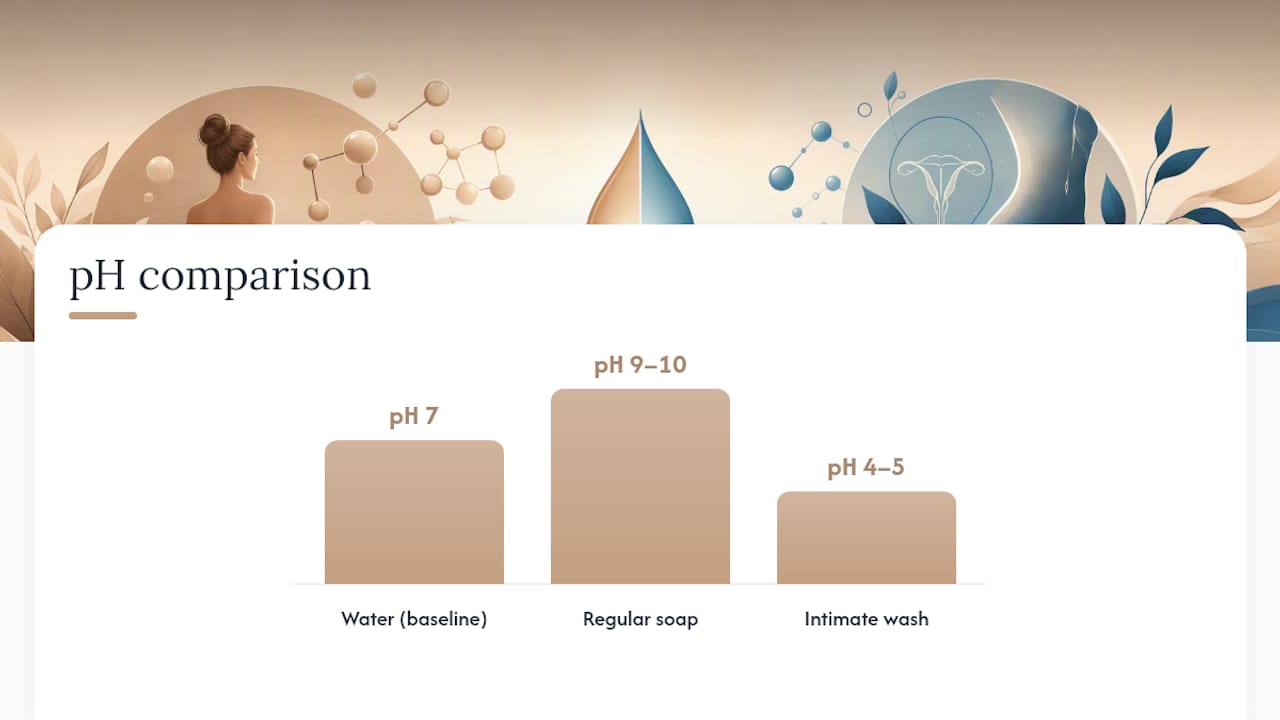
Intimate washes exist to close that gap. Most are formulated as syndets (synthetic detergents rather than true soap), adjusted to a mildly acidic pH, and some include lactic acid or lactoserum (a whey-derived ingredient) intended to echo the vagina’s own protective chemistry. The theory is sound: a cleanser that does not fight the skin’s natural acidity should, in principle, be gentler than an alkaline soap.
The evidence is more cautious than the marketing. Some formulations built around lactic acid and gentle surfactants have shown modest improvements in vulvar hydration and pH stability in small studies, but the benefit is product-specific rather than universal, and not every intimate wash on the shelf delivers it. A wash can call itself “intimate” and still contain fragrance, alcohol, or harsh preservatives that undo the whole point.
Pro Tip: Don’t judge a wash by the word “intimate” on the label. Judge it by whether the ingredient list is short, fragrance-free, and free of denatured alcohol high on the list.
A short way to hold the three options in your head:
- Water: neutral, always safe, does not touch pH or microbiome, but does not do anything for skin barrier support either.
- Regular soap: effective at cleaning generally, but its alkalinity and fragrance load make it a poor match for vulvar skin specifically.
- Intimate wash: designed to sit closer to natural pH, with some formulations showing genuine skin benefits, though quality and formulation vary considerably between products.
None of the three should ever go inside the vagina. That rule does not change depending on which one you are holding.
What the clinical evidence actually says
The strongest, most consistent finding across the research is almost boring in its simplicity: washing inside the vagina is the behaviour to avoid, and everything else is comparatively minor. Systematic reviews of intimate hygiene practices consistently report higher bacterial vaginosis prevalence among people who douche or wash internally, and some analyses extend that association to a higher risk of sexually transmitted infections. That is not a fringe finding buried in one small study. It repeats across multiple observational cohorts and reviews, which is about as close to a settled point as this field gets.
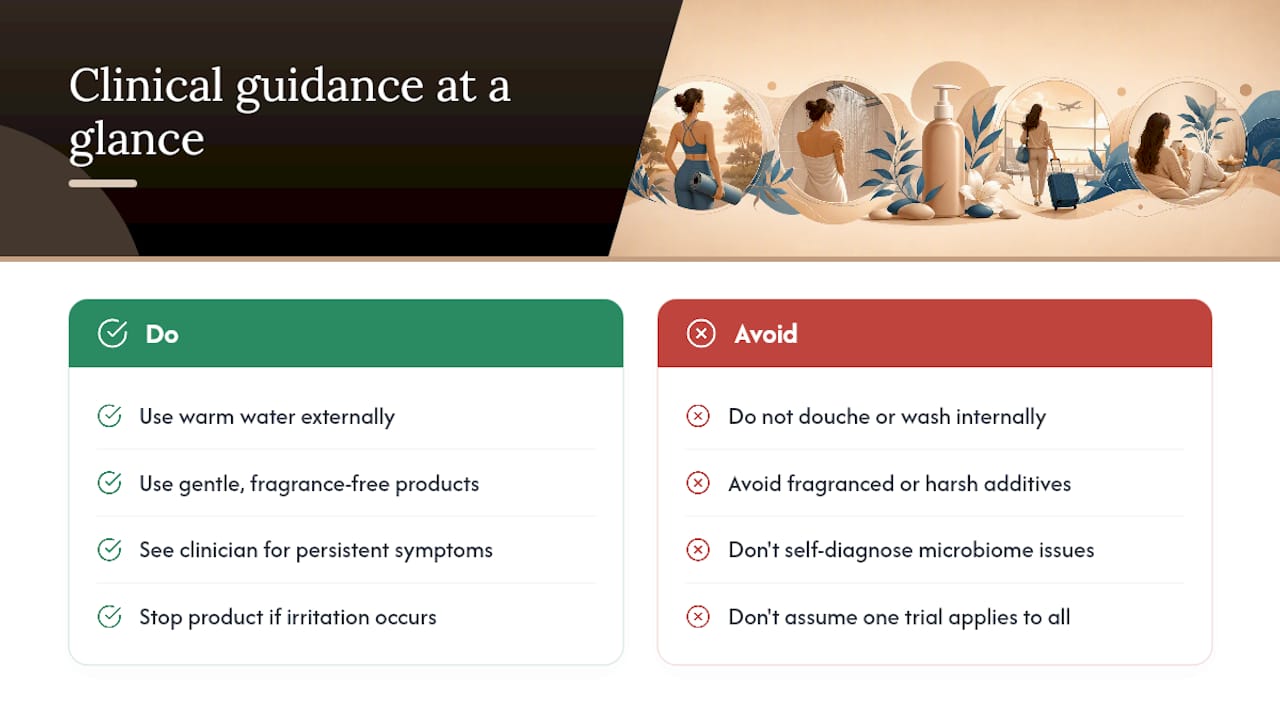
Gynaecologists generally advise warm water for everyday vulvar hygiene, treating an intimate wash as an optional extra rather than a requirement, and stressing that any product used should stay external and steer clear of fragrance or harsh additives.
That guidance, echoed by clinical commentary on feminine wash products, lines up closely with what the NHS says about bacterial vaginosis: avoid douching, keep cleansing gentle and external, and see a clinician if symptoms such as unusual discharge, odour or itching persist.
The numbers that matter most: the clearest statistical signal in this whole body of research is not about which product wins, it’s about method. Observational studies tie the frequency and method of washing, not the brand of cleanser, to differing rates of bacterial vaginosis, which suggests that how you wash matters more than what you wash with, provided you are washing externally with something gentle.
Where the evidence gets genuinely interesting, and genuinely more cautious, is at the product level. Small trials of lactic-acid-based cleansers have reported improved hydration and better pH stability on vulvar skin compared with standard washing. That is a real, measurable effect, not marketing spin. But the same body of research is candid about its own limits: trial data in this space tend to be small, short-term, and specific to the exact formulation tested. A result from one lactic-acid wash does not automatically transfer to every product carrying similar language on the box.
That distinction between vulvar dermatology and vaginal microbiology also shapes what “getting it wrong” looks like in practice. Irritation on the vulva, redness, itching, a stinging sensation after washing, is usually a topical skin response, and it often resolves simply by stopping whatever product caused it and switching to plain water or an emollient. Vaginal microbiome disturbance, by contrast, is not something you can self-diagnose by how the skin feels; unusual discharge, a change in odour, or persistent itching internally warrants a clinical opinion rather than a product swap.
So where does that leave the person standing in front of a shelf of intimate washes? The honest summary is: water covers the basics for almost everyone, a well-formulated intimate wash may offer real, modest benefits for people who prefer or need a product, and no wash, however well reviewed, replaces medical advice when symptoms suggest something is actually wrong.
When an intimate wash helps, and how to use one safely
An intimate wash earns its place in a handful of specific situations, not as a daily default. Consider one when:
- You’re menstruating. Extra discharge and blood residue can make water-only cleansing feel insufficient, and a gentle external wash can help you feel fresher without stripping the skin.
- You’ve just finished intense exercise. Sweat accumulation in skin folds benefits from a mild cleanser that lifts residue without the harshness of regular soap.
- You notice a transient, non-worrying change in odour. A normal, healthy vulva has a natural scent that varies through the cycle; a gentle external wash can address a temporary shift, but a persistent or strong odour change should prompt a GP visit rather than a product purchase.
- You have particularly sensitive skin that reacts to standard soap. If regular shower gel leaves you itchy or dry in this area, a purpose-formulated wash may genuinely reduce irritation.
Outside those scenarios, water does the job perfectly well, and reaching for a product every single day is not required for good hygiene.
If you do choose to use one, a short safety checklist keeps things sensible:
- External only. Never insert a wash, or any cleanser, into the vagina.
- Fragrance-free. Scent is the single most common irritant in this category.
- pH-appropriate. Look for a mildly acidic formulation rather than a neutral or alkaline one.
- Rinse thoroughly. Residue left on the skin is more likely to irritate than a small amount of the active product itself.
- Stop at the first sign of irritation. Redness, itching or stinging means the product is wrong for your skin, not that you need to persevere.
Frequency should stay low. Washing once daily at most is plenty for external washing; more than that risks the same over-washing problem associated with harsh soap, where stripping natural oils leaves the skin barrier compromised. Pat the area dry afterwards rather than rubbing, and wipe front to back after using the toilet to avoid transferring bacteria from the bowel.
Pro Tip: If you’re only going to change one habit, make it this: stop washing more than once a day. Frequency causes more irritation in this area than product choice ever does.
Seek clinical advice rather than experimenting further if you notice a strong fishy odour, grey or green discharge, persistent itching, or pain during urination or sex. Those are signs worth a GP appointment, not a different wash.
Ingredients and claims worth questioning on the label
A handful of ingredients turn up again and again in the products worth avoiding for this area. Added fragrance or parfum sits at the top of the list. It is the single most common cause of contact irritation in intimate cleansers, and it adds nothing to how well a product actually cleans. Essential oils, marketed as “natural,” can be just as irritating as synthetic fragrance, sometimes more so, because concentrations in small bottles are often higher than people expect. Sodium lauryl sulfate (SLS) and sodium laureth sulfate (SLES) are strong foaming agents that work well in shampoo and dishwashing liquid and rather too well on delicate skin, stripping oils faster than the skin can replace them.
Antiseptic additives, such as triclosan or high concentrations of chlorhexidine, are another red flag. They kill bacteria indiscriminately, including the protective Lactobacillus species you want to keep around, and there is no good reason for a healthy person to use an antiseptic wash routinely. High alcohol content, often listed as denatured alcohol or ethanol near the top of an ingredient list, is drying and can worsen the exact irritation a wash is supposed to prevent.
Marketing claims deserve just as much scrutiny as ingredients. “pH balanced” is not a regulated or standardised term, so it can appear on a label without meaning much in practice; the ingredient list tells you more than the claim does. “Odour-eliminating” language often signals a heavier fragrance load rather than a genuine hygiene benefit, and a healthy vulva having a mild, natural scent is normal, not something to eliminate.
A quick three-point label check before buying:
- Is fragrance or parfum absent from the ingredient list?
- Is the product explicitly described for external use only?
- Are the first few ingredients recognisable, gentle surfactants rather than sulfates or high alcohol?
If a product passes those three checks, it is a reasonable candidate for occasional external use.
How M-shop chooses the intimate washes it stocks
M-shop’s approach to intimate hygiene follows the same logic covered above: prioritise gentle, fragrance-conscious formulations over anything loaded with additives that promise more than they deliver. The shop leans on the reputation that some Polish skincare brands have for straightforward, effective formulations, and intimate washes are treated with the same scrutiny as any face or body product on the shelves.
Among the ranges stocked, Lactacyd Femina and its Plus variant are built around lactic-acid technology, echoing the pH-supportive approach described in the research on lactic-acid-based cleansers. The Ziaja Intima range offers a gentler, fragrance-conscious alternative for people who prefer a lighter formulation. Neither is presented here as superior to the other; both simply fit the safe-use checklist of external use, mild pH, and a manageable ingredient list.
Readers who want more detail on daily microbiome-friendly habits can find further guidance in the shop’s own intimate hygiene and pH balance guide. Product-specific questions are best directed straight to customer support.
Where to find a suitable intimate wash on M-shop
The shop provides an alternative to trawling supermarket shelves for a wash that ticks every box on the safety checklist above. Ingredients and formulation details are listed on each product page, so buyers can check for fragrance, pH claims and surfactant type before purchasing, rather than guessing from marketing copy alone.

The intimate hygiene range sits alongside the shop’s wider skincare and body care categories, all sourced directly from Poland with the same family-owned attention to product selection. If sensitive skin is a concern beyond just this area, the fragrance-free cleansing gel-cream from AA Oceanic is worth a look too, built for atopic and reactive skin types more generally.
If you want a fragrance-free, lactic-acid-based option that matches everything covered in this guide, browse the Lactacyd and Ziaja intimate washes currently listed, or get in touch with the shop directly if you have questions about a specific formulation before you order.
A publisher’s note on evidence versus marketing
The gap between what the intimate wash aisle promises and what the research actually supports is wider than most shoppers realise. Walk down that aisle and nearly every bottle claims to “balance,” “protect” or “restore” something, language that implies the vagina needs active intervention to function. It largely doesn’t. The genuinely useful research finding here isn’t about which wash wins; it’s that internal washing of any kind is the behaviour worth avoiding, and that finding gets buried under marketing noise built around external product choice.
That doesn’t mean every intimate wash is a waste of money. The lactic-acid formulations with real, if modest, trial support deserve more credit than sceptics give them, and dismissing the whole category because some products overreach on their claims throws out a useful option for people whose skin genuinely benefits from a gentler cleanser than soap. The smarter position sits between the two extremes: treat water as your default, treat a well-formulated wash as a legitimate tool for specific situations, and treat any product screaming about odour elimination or vague pH claims with real suspicion.
What this guidance can’t replace is a clinical opinion when something feels wrong. No amount of label-reading substitutes for a GP visit if discharge, odour or discomfort persists.
— Krzysztof
This article is general information, not a substitute for advice from a qualified doctor. Consult a qualified healthcare professional about your own circumstances before acting on anything here.
Sources
The guidance in this article draws on peer-reviewed and clinical sources rather than product marketing:
- Do You Really Need to Use a ‘Feminine Wash?’
- Role of female intimate hygiene in vulvovaginal health: Global hygiene practices and product usage
- Bacterial vaginosis - NHS
Persistent symptoms, unusual discharge, odour, itching, or discomfort always warrant a conversation with a GP rather than a change of product.
FAQ
Should you wash an intimate area with soap?
Regular soap is not the ideal choice for the vulva because most bar soaps and shower gels are alkaline and often fragranced, which can disrupt the skin’s natural pH and strip protective oils. Warm water or a fragrance-free, mildly acidic intimate wash used externally is the better option.
What is the best thing to wash your privates with?
Plain warm water is sufficient for most people and never disrupts pH or the vaginal microbiome. If you prefer a product, choose a fragrance-free, externally-labelled intimate wash such as those in the Lactacyd or Ziaja Intima ranges, and avoid anything containing sulfates or added fragrance.
Is it healthy to use an intimate wash?
Used correctly, an intimate wash is a safe optional choice for external cleansing, and some lactic-acid formulations have shown modest benefits for vulvar hydration and pH stability in small studies. It becomes unhealthy only when used internally, applied too frequently, or formulated with fragrance and harsh surfactants.
Can you use intimate wash all over your body?
Most intimate washes are formulated specifically for the more delicate, mildly acidic environment of the vulva, so using them all over the body isn’t necessary and offers no particular advantage over a regular gentle body wash. It also isn’t harmful in most cases, but there is little reason to extend a product designed for one purpose beyond it.