



Patch test skincare: 7 to 10 days and read INCI names first
Yes, patch test before using any new skincare product. Apply a small amount to a discreet area, such as the inner forearm, and watch it for several days before applying it to your face. This single step catches most irritant and allergic reactions before they reach visible skin, though it isn’t foolproof, so stop immediately and seek medical help if you notice severe swelling, blistering, or breathing difficulty.
TL;DR:
- Patch testing for new skincare products should be done for seven to ten days, applying twice daily and observing for delayed allergic reactions.
- Use a small, clean patch area such as behind the ear or inside the elbow, avoiding damaged skin, eczema patches, or sunburned areas.
- It is crucial to test concentrated or active ingredients like retinoids or acids at full strength to detect possible delayed hypersensitivity.
- Mild irritant reactions appear quickly and stay localized, while allergic reactions develop gradually, spread beyond the patch area, and may cause swelling or blisters.
- Proper ingredient list review and keeping a symptom log enhance patch test effectiveness and help avoid re-exposure to known allergens.
Table of Contents
- How to do a patch test for skincare, step by step
- How long should you patch test a new skincare product?
- Irritation or allergy? How to tell the difference
- What ingredients commonly cause skin reactions?
- When do you need professional patch testing?
- Why most people patch test wrong (and what actually matters)
- Trusted skincare and dermatology resources
- Sources
- FAQ
How to do a patch test for skincare, step by step
A proper skin sensitivity test takes minutes to set up but needs patience to read correctly. Rushing the process is the main reason people end up with a reaction on their face that a patch test would have caught first.
- Pick a clean, undamaged spot. The inner forearm, the bend of the elbow, or the skin behind your ear all work well. Avoid patches of eczema, sunburn, or broken skin, which can give you a false reading.
- Apply the product as directed. Use roughly a quarter-sized amount for creams and serums, the same concentration you’d use normally.
- Note the product name and batch number. Formulations change between batches more often than people assume.
- Reapply twice daily, or as the product’s instructions suggest, and leave the area undisturbed between applications.
- Log what you see. Write down the date, time, and any symptoms, however minor.
- Stop at the first sign of a serious reaction. Swelling, blistering, or spreading redness means the test is over.
If you’re introducing several new products at once, resist the temptation to trial them together.
- Test one product at a time, spaced a few days apart.
- Keep a separate patch site for each item.
- Never mix untested products on the same patch.
- Hold off on retinoids, acids, or fragranced items until the current test clears.
Pro Tip: Photograph the patch site each morning with a ruler or coin next to it for scale. A photo timeline makes it far easier to spot gradual spreading that’s easy to miss day to day, and it’s genuinely useful if you end up showing a dermatologist. Concentrated formulas, such as collagen creams, are worth a longer look before you commit; M-shop’s guide to testing collagen cream safely walks through a 48 hour version of this same process.
How long should you patch test a new skincare product?
Reactions fall into two categories, and the difference decides how long you need to wait. Irritant reactions tend to show up within minutes to hours. Allergic reactions, technically Type IV delayed hypersensitivity, often take one to three days to appear, and sometimes longer, because your immune system needs time to mount a response.
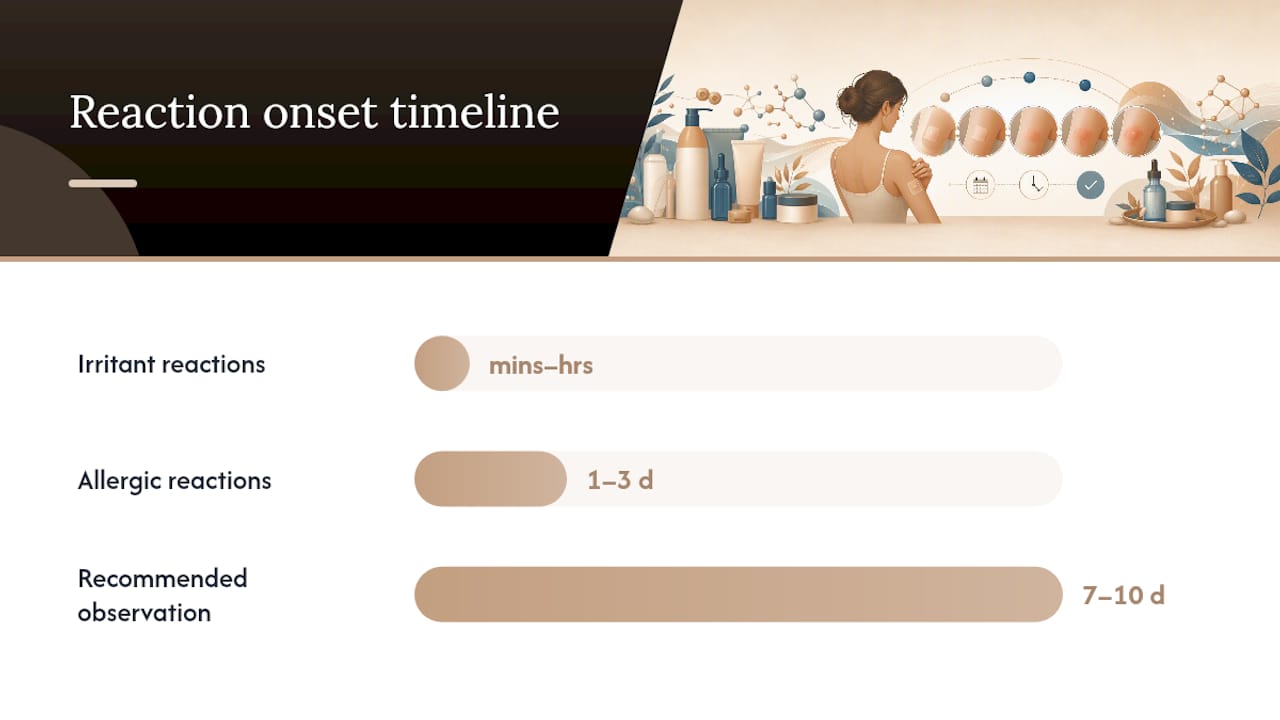
That’s why a quick five minute check isn’t enough on its own. Dermatology guidance from the American Academy of Dermatology recommends testing twice daily for 7 to 10 days before assuming a product is safe, though some clinicians treat 3 to 7 days as a cautious minimum for lower-risk items.
Product type changes the rules slightly:
- Rinse-off products (cleansers, masks, shampoos): apply, leave on for about five minutes or as the label states, then rinse and monitor as usual.
- Leave-on actives (retinoids, acids, vitamin C): test the full strength you intend to use, and expect a longer observation window given how these ingredients interact with the skin barrier.
- Essential oils: never test undiluted. Dilute in a carrier oil first, and keep the test away from facial skin entirely.
Ten days feel excessive for something you’re eager to try, but it’s the window that actually catches delayed allergic contact dermatitis rather than just the obvious irritants.
Irritation or allergy? How to tell the difference
Not every red patch means you’re allergic to something. Irritant contact dermatitis and allergic contact dermatitis look similar at a glance but behave very differently, and knowing which one you’re dealing with changes what you do next.
Irritation usually shows up fast and stays put:
- Stinging or burning within minutes to a few hours
- Dryness, tightness, or mild peeling
- Redness confined to exactly where the product touched
Allergic reactions tend to arrive late and spread:
- Itching that builds rather than fades
- Redness extending beyond the original patch area
- Eczema-like rash, raised bumps, or fluid-filled blisters
- Swelling, particularly if it involves the eyes or lips
For mild irritation, wash the area gently with lukewarm water, stop the product, and apply a plain barrier ointment or cool compress. Most irritant reactions settle within a day or two once the trigger is removed.
Pro Tip: If redness is still spreading after you’ve washed it off, that’s your cue it’s allergic rather than irritant, since true irritation calms down once the substance is gone. Certain red flags mean you shouldn’t wait it out at home: progressive swelling, blistering, any involvement around the eyes or eyelids, symptoms affecting your breathing or wider body, or a reaction that simply won’t settle after a few days. Any of those warrants a call to your GP or a dermatologist.
What ingredients commonly cause skin reactions?
Fragrance is the single biggest repeat offender in cosmetic allergy, and it’s also the hardest to spot because “parfum” on an INCI list can represent dozens of individual fragrance chemicals bundled under one word. Preservatives run a close second, particularly methylisothiazolinone (MI) and formaldehyde-releasing preservatives. Lanolin, certain essential oils, and nickel from metal applicator tips or packaging round out the usual list.
Reading an ingredient list properly means learning to translate scientific names into things you’d recognise. Arachis Hypogaea Oil, for instance, is simply peanut oil, which matters enormously if you have a nut allergy. Botanical extracts hide behind Latin names that give no hint of what they actually are unless you look them up.
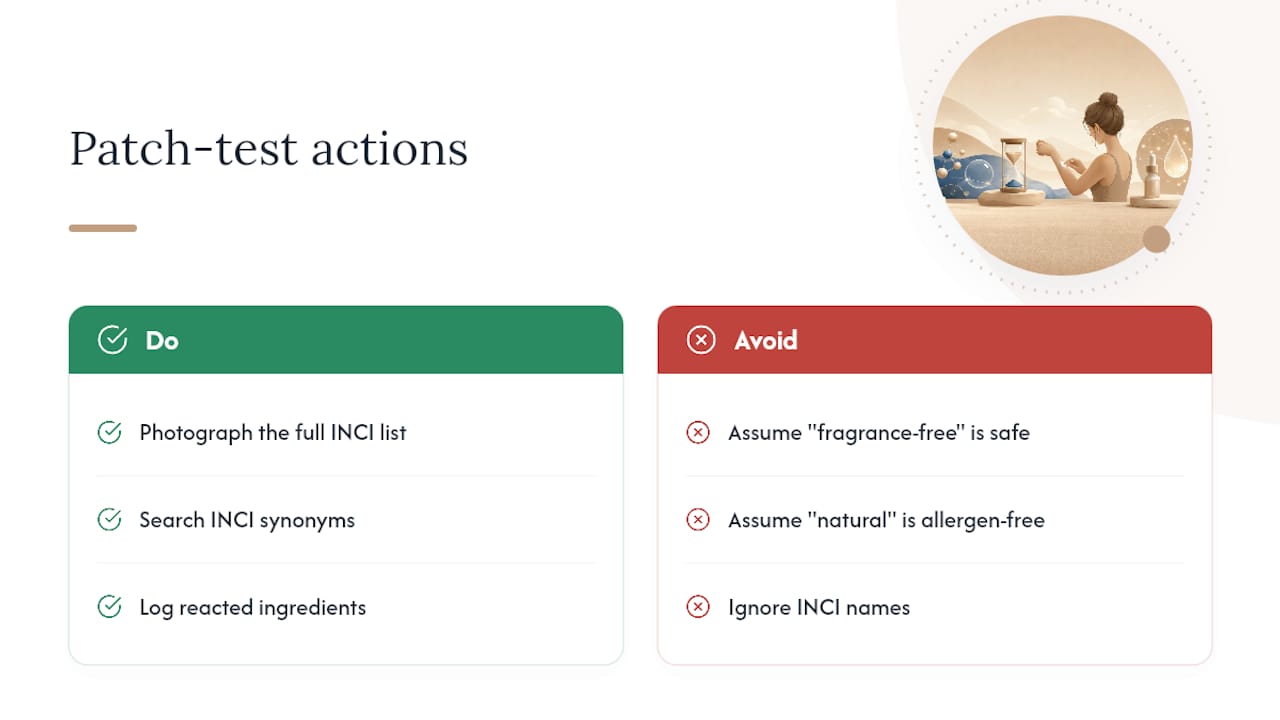
Contact allergy commonly traces back to fragrance mixes, preservatives, and botanical extracts, and ingredient synonyms on INCI labels routinely mask the allergen a person is actually reacting to.
After any reaction, however mild, it’s worth doing three things: photograph or copy the full INCI list, search for synonym names of anything you suspect, and keep a running checklist of ingredients you’ve reacted to before, so you can scan new products against it. One label myth worth killing outright: “fragrance-free” or “natural” does not automatically mean allergen-free. Natural extracts cause plenty of reactions, and “fragrance-free” products can still contain masking fragrances added to cancel out other smells.
When do you need professional patch testing?
A home patch test is a screening tool, not a diagnosis. It catches obvious intolerances, but it can’t identify the exact allergen the way clinical patch testing can, and a negative result at home doesn’t guarantee the product is safe for repeated use everywhere on your body.
Formal testing at a dermatology or allergy clinic uses standardised allergen panels applied in small chambers on the back, with readings typically taken at 48, 72, and sometimes 96 hours to catch slower reactions. It’s a different level of resolution entirely.
Book an appointment if any of these apply:
- You’ve had repeated reactions and can’t pin down the trigger
- A reaction involved your eyelids, face, or spread widely
- You experienced severe blistering or a widespread rash
- Home testing keeps giving you inconsistent or unclear results
Bring product samples, their ingredient lists, and your symptom log (dates, times, what you noticed) to the appointment. It gives the clinician a genuine starting point instead of guesswork.
Why most people patch test wrong (and what actually matters)
The mistake I see most often isn’t skipping the patch test entirely. It’s doing it for a day, seeing nothing, and declaring the product safe. That’s testing for irritation and calling it an allergy screen, and the two aren’t the same thing at all.
Patch testing only works if you respect the biology behind it. Delayed hypersensitivity needs days to show itself, not hours, which is exactly why the 7 to 10 day window matters more than the five minute rinse-off rule for anything you plan to leave on your skin. I’d also argue the label-reading side gets underrated. Most people patch test the product but never actually read what’s in it, so when a reaction does happen, they’ve learned nothing they can use to avoid the same ingredient next time.
None of this replaces medical advice, and it’s not meant to. If you’re testing a concentrated formula, M-shop’s own guidance on trialling budget or unfamiliar brands covers the same discipline applied to lower-cost lines, and it’s worth reading alongside this.
— Krzysztof
Trusted skincare and dermatology resources
For deeper reading: Medical News Today covers the five-minute rinse-off rule and irritation-versus-allergy distinctions; the American Academy of Dermatology sets the twice-daily, 7 to 10 day standard; NCBI reviews contact allergy triggers; Healthline details essential oil dilution. This list isn’t exhaustive. Anyone with severe symptoms should contact the NHS or a dermatologist directly rather than relying on articles alone.
Once you’ve cleared a patch test, choosing lower-irritant formulas from the outset cuts your risk further. M-shop stocks fragrance-conscious and hypoallergenic options, including the Biały Jeleń hypoallergenic chestnut soap for sensitive cleansing routines, and dermatologist-oriented lines like Pharmaceris T Sebostatic Day cream for acne-prone or reactive skin. If you’re testing a concentrated active, ease in with something like the Celia Collagen + Vitamines 40+ cream, applied to a small patch first exactly as this guide describes, before working it into your full routine.
Sources
- Patch testing skin care products safely — Medical News Today
- How to test skin care products — American Academy of Dermatology (AAD)
- Contact dermatitis review — NCBI PMC
- How to perform a self skin patch test — Healthline
FAQ
How do you do a patch test for skincare?
Apply a small amount of the product to a clean area such as the inner forearm or behind the ear, then reapply twice daily for 7 to 10 days while watching for redness, itching, or swelling. Stop immediately if you notice a severe reaction and rinse the area.
How long should you patch test a skincare product?
Dermatology guidance recommends testing twice daily for up to 7 to 10 days to catch delayed allergic reactions, though 3 to 7 days is sometimes used as a shorter minimum for lower-risk products. Rinse-off products only need to sit for about five minutes before washing during the test.
What is a skin patch test used for?
A patch test screens for irritant or allergic reactions to a specific product or ingredient before it’s applied more widely, particularly to the face. It’s a home safety check, not a substitute for clinical allergen testing, which uses standardised panels to identify exact triggers.
What is a patch test in beauty?
In a beauty context, a patch test means trialling a cosmetic product on a small, discreet area of skin before using it as intended, usually to catch sensitivity before it affects visible skin like the face. It’s standard practice recommended before introducing any new skincare or cosmetic item, especially one with active ingredients or fragrance.