



5 Quick Checks to Verify Polish Cosmetics Expiry Dates for UK Buyers
Yes: most Polish cosmetics carry a printed expiry date (EXP), the PAO open-jar symbol, or a batch code that a decoder can date. If none of those are legible, run a sensory check instead. EU Regulation 1223/2009 sets the labelling rules behind all three, and the safety rule that trumps them all is simple: follow the PAO count and bin anything showing changes in smell, texture, or colour. M-Shop.uk sources its Polish stock directly and this guide leans on that regulation plus NHS and Cleveland Clinic advice.
TL;DR:
- Most Polish cosmetics show expiry dates or open-jar symbols, but sensory checks remain crucial, especially if symbols are unclear or faded.
- Batch codes indicate production dates, not expiry, and decoders provide estimates that should never override sensory cues like smell or texture.
- Storage in cool, dry places and hygiene practices such as regular brush cleaning extend product safety and effectiveness.
- Mascara, sunscreen, and natural formulas tend to have shorter PAOs, requiring extra caution and timely replacement.
- Signs of a product going bad include unusual smell, separation, color change, texture shifts, or skin irritation, which warrant immediate disposal.
Table of Contents
- How to check Polish cosmetics expiry dates quickly
- What do EXP and PAO symbols actually mean?
- What are batch codes and how reliable are batch code decoders?
- How long do different cosmetics actually last?
- How should you store cosmetics to make them last?
- What are the warning signs a cosmetic has gone bad?
- Why trust this guide on Polish cosmetics expiry
- What most people get wrong about checking cosmetic expiry
- Where to buy genuine Polish cosmetics with trustworthy labelling
- Sources
How to check Polish cosmetics expiry dates quickly
Work through these five checks in order. Most products will resolve at step one or two.
- Find the printed EXP or hourglass symbol first. This is the “minimum durability” date and applies to any cosmetic whose unopened shelf life is 30 months or under. It usually appears as “EXP 03/2027” or an hourglass icon with a date beneath it, often stamped on the base of a jar or the crimped end of a tube.
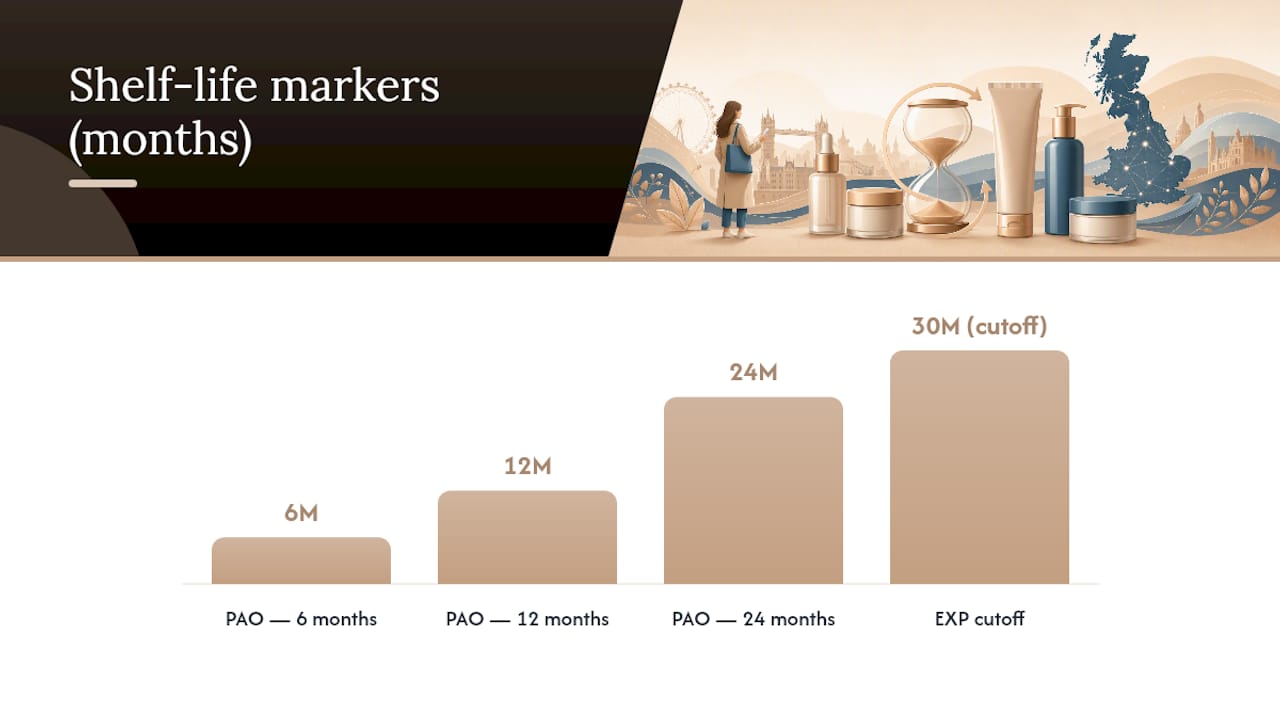
- No EXP? Look for the PAO symbol instead. Products designed to last more than 30 months unopened skip the EXP date and print an open-jar icon with a number and “M” (6M, 12M, 24M) telling you how many months you have after first use.
- Write the opening date on the product the day you open it. Do this before you forget, because PAO only means anything if you know when the clock started.
- Locate the batch code and run it through a reputable decoder as a rough guide. Batch codes are stamped near the barcode or on the crimp seal and tools such as Lot Date’s checker will estimate a production date, but treat the result as an estimate rather than a certificate.
- Do a sensory pass regardless of what the codes say. Smell it, look at the texture, check the colour against how it looked when new. Trust your senses over a symbol every time they disagree.
If a product fails any of these checks, especially anything used near the eyes, the safest move is to stop using it immediately rather than debate the borderline cases.
Immediate actions once you’ve assessed a product:
- Mark the opening date on the packaging with a permanent marker, not a sticky label that can peel off.
- Quarantine anything you’re unsure about in a separate drawer until you’ve checked it properly, rather than leaving it in daily rotation.
- Replace mascara within three to six months of opening regardless of how it looks, because the tube’s damp, dark environment is the fastest-breeding ground in any bathroom cabinet.
- Bin anything that stings, reddens the skin, or smells noticeably different from when you bought it.
Pro Tip: Keep a small notebook or phone note listing opening dates for your most-used products. It sounds excessive until the day you can’t remember whether that concealer is four months old or fourteen.
What do EXP and PAO symbols actually mean?
The hourglass and the open jar aren’t interchangeable decorations. They’re two distinct legal answers to two different questions, and knowing which one you’re looking at changes how you use the product.
EXP, sometimes shown as an hourglass icon, is the minimum durability date. Under EU cosmetics law, any product with an unopened shelf life of 30 months or less must display it, and manufacturers are required to guarantee the product performs as intended up to that printed date, according to Gov. Think lightweight serums, some SPF formulas, and natural products with fewer preservatives. These tend to have shorter unopened lives precisely because they contain less of the chemistry that fights microbial growth.
PAO, the little open-jar icon, tells a different story. It’s for products whose unopened shelf life runs past 30 months, so instead of a fixed calendar date, the label gives you a countdown that starts the moment you break the seal. The number inside or beside the jar (6M, 12M, 24M) means months, not days or weeks, and the Wikipedia entry on the period-after-opening symbol traces its adoption as a standard EU cosmetics marking.
Polish packaging follows the same logic as any other EU market, which matters if you’re used to reading labels from elsewhere. GBA Polska’s breakdown of cosmetic labelling confirms that Polish brands use EXP for shorter-lived products and PAO for longer-lived ones under the same 30-month threshold, so a Polish face cream and a British one carry identical symbol logic even if the surrounding text is in a different language.
Look for these markings on the base, the crimped seal, or occasionally printed inside the box rather than on the bottle itself:
- Hourglass icon plus a date, often formatted DD/MM/YYYY or MM/YYYY
- Open jar icon with a number and “M” printed inside or next to it, indicating months of use after opening
- The phrase “best used within” alongside either symbol on some Polish and wider EU packaging
Roughly 30 months is the cutoff figure that decides which symbol you’ll see, so a product’s own claimed longevity, not the type of product, determines the labelling format.
What are batch codes and how reliable are batch code decoders?
A batch code (sometimes called a lot number) identifies the specific production run a product came from. It exists for manufacturing traceability, quality control recalls, and internal stock rotation, not as a consumer-facing expiry indicator. That distinction trips people up constantly: a batch code tells you roughly when something was made, never when it stops being safe to use.
Codes typically sit near the barcode, on the crimped seal of a tube, or stamped into the base of a jar. Formats vary wildly between manufacturers: some use a simple sequence of numbers, others mix letters and digits, and a few Polish brands embed the production date directly in a shortened numeric string. There’s no universal EU standard for the code’s structure itself, only a requirement that one exists.
Decoders such as Lot Date’s cosmetic batch code checker interpret these formats against known manufacturer patterns to estimate a production date. That estimate is genuinely useful for one specific job: telling you how old an unopened product is before you buy it, particularly useful for spotting end-of-line stock that’s technically unexpired but already several years old. What it cannot do is confirm safety after opening, because that depends on storage conditions, contamination, and formula stability that no code captures. NHS guidance is explicit that batch codes work best as an age estimate rather than a safety verdict, with PAO remaining the authoritative measure once a product is in use.
Practical steps for decoding a Polish cosmetic’s batch code:
- Check the base of jars, the crimped end of tubes, and the underside of compact packaging first.
- Photograph the code before it fades or rubs off, since some inks wear away within weeks of regular handling.
- Run it through more than one decoder if the first gives an implausible result, since community tools don’t always agree.
- If the code is smudged, partial, or in an unfamiliar format, contact the retailer or manufacturer directly, since some producers will decode a code on request and confirm a production date with more certainty than any third-party tool.
Pro Tip: If you’re buying discounted Polish cosmetics anywhere online, run the batch code through a decoder before you buy rather than after. A bargain that’s actually two years from expiry is a genuine bargain; one that’s expired in six weeks is just clutter.
Treat every decoder result as a helpful estimate and nothing more. The gap between “probably made in early 2024” and “definitely made in March 2024” rarely matters for day-to-day use, but it matters enormously if you’re relying on that figure to justify using something well past when your senses are telling you to stop.
How long do different cosmetics actually last?
Shelf life depends heavily on formulation, and the categories that fail fastest aren’t always the ones people worry about most. Natural or low-preservative formulas, a genuine selling point for many Polish skincare lines, often degrade faster than conventional formulas because they contain less of the chemistry that resists microbial growth over time.
| Product type | Typical PAO after opening | Notes |
|---|---|---|
| Mascara | A few months | Highest contamination risk; damp tube environment breeds bacteria fast |
| Liquid foundation | Several months up to about a year | Oxidises and separates; watch for colour shift |
| Cream (face/body) | Several months up to about a year | Natural and low-preservative formulas sit at the shorter end |
| Sunscreen (SPF) | Several months up to about a year | Active filters degrade with heat and air exposure; efficacy drops even if it looks fine |
| Nail polish | Around a year to more than a year | Thickening and separation are the tell; a splash of remover can sometimes revive it briefly |
| Powder products (eyeshadow, blush) | Over a year | Lower water content means slower bacterial growth |
| Lipstick and lip products | Around a year to more than a year | Texture change and smell shift are the main warning signs |
Sunscreen and mascara deserve extra caution regardless of what a table suggests. SPF products lose active protection well before they look or smell obviously wrong, so relying on appearance alone is a genuine risk during summer months. Mascara, meanwhile, sits so close to the eye that any contamination has an almost direct route to causing infection.
Unopened shelf life and PAO measure two different things, and confusing them is where most people go wrong. A cream can sit sealed in a drawer for two years without issue, then need replacing within six months once you’ve opened it, because the seal, not the calendar, is what was holding degradation at bay. Formulas built around naturally derived ingredients such as those found in many Polish skincare lines tend to sit at the shorter end of every range in that table, which is worth knowing before you stock up.
How should you store cosmetics to make them last?
Heat, light, and moisture are the three things accelerating every degradation process on that table above. A bathroom shelf next to a hot shower is close to the worst place to keep skincare, even though it’s the most convenient. Cool, dry storage away from direct sunlight, a bedroom drawer or a cupboard rather than a steamy windowsill, slows oxidation and bacterial growth measurably.
Hygiene habits matter just as much as temperature. Wash your hands before dipping into any jar-format product, and use clean applicators rather than fingers wherever a spatula or brush is provided. Double-dipping mascara wands or lip products introduces bacteria from your skin directly into the product, which then multiplies in exactly the warm, damp conditions those formulas already favour.
- Store creams and serums somewhere consistently cool rather than fluctuating between hot and cold.
- Clean makeup brushes and sponges weekly with a gentle cleanser, since built-up residue is a bacteria reservoir in its own right.
- Never add water to thickened mascara or nail polish to revive it; that only introduces new contamination.
- Mark the opening date the day you first use a product, using a permanent marker directly on the packaging.
Buying full-size products you know you won’t finish within the PAO window is a common source of waste. Choosing travel-size or smaller formats for anything you use rarely reduces both the financial waste and the contamination risk of a product lingering past its safe window. A step-by-step hygiene routine for applicators and brushes is worth following closely if you use several products daily rather than occasionally.
Pro Tip: Buy a cheap pack of small stickers or a fine-tip permanent marker and keep it in your makeup drawer specifically for opening dates. The habit only sticks if the tool is right there when you open something new.
What are the warning signs a cosmetic has gone bad?
Some signs are unambiguous enough that there’s no debate to be had. If a product shows any of the following, stop using it and throw it away rather than trying to stretch a few more uses out of it.
- A smell that’s noticeably different from when the product was fresh, whether sour, rancid, or simply “off.”
- Visible separation in creams and lotions, where the oil and water phases split rather than blend smoothly.
- Clumping or a gritty texture in anything that used to feel smooth.
- Any colour shift, particularly foundation turning orange or grey as it oxidises.
- Mascara flaking off the lashes rather than applying evenly.
- Nail polish thickening in the bottle to the point where it drags rather than flows.
- Skin reactions of any kind, including redness, stinging, or itching, after use.
Cleveland Clinic’s guidance on expired makeup treats sensory and performance changes as reliable indicators on their own, meaning you don’t need a batch code or a calendar to justify binning something that fails these checks. If a product passes every symbol and code check but fails a sensory one, the sensory result wins every time.
Eye and lip products deserve the strictest interpretation of these signs, because both sit close to mucous membranes where irritation escalates quickly. When in doubt with mascara, eyeliner, or lip balm, discard rather than debate; the cost of a new tube is trivial next to the cost of an eye infection. NHS guidance backs the same principle: any change in smell, texture, colour, or performance is grounds for immediate disposal, not a “use it up first” compromise.
Why trust this guide on Polish cosmetics expiry
This guide is written by Krzysztof, drawing on hands-on familiarity with Polish cosmetic packaging and the practical habit of checking batch codes before buying discounted stock. That habit, checking the code before the purchase rather than after, is the single most useful thing a regular buyer of Polish brands can adopt.
M-Shop.uk is a family-owned retailer specialising in Polish cosmetics and skincare, sourcing collagen and algae-based formulas directly from Poland rather than through intermediary distributors. That direct relationship matters for exactly the checks covered here: shorter supply chains mean less time between production and your bathroom shelf, which reduces the odds of buying something already close to its EXP date. It also means labelling and packaging arrive as the manufacturer intended, rather than repackaged or relabelled somewhere along the way.
If you’ve bought from M-Shop.uk, apply the same five-step check from earlier the moment your order arrives:
- Check EXP or PAO immediately on unboxing, before the product goes into daily rotation.
- Photograph the batch code for your own records in case you need it later.
- Contact M-Shop.uk directly if a label seems unclear or a code won’t decode, rather than guessing.
What most people get wrong about checking cosmetic expiry
Most guides on this topic treat batch codes as if they were a second expiry date, and that’s the single biggest misunderstanding worth correcting. A batch code tells you when something was made. It says nothing about how it’s been stored, how many times the jar’s been opened, or whether contamination has already started. Treating a decoder result as a safety verdict, rather than a purchase-time age check, is where people talk themselves into using products they should have binned months earlier.
The conventional advice also underweights sensory checks in favour of anything printed or coded. That’s backwards. A perfectly within-date cream that smells wrong has already failed, symbols or no symbols. If there’s one thing worth prioritising above every other check in this guide, it’s this: trust your nose and your skin over any icon, and write the opening date down the moment you break a seal. Everything else here supports that one habit; nothing replaces it.
— Krzysztof
Where to buy genuine Polish cosmetics with trustworthy labelling
M-Shop.uk gives you what a batch-code decoder and a squint at a packaging symbol can’t: cosmetics sourced directly from Poland with intact, legible EU-standard labelling, at prices that undercut UK high street equivalents by a wide margin thanks to family-owned sourcing rather than layers of distributor markup.
That directness matters for everything covered above. Shorter supply chains mean fresher stock, clearer batch codes, and packaging that hasn’t been repackaged or relabelled anywhere along the way. Browse formulas built around collagen and algae, including the Ziaja Lifting Solution 40+ night cream and the Pharmaceris T sebostatic day cream with SPF, and you’ll find EXP dates and PAO symbols printed exactly as they should be, with regular discounts of up to 15% during sales. Check current stock and place an order today to see the labelling for yourself the moment it arrives.
Sources
- Does makeup expire? 5 signs to toss it - Cleveland Clinic
- Cosmetic Product Label – Part I – GBA POLSKA