



Buy authentic Polish nail care brands in the UK: check INCI and HEMA
Polish nail care brands have built their reputation on professional-grade gel and hybrid systems that prioritise nail health alongside long-lasting colour. The clearest buying signal to check before purchase is a HEMA-free or TPO-free label, ideally paired with EU manufacturing details and actives like keratin, jojoba oil or vitamin E. Buy from retailers that publish full ingredient lists and clear provenance, not from listings that hide either.
TL;DR:
- Polish nail products, especially gels and hybrid polishes, are more durable and can last up to four weeks if cured under UV or LED lamps compatible with the specific formula.
- Checking for HEMA-free and TPO-free labels, along with clear manufacturer origin and ingredient transparency, is essential to ensure safety and authenticity when purchasing.
- Strengthening treatments with keratin or hydrolyzed proteins are effective for brittle nails, and cuticle oils with jojoba oil and vitamin E should be used daily for best hydration.
- Buying from retailers with full ingredient lists, clear sourcing information, and reliable return policies reduces the risk of counterfeits or unregulated imports.
- Polish brands from Poland gain their reputation through professional-grade, safety-focused formulas developed in a competitive salon environment, offering high performance at a lower price point than many Western competitors.
Table of Contents
- What makes Polish nail care brands distinctive
- Key product types to know: gels, strengtheners and cuticle oils
- How to choose authentic Polish nail products as a UK shopper
- Why these buying rules actually hold up
- The leading Polish nail care brands and what sets each apart
- How Polish nail brands built an international reputation
- Polish brands versus international competitors on quality and price
- Cruelty-free claims, vegan formulas and ethical sourcing
- Counterfeits, compliance and other risks to watch for
- What customer feedback says about Polish nail brands
- Why the safety story matters more than the marketing story
- Where to buy authentic Polish nail care with confidence
- Sources
What makes Polish nail care brands distinctive
Poland’s nail industry grew out of a dense, competitive salon sector, and that heritage shows in the product range. Most established Polish brands sell across several categories rather than a single flagship polish: builder gels for structural work, hybrid polishes (a nail varnish cured under a lamp rather than air-dried), strengthening treatments, and finishing top coats designed for professional turnover.
Durability is the headline claim. Professional gel systems can hold colour and shine for up to four weeks without chipping, and most are engineered to cure under either UV or LED lamps, which matters if you already own a lamp bought for a different brand. Compatibility isn’t universal, so checking the cure time and lamp type on the packaging saves a wasted purchase.
Ingredient safety has reshaped the category more than colour trends have. Reactions to acrylate monomers among salon staff and clients pushed the wider HEMA-free and TPO-free formulation shift, and Polish professional brands adopted it early, partly because so many of their customers are technicians handling the product daily rather than occasional home users.
What else tends to set these formulas apart:
- High pigment loading, meaning fewer coats for full opacity
- Brush and bottle design built for salon speed rather than home hobbyists
- Formulas that skip formaldehyde, toluene and phthalates as standard, not as a premium add-on
- Treatment ranges sold alongside colour, rather than as an afterthought
None of this is exclusive to Poland. But the combination of salon-first development and an early move on allergen reduction is a genuine regional pattern, not marketing gloss.
Key product types to know: gels, strengtheners and cuticle oils
Choosing the right product category matters more than choosing the right shade. Here’s how the main types differ and who each one suits.
- Gel and hybrid polishes. These need a UV or LED lamp to cure and typically outlast standard polish by weeks rather than days. They suit anyone who wants durability over frequent colour changes, but they need acetone or a specific removal process, which is harsher on nails if done incorrectly.
- Strengtheners and treatment polishes. Look for keratin or hydrolysed proteins on the ingredient list. These suit anyone dealing with splitting or peeling nails, a condition affecting more than one in four women according to nail health surveys.
- Cuticle oils and serums. Jojoba oil and vitamin E dominate this category. They work best applied daily rather than as an occasional treat, since cuticle hydration is cumulative.
Home use versus salon use changes the calculation too. A gel system bought for home application needs a lamp, a proper base and top coat, and patience with the removal process. A strengthener or cuticle oil needs none of that and slots into any routine.
Pro Tip: If you’re switching from acrylic to gel and have had a reaction before, check for HEMA-free labelling first. It’s the single fastest filter for reducing contact-allergy risk.
How to choose authentic Polish nail products as a UK shopper
Start with the ingredient list, not the packaging. A genuine, current-generation Polish gel or hybrid polish will usually state HEMA-free or TPO-free directly on the bottle or product page, and it should avoid formaldehyde, toluene and phthalates as a baseline rather than a marketing extra. If a listing has no ingredient information at all, that’s the first red flag.
Manufacturing origin is the second check. Products genuinely made in Poland, or clearly imported from an EU manufacturer, tend to list this on the packaging or the retailer’s product page. Vague descriptions such as “European inspired” without a stated origin are worth treating with caution.
For gel systems specifically, confirm lamp compatibility before buying. Some technical Polish brands go further than most and publish full compatibility charts covering lamp type, cure time, and recommended base and top coat pairings, which materially affects how the finished manicure wears and finishes.
Retailer trust signals matter as much as product claims:
- A published INCI (ingredient) list on every product page, not just headline actives
- Clear returns and shipping policies, including where the product ships from
- Contactable customer service, ideally with a real address or company registration
- Pricing that’s competitive without being suspiciously low against comparable salon-grade products
Statistic to weigh: onychoschizia, the medical term for split or brittle nails, affects more than a quarter of women, which is exactly why strengthening actives aren’t a cosmetic afterthought when you’re choosing between two similar polishes.
Before buying from an unfamiliar seller, ask directly: where is this manufactured, is it HEMA-free, and what’s the returns process if the shade or cure doesn’t match the description? A retailer that answers plainly is usually one worth trusting.
Why these buying rules actually hold up
The push toward HEMA-free and TPO-free formulas isn’t a fashion. Acrylate monomers used in older gel and acrylic systems are a documented cause of contact allergy among both nail technicians and clients, which is why the shift has come as much from professionals protecting their own hands as from consumer demand.
Pairing hydration with structural protection, cuticle oil alongside a strengthening treatment, gives nails the best chance at recovering from repeated gel or acrylic cycles rather than degrading further.
That combination approach beats reaching for one product and expecting it to fix everything. Cuticle oil softens and hydrates skin around the nail; a strengthener with keratin or hydrolysed protein reinforces the nail plate itself. They solve different problems.
Pro Tip: Apply cuticle oil nightly, not just before a manicure. It’s cumulative hydration, not a one-off fix.
M-Shop’s own product pages list full INCI ingredient information on items like this nail repair treatment, reflecting the same provenance standard this guide recommends: family-run, sourcing directly from Poland, and transparent about what’s actually in the bottle.
The leading Polish nail care brands and what sets each apart
Poland’s professional nail sector has produced several brands that punch well above their price point internationally. Paese built its reputation on treatment-led ranges, pairing colour with repair-focused formulas aimed at nails weakened by frequent gel removal. Eveline Cosmetics takes a broader approach, covering cuticle preparation and professional-style gel-cream treatments that sit between a cosmetic and a proper nail therapy product.
Bielenda leans into active ingredients across its wider beauty range, and its nail-adjacent products tend to follow the same philosophy: visible actives, clearly labelled, at accessible prices. Smaller specialist brands within the Polish hybrid polish space have also pushed HEMA-free formulations into the mainstream faster than some larger international names, partly because the domestic salon market demanded it first.
What links them isn’t a shared owner or a single manufacturing site. It’s a shared starting point: Poland’s salon industry is dense and price-competitive, so brands that survive there have usually already proven durability and safety credentials before they ever reach a UK shopper’s basket. That’s a useful filter in itself. A brand that’s thrived in a market with thousands of working technicians testing it daily has passed a harder test than most marketing claims can offer.
How Polish nail brands built an international reputation
Poland’s nail care sector grew directly out of its salon industry rather than a cosmetics conglomerate deciding to launch a polish range. Through the 2000s and 2010s, the number of nail salons and freelance technicians in Poland expanded rapidly, creating intense domestic demand for reliable, fast-curing, professional-grade products at a price point salons could actually sustain.
That domestic pressure did something useful: it forced brands to compete on performance rather than packaging. A polish that chipped after a week or caused reactions among technicians handling it dozens of times a day simply didn’t survive in that market. The brands that did survive built formulas tough enough for repeat professional use.
Export growth followed once EU trade access made shipping straightforward and UK, German and Scandinavian salons started noticing the price-to-performance ratio. Polish brands didn’t need to reinvent gel chemistry. They needed to make it reliable and affordable at scale, and that’s largely what pushed them into wider European retail and, eventually, into UK-facing online shops that could import directly rather than through multiple distributor layers.
The result is a category that reached international shelves through practical demand rather than through heavy international marketing budgets, which is part of why many UK shoppers are only now discovering it.
Polish brands versus international competitors on quality and price
Price is where the comparison usually starts, and Polish brands tend to undercut equivalent French, American or Korean professional lines by a noticeable margin without a corresponding drop in formula quality. That’s partly down to manufacturing costs within Poland and partly down to a domestic market that has never tolerated premium pricing for basic performance.
Quality comparisons are less about a single winner and more about what each market prioritises. French and Italian brands often lead on finish aesthetics and shade curation. Korean brands frequently lead on packaging innovation and trend-responsive colour drops. Polish brands have tended to lead on the safety and durability axis: HEMA-free adoption came early, and treatment-led ranges (strengtheners, repair gels) are often built into the core catalogue rather than sold as a separate premium tier.
Editorial testing across the wider non-toxic polish category backs this up. Comparative reviews judging polishes on application, finish, wear time and removal have repeatedly found that cleaner, lower-irritant formulas can match conventional polishes on performance rather than sacrificing wear for safety. That finding cuts against the old assumption that “safer” automatically means “weaker,” and it’s a big part of why Polish brands haven’t needed to choose between the two.
Cruelty-free claims, vegan formulas and ethical sourcing
Cruelty-free and vegan positioning has become far more common across Polish nail brands over the past decade, tracking a wider European shift rather than a uniquely Polish one. Many mid-size and larger Polish cosmetics manufacturers now formulate without animal-derived ingredients as standard in their nail ranges, and several carry independent cruelty-free certification rather than relying on a self-applied label.
Where it gets more genuinely useful is the ingredient sourcing angle. Actives like jojoba oil and plant-derived proteins used in strengtheners are naturally vegan-friendly, so brands built around treatment ranges often end up ethically positioned almost by default, rather than through a deliberate rebrand.
That said, “cruelty-free” and “vegan” aren’t interchangeable, and it’s worth checking both separately if either matters to you. A polish can be vegan (no animal-derived ingredients) without being independently certified cruelty-free, and vice versa. The most reliable signal is a specific certification logo or a clearly stated policy on the brand’s own site, not a vague “natural” claim on the front of the bottle, which carries no regulatory meaning in cosmetics.
Sustainability claims around packaging are improving but inconsistent across the category, and shoppers who care about this should check individual brand policies rather than assume the whole national industry has moved together.
Counterfeits, compliance and other risks to watch for
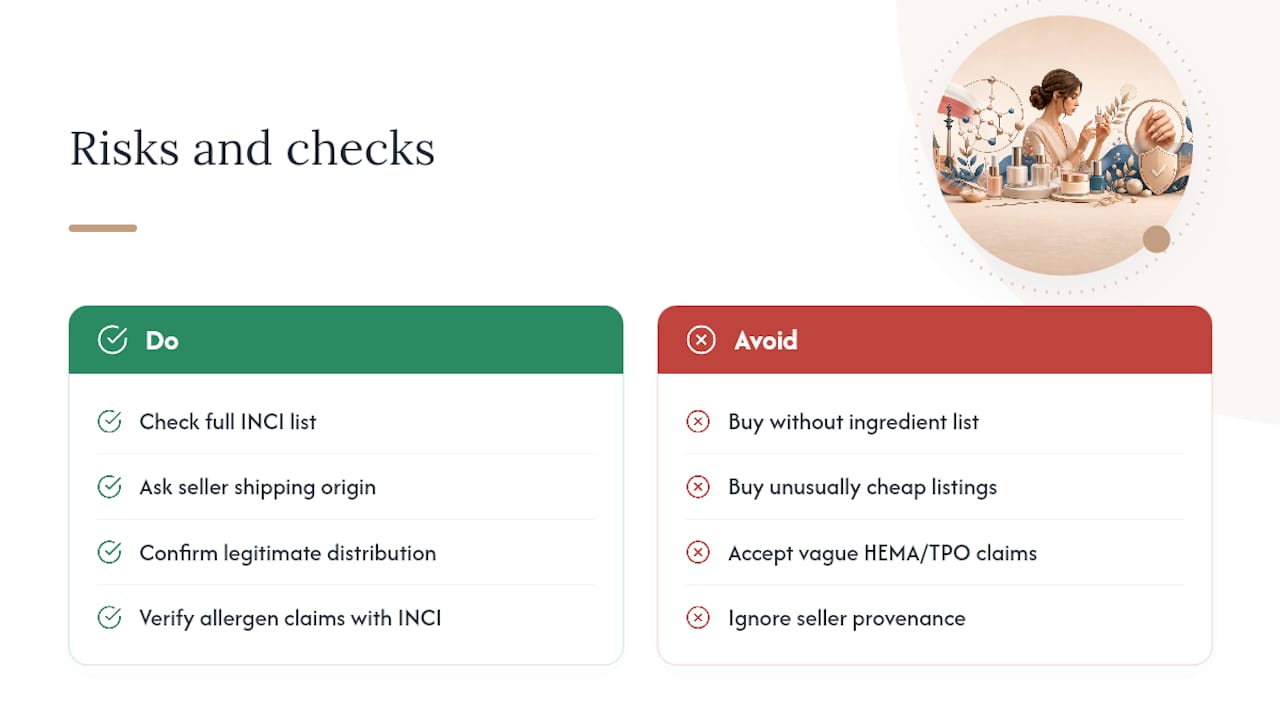
The biggest practical risk for UK shoppers buying Polish nail products online isn’t formula quality, it’s authenticity. Counterfeit and grey-market listings of popular Polish polish and gel brands do circulate on general marketplaces, usually identifiable by missing ingredient lists, unusually low prices, or sellers who can’t specify a shipping origin when asked directly.
Regulatory compliance is the second recurring issue. Cosmetics sold in the UK and EU are subject to ingredient restrictions on substances like formaldehyde and certain phthalates, and legitimate Polish manufacturers formulate to those standards as a baseline. Counterfeit or unregulated imports sidestepping proper distribution channels don’t carry the same guarantee, which is exactly why provenance checks matter more than they might seem to for a nail polish purchase.
There’s also a subtler compliance issue around allergen labelling. As HEMA-free and TPO-free formulations have become a selling point, some listings use the terms loosely without full ingredient disclosure to back them up. A genuine claim should be verifiable against a published INCI list, not just a headline on the packaging.
None of this means buying Polish nail products online is risky by default. It means the same verification habits that apply to any cosmetics purchase, checking ingredients, checking origin, checking who you’re actually buying from, apply here with slightly more weight given how fragmented the online market for imported polish has become.
What customer feedback says about Polish nail brands
Recurring themes show up across customer feedback on Polish nail and gel systems: durability holding up close to the advertised wear time, pigment payoff needing fewer coats than expected, and price standing out as favourable against comparable salon-grade Western European brands. Complaints, where they appear, tend to cluster around inconsistent lamp compatibility between older and newer gel formulas, and occasional confusion over which base and top coat pairing gives the advertised cure time.
Reputation for treatment-led ranges, strengtheners and repair gels specifically, tends to run ahead of reputation for trend-led colour drops, which fits the sector’s salon-first development. Reviewers who’ve used a strengthener alongside a hydrating cuticle oil for several weeks consistently report better outcomes than those using either product alone, which lines up with the combination approach professionals already recommend.
The most useful reviews, and the ones worth trusting most, are the ones describing wear across a realistic routine rather than a single application. Editorial testing methodology backs this up directly: repeat-use testing over real-time wear tells you far more about a polish’s actual durability than a first-day impression, and the same logic applies to reading customer reviews. A five-star review written on day one carries less weight than one written after two weeks of normal hand use.

Why the safety story matters more than the marketing story
The conventional advice on Polish nail brands treats them as a value play: cheaper than French or American equivalents, good enough quality, buy them if you’re on a budget. That framing misses the actual story, which is that Poland’s salon-dense domestic market forced an early, practical move toward HEMA-free and TPO-free formulas well before it became a mainstream selling point elsewhere.
What gets underrated is how much that safety shift matters for anyone who’s had a reaction to acrylics before, or anyone getting gels done regularly enough that cumulative exposure becomes a real consideration. Colour range and finish are almost a solved problem across the category now. Ingredient transparency and manufacturing provenance are where the genuine differences between a good purchase and a risky one actually sit.
My honest priority order for anyone shopping this category: check the ingredient list and HEMA/TPO status first, check the retailer’s provenance and returns policy second, and treat shade and finish as the last decision, not the first. Buy from someone who’ll actually tell you where the product came from.
— Krzysztof
Where to buy authentic Polish nail care with confidence
M-Shop is a family-run importer bringing Polish cosmetics, including nail care, straight from Poland to UK shoppers, without the layered distribution that makes provenance harder to verify. Every product page lists full ingredient details, and the catalogue runs on regular promotions, so authentic formulas don’t come with an inflated price tag.

That combination, direct sourcing plus transparent ingredient listings, is exactly the checklist this guide has walked through: known origin, published INCI information, and a retailer you can actually contact if something’s unclear. Beyond nail care, the same sourcing standard runs across M-Shop’s skincare range, including treatments like the Celia collagen anti-wrinkle cream for anyone building out a wider Polish skincare routine alongside their nail care choices.
If you’re ready to see it in practice, browse the nail repair range or head to the full Polish cosmetics catalogue to compare products directly against the ingredient checklist covered above.
Sources
For deeper reading on the topics covered here, the Allergy Clinic’s guide to HEMA and acrylic nail reactions explains the clinical background behind the HEMA-free shift. Expert Reviews covers strengthening ingredients in more depth, while Byrdie’s non-toxic polish testing offers independent comparison data on wear and finish. For sensitive skin more broadly, this partner guide on essential product checks is a useful companion read.
- Acrylic nails & HEMA allergy — Allergy Clinic
- Best nail strengthener — Expert Reviews
- Best non-toxic nail polishes — Byrdie — 2026-06-03