



Why Polish skincare is different: a complete guide
Polish skincare often gets dismissed as simply a budget-friendly alternative to French pharmacy brands or Korean beauty. That misreading misses something genuinely interesting. Why Polish skincare is different comes down to three interlocking forces: a cultural philosophy rooted in long-term skin health, a rigorous EU regulatory framework that shapes every formula, and a heritage of botanical ingredients that have been refined over generations. This guide unpacks all three, so you can understand what sets these products apart and whether they deserve a place in your routine.
Table of Contents
- Key takeaways
- Why Polish skincare is different from other traditions
- The barrier-first philosophy explained
- Polish herbal ingredients and traditional remedies
- Polish skincare vs other international trends
- How to adopt Polish skincare principles
- My honest take on what makes Polish skincare work
- Discover authentic Polish skincare at M-shop
- FAQ
Key takeaways
| Point | Details |
|---|---|
| Barrier-first philosophy | Polish skincare prioritises protecting the skin’s hydrolipid barrier before addressing any other concern. |
| EU regulatory standards | Every Polish cosmetic must comply with strict EU safety laws, making formulations more accountable than many global alternatives. |
| Heritage botanical ingredients | Chamomile, calendula, and rye are scientifically validated staples found throughout the traditional Polish beauty remedies list. |
| Pragmatic routine structure | Polish skincare routines are shorter and more consistent than K-beauty rituals, focusing on daily habits over elaborate steps. |
| Accessible quality | Polish brands deliver clinically informed formulations at pharmacy prices, without compromising on ingredient integrity. |
Why Polish skincare is different from other traditions
The short answer is that Polish skincare was never built around trends. It was built around function. The Polish cosmetics industry grew steadily through the latter half of the twentieth century, developing a manufacturing culture that valued efficacy and safety over novelty. Today, over 1,300 manufacturers operate within Poland, many of them small and mid-sized enterprises that can pivot quickly to adopt new ingredients while maintaining strict quality controls.
That manufacturing agility sits inside a very firm regulatory boundary. All Polish cosmetics sold in the EU must comply with EU Cosmetic Regulation 1223/2009, which requires a full Cosmetic Product Safety Report, a designated responsible person, product notification through the CPNP portal, and adherence to a substantial list of prohibited and restricted substances. This is considerably more demanding than the framework governing cosmetics in the United States, where pre-market safety assessment is not legally required in the same way.
The practical result for consumers is meaningful. When you pick up a Polish moisturiser, the formula has been assessed for safety before it ever reached the shelf. Ingredients have been evaluated in context, impurity limits have been set, and the manufacturer is legally accountable. That is not marketing language. It is a legal baseline.
| Regulatory requirement | EU (Polish brands) | US market |
|---|---|---|
| Pre-market safety report | Mandatory | Not required |
| Prohibited substances list | Over 1,300 entries | Around 11 entries |
| GMP standard | EN ISO 22716 required | Voluntary |
| Responsible person designation | Required | Not required |
Regulations also evolve. Polish brands must continuously reformulate as EU amendments tighten ingredient standards. A 2026 update, for instance, introduced new restrictions on UV filter impurities, requiring brands to re-assess and adjust sunscreen formulations even for products already on the market. That ongoing cycle of compliance keeps Polish products at a high standard long after launch.
The barrier-first philosophy explained
If you read about Polish skincare benefits, the phrase “barrier-first” appears repeatedly. It is not a buzzword. It describes a genuine sequencing logic that shapes both product formulation and daily routine structure.
The skin’s hydrolipid barrier is its outermost defence. It regulates moisture loss, protects against environmental aggressors, and keeps the microbiome balanced. Polish skincare philosophy treats this barrier as the foundation. Everything else, brightening, anti-ageing, texture refinement, comes after the barrier is supported. The routine reflects this in a clear order:
- Gentle cleansing. Remove impurities without stripping lipids. A micellar cleanser is a common first choice because it lifts debris without disrupting the skin’s pH.
- Hydration. Apply a humectant layer, typically containing hyaluronic acid or glycerin, to draw moisture into the skin.
- Occlusion. Seal that moisture in with a ceramide-rich cream or barrier repair formula to reduce transepidermal water loss.
- Protection. Finish with a broad-spectrum SPF, every morning, regardless of cloud cover or season.
That final step is where Polish skincare routines diverge most visibly from many Western habits. Daily high-SPF sunscreen is treated as non-negotiable, not an optional warm-weather addition. Polish women apply it in January. They apply it when working indoors. The cultural understanding is that UV exposure accumulates silently, and prevention is far more effective than correction.
Pro Tip: If you are new to Polish skincare principles, start by auditing your existing routine for anything that strips or irritates. A gentle cleanser and a ceramide moisturiser are the two most impactful changes you can make before adding any active ingredients.
The ingredient profiles in Polish products reflect this philosophy directly. Ceramides rebuild the lipid matrix. Niacinamide strengthens barrier function and reduces inflammation. Probiotics support microbiome balance. Humectants like urea and panthenol maintain hydration levels. These are not exciting ingredients in the way that retinol or vitamin C tend to generate headlines. They are quietly effective, and that is precisely the point.

Polish herbal ingredients and traditional remedies
The role of Polish herbs in skincare is not simply nostalgic. These botanical ingredients have been used in Polish households for generations, and modern formulation science has validated many of their traditional applications.
Chamomile (Matricaria chamomilla) is perhaps the most recognisable. It appears in soothing serums, eye creams, and gentle cleansers throughout the Polish herbal beauty ingredients list because its bisabolol content genuinely reduces redness and calms reactive skin. Calendula (Calendula officinalis) is another staple, valued for its wound-healing and anti-inflammatory properties, particularly in products designed for sensitive or compromised skin.
Less well known outside Poland is the use of rye. Rye-based treatments have a long history in Polish folk beauty, where rye bread rinses were used to soften and clarify skin. Contemporary Polish brands have translated this into fermented rye extracts that deliver gentle enzymatic exfoliation and prebiotic benefits without the irritation risk of synthetic acids.
- Chamomile extract: Soothes inflammation, reduces redness, suits sensitive and post-procedure skin.
- Calendula extract: Supports barrier repair, accelerates healing, common in products for dry or irritated skin.
- Fermented rye: Provides gentle exfoliation and prebiotic activity, supporting microbiome health.
- Birch water: A hydrating and toning ingredient with antioxidant properties, harvested in spring.
- Linden flower: Used in calming formulations, particularly for skin prone to flushing or sensitivity.
What makes the Polish herbal cosmetics benefits guide genuinely interesting is the biotech layer added to these traditional ingredients. Botanical extracts are now combined with microbiome-friendly probiotics and modern moisturising actives to create formulas that honour heritage while meeting contemporary clinical standards.
Pro Tip: When exploring Polish natural ingredient skincare routines, look for products that list botanical extracts alongside ceramides or niacinamide. That combination signals a brand that understands both tradition and modern barrier science.
Cultural practices also play a role. Cold water rinses after cleansing are a common Polish habit, believed to close pores and stimulate circulation. Regular visits to thermal spas, particularly in southern Poland, are part of a broader wellness culture that treats skin health as connected to overall physical wellbeing rather than purely cosmetic.
Polish skincare vs other international trends
Understanding why Polish skincare routines feel different is easier when you compare them directly to other popular approaches.
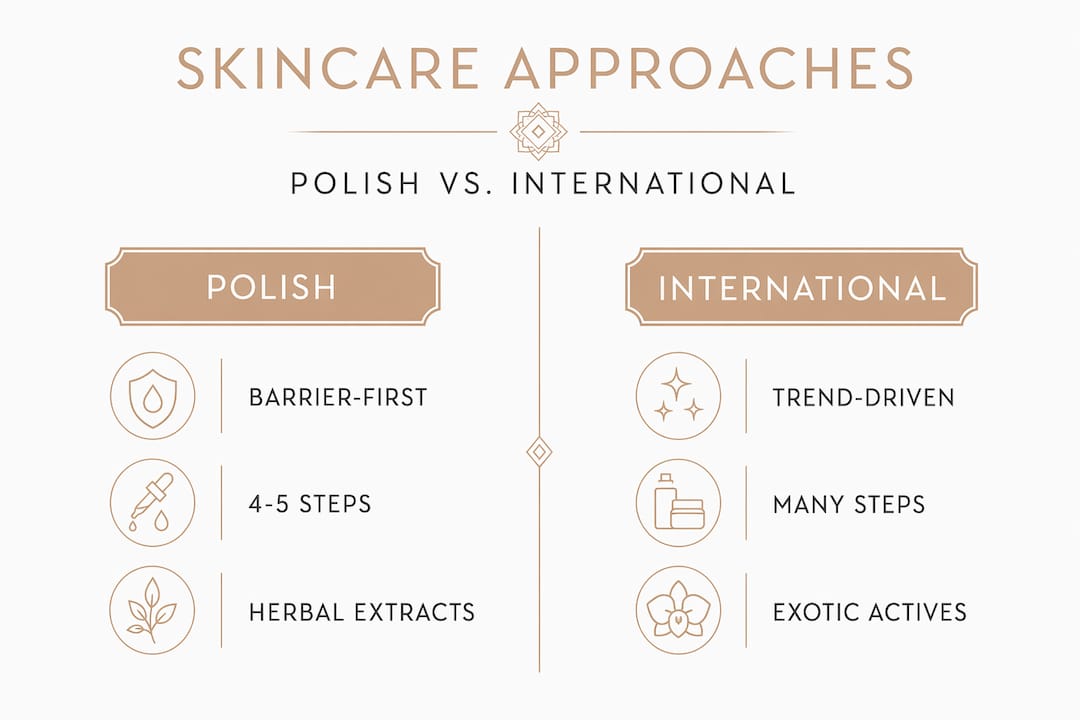
| Feature | Polish skincare | K-beauty | General Western approach |
|---|---|---|---|
| Routine length | 4 to 5 steps | 8 to 12 steps | Varies widely |
| Core focus | Barrier repair and tolerance | Hydration and glow | Active ingredients and correction |
| Ingredient philosophy | Clinically validated, traditional botanicals | Fermented ingredients, snail mucin, sheet masks | Retinoids, acids, peptides |
| Cultural value | Pragmatism and longevity | Ritual and sensory experience | Results and speed |
| SPF culture | Daily, non-negotiable | Strong SPF culture | Often seasonal or inconsistent |
Polish skincare stands apart from Korean beauty primarily through its simplicity and its resistance to trend-chasing. K-beauty introduced the world to layering, glass skin, and multi-step rituals that are genuinely pleasurable. Polish skincare asks a different question: what is the minimum effective routine that keeps skin healthy for decades?
That is not a criticism of K-beauty. It is a reflection of different climates, different cultural values, and different skin priorities. Central European winters are harsh and drying. The Polish approach to skincare evolved partly in response to that environment, prioritising barrier resilience over aesthetic novelty.
How to adopt Polish skincare principles
You do not need to overhaul your entire routine to benefit from Polish skincare logic. The changes that matter most are structural.
- Audit your cleanser. If it leaves your skin feeling tight or squeaky, it is stripping your barrier. Switch to a micellar or low-pH gel formula.
- Add a ceramide moisturiser. Apply it while your skin is still slightly damp after cleansing to lock in hydration. A product like the Bielenda capillary repair cream is a good example of barrier-focused Polish formulation.
- Commit to daily SPF. Not just in summer. Not just on sunny days. Apply a broad-spectrum SPF 30 or higher every morning as the final step.
- Introduce niacinamide. It works well alongside ceramides and is well tolerated by most skin types. Start at 5% and assess your skin’s response over four weeks.
- Consider a gentle exfoliant. Polish skincare does not avoid exfoliation, but it favours enzymatic or low-acid options over aggressive scrubs. A Bielenda enzymatic scrub illustrates this approach well.
- Simplify before you add. Polish skincare philosophy is sceptical of stacking multiple actives. If your skin is reactive or congested, strip back to the basics first and rebuild slowly.
The beauty of this approach is that it is affordable. Polish pharmacy brands are priced for everyday use, not occasional luxury. That accessibility is part of the philosophy. Consistent daily habits with reliable products outperform occasional use of expensive ones.
My honest take on what makes Polish skincare work
I have spent years watching beauty trends arrive with enormous fanfare and disappear just as quickly. What I find genuinely compelling about Polish skincare is that it was never designed to be trendy. It was designed to work.
The barrier-first logic is something I wish I had understood earlier. So much skin sensitivity, congestion, and premature ageing traces back to a damaged barrier, often caused by over-cleansing or over-exfoliating in pursuit of faster results. Polish skincare sidesteps that trap by starting with protection rather than correction.
What also strikes me is the transparency that comes with EU compliance. When a Polish brand lists its ingredients and backs them with a safety report, that is not a marketing choice. It is a legal requirement. That structural accountability changes the relationship between brand and consumer in a way that voluntary certifications simply cannot replicate.
The cultural dimension matters too. The reason why Polish women’s skin routines tend to produce long-term results is not just the products. It is the consistency. Sunscreen every day. Gentle cleansing every evening. Moisturiser without exception. That kind of disciplined simplicity is genuinely difficult to market, but it is what actually works.
If you take one thing from this, let it be this: skin health is cumulative. The habits you build now compound over years. Polish skincare understands that, and it shows.
— Krzysztof
Discover authentic Polish skincare at M-shop
If this has made you curious about trying these principles for yourself, M-shop is the place to start. As a family-owned business bringing authentic Polish cosmetics to the UK, M-shop stocks a curated range of brands that embody everything discussed here: barrier-supporting formulas, botanically grounded ingredients, and EU-compliant safety standards.

Whether you are looking for a gentle micellar cleanser to rebuild your routine from scratch, a daily SPF for children that reflects Poland’s sunscreen-from-birth culture, or a full introduction to Polish cosmetics in the UK, M-shop makes it straightforward to shop with confidence. Every product is sourced directly, so you know exactly what you are getting.
FAQ
What makes Polish skincare different from Western brands?
Polish skincare prioritises barrier repair and long-term skin health over quick cosmetic fixes. Products are formulated under strict EU safety regulations, which require pre-market safety assessments and ingredient accountability that many Western markets do not mandate.
What are the key ingredients in Polish skincare?
The most common ingredients include ceramides, niacinamide, probiotics, hyaluronic acid, and traditional botanical extracts such as chamomile, calendula, and fermented rye. These are chosen for their clinically supported barrier and hydration benefits.
How does Polish skincare compare to K-beauty?
Polish skincare routines are shorter and more focused on barrier resilience, typically four to five steps. K-beauty emphasises layering and sensory ritual, often using eight or more steps. Both have strong SPF cultures, but their ingredient philosophies and routine structures differ significantly.
Do Polish skincare brands follow strict safety standards?
Yes. All Polish cosmetics sold in the EU must comply with Regulation 1223/2009, which requires a full safety report, GMP compliance, and adherence to a list of over 1,300 prohibited substances. Brands must also update formulations as regulations evolve.
Can I build a Polish-inspired routine on a budget?
Absolutely. Polish pharmacy brands are designed for consistent daily use at accessible price points. Starting with a gentle cleanser, a ceramide moisturiser, and a broad-spectrum SPF covers the core principles without significant expense.
Recommended
- Bielenda Professional Enzymatic Face Scrub with Aloe and D-panthenol 1 – M-Shop.UK
- Bielenda Professional Soothing Face Mask with White Clay 150g – M-Shop.UK
- Bielenda Professional Capillary Repair Face Cream with Rutin and Vitam – M-Shop.UK
- Bielenda Professional Antibacterial Face Mask with Green Clay 150g – M-Shop.UK