



Real results in 4–12 weeks: evidence-backed collagen eye cream benefits
Collagen eye creams reliably hydrate the delicate under-eye area and, when formulated with collagen-stimulating actives, can measurably reduce fine lines within weeks. Intact collagen molecules rarely penetrate deep enough to rebuild skin structure, so the real work falls to peptides, hyaluronic acid, and retinoids. Expect gradual improvement over 4 to 12 weeks of consistent use, not overnight transformation.
TL;DR:
- Hydration benefits are immediate, but lasting results on wrinkles and elasticity require at least 8 to 12 weeks of consistent use.
- Peptides and retinoids stimulate collagen production on a biological level, leading to more durable improvements over time.
- Most collagen in creams acts as a humectant and does not penetrate deeply; actual collagen boosting comes from active ingredients like peptides and vitamin C.
- Short-term puffy eyes respond temporarily to caffeine and antioxidants, but structural issues like dark circles need targeted or invasive solutions.
- Results follow a layered timeline: surface hydration within minutes, early brightness in weeks, and structural firmness in three months or more.
Table of Contents
- What are the real benefits of collagen eye cream?
- The ingredient science behind collagen creams
- What does the clinical evidence actually show?
- How should you apply a collagen eye cream for best results?
- Safety, tolerability and who should be careful
- How soon will you see results?
- Why we’re selective about which collagen formulas we stock
- A collagen cream worth considering for your eye area
- Sources
What are the real benefits of collagen eye cream?
The honest answer sits between two extremes: not the miracle marketing promises, and not the cynical dismissal that “moisturiser is moisturiser.” Collagen eye creams deliver a specific set of benefits, each tied to a distinct mechanism, and knowing which one you’re chasing changes which product actually makes sense for you.
Hydration and immediate surface smoothing happen fastest and most reliably. Humectants like hyaluronic acid pull water into the skin’s outer layers, and film-forming ingredients lock that moisture in place. One instrumental evaluation found measurable improvements in hydration and transepidermal water loss within 30 minutes of application, which explains why your under-eyes look temporarily plumper right after you apply cream. That’s a real, visible effect. It’s also the shortest-lived one, fading as the humectant evaporates unless you reapply or seal it with an occlusive.
Fine-line and wrinkle reduction is plausible but slower, and the degree of change varies a lot by formulation. The same periorbital ageing study recorded measurable wrinkle reduction across a 7 to 56 day window, with many endpoints improving most clearly by day 28 to 56. That timeline matters: anyone expecting a smoother eye area after three nights is chasing a result the biology doesn’t support.
Elasticity and firmness improve through a different route entirely. Peptides act as signalling molecules that tell fibroblasts, the cells responsible for producing collagen and elastin, to ramp up activity — the Boost Collagen Production guide from Copper Peptides Store explains how this works in detail. Retinoids work on skin turnover and have decades of dermatological evidence behind their effect on collagen density. A 12-week trial of an active anti-ageing eye cream reported an 18.81% increase in elasticity alongside gains in hydration and collagen markers, giving a rough sense of what a well-formulated product can achieve over that timeframe.
Dark circles and puffiness are where topical products hit their limits fastest. Caffeine and antioxidants can temporarily constrict blood vessels and reduce fluid retention, easing morning puffiness for a few hours. But persistent dark circles often come from structural causes, thin skin revealing underlying blood vessels, volume loss, or pigmentation, that no cream reaches. If concealer barely helps and the shadow looks bluish rather than brown, you’re likely dealing with a vascular or structural issue that sits outside what any topical formula can fix.
Here’s the practical breakdown of what you can expect from each benefit category:
- Hydration: visible within 30 minutes, needs consistent reapplication to maintain
- Fine lines: measurable change from around week 4, clearer by week 8 to 12
- Elasticity: gradual improvement over 8 to 12 weeks with peptide or retinoid actives
- Puffiness: temporary relief from caffeine-based formulas, hours rather than days
- Dark circles: mild brightening possible with vitamin C or niacinamide; structural causes need non-topical solutions
Short-term versus long-term effects come down almost entirely to formulation. A cream loaded with glycerin and hyaluronic acid but nothing else will plump the skin today and do very little for its structure in three months. A cream built around peptides and retinoids works more slowly but changes something more durable. Reading the ingredient list, not the front-of-pack claims, tells you which kind of product you’ve actually bought.
The ingredient science behind collagen creams
Every claim on an eye cream label traces back to one of six ingredient categories, and each works through a completely different mechanism. Understanding the map between ingredient, mechanism, and outcome is the fastest way to see through marketing and judge whether a product can plausibly do what it promises.
Peptides are short chains of amino acids that mimic the fragments produced when collagen breaks down naturally. Skin reads these fragments as a signal that repair is needed, prompting fibroblasts to produce more collagen. This signalling effect has clinical support: the Boost Collagen Production guide from Copper Peptides Store explains how specific peptide sequences trigger this fibroblast response, and the 12-week trial cited earlier recorded a 54.99% increase in collagen production in a formulation built around this mechanism.
Hyaluronic acid works on hydration, not structure. It can hold many times its weight in water, and topical application can double skin hydration rapidly while reducing water loss through the skin barrier for hours afterwards. Molecular weight matters here: high molecular weight hyaluronic acid sits on the surface and hydrates the outer layers, while low molecular weight versions penetrate slightly deeper. Neither rebuilds collagen, but both make skin look smoother by filling it with water.
Retinoids (retinol and its derivatives) increase cell turnover and have the longest track record of any anti-ageing ingredient for stimulating collagen production. The trade-off is time and tolerance: visible effects typically take 8 to 12 weeks, and the eye area, being thinner and more reactive than the rest of the face, tolerates retinoids poorly at high concentrations. Most eye-specific formulas use lower percentages than face creams for exactly this reason.
Vitamin C functions as a cofactor, meaning collagen synthesis enzymes literally cannot complete the process without it. It’s also a notoriously unstable ingredient. L-ascorbic acid degrades quickly when exposed to light and air, which is why stabilised forms (ascorbyl glucoside, sodium ascorbyl phosphate) or opaque, airless packaging matter more with vitamin C than almost any other active.
Niacinamide and caffeine round out the common formulation. Niacinamide supports barrier function and has some evidence for reducing pigmentation, while caffeine’s vasoconstrictive effect gives it a genuine, if temporary, role in de-puffing. A 2024 review of eye cream ingredients found clinical support for all six ingredient categories addressing periorbital concerns, though it flagged a shortage of large, eye-specific trials as opposed to general facial skin studies.
So where does “collagen” itself fit into a collagen eye cream? Mostly as a humectant. Collagen molecules are too large to cross into the deeper dermis, so when a product lists collagen as a headline ingredient, it’s usually working the same way hyaluronic acid does, sitting on the surface and drawing in moisture, rather than integrating into your skin’s own collagen network. Genuine “collagen boosting” happens through the peptides, retinoids, and vitamin C that stimulate your fibroblasts to do the work themselves, a distinction worth understanding before you pick a collagen versus retinol product for wrinkle reduction.

Pro Tip: Check the ingredient list, not the product name. A cream branded “Collagen Eye Cream” that lists collagen fifth on the ingredient panel, behind water, glycerin, and a couple of emulsifiers, is leaning on the word for marketing. Look instead for named peptides (like palmitoyl tripeptide) or a stated retinol percentage near the top of the list.
What does the clinical evidence actually show?
Clinical trials on eye creams tend to measure four things: hydration, elasticity, transepidermal water loss (TEWL), and collagen density, using instruments that quantify what would otherwise be subjective “does my skin look better” judgements.
A 12-week trial of an anti-ageing eye cream measured a 54.99% increase in collagen production, a 28.12% improvement in hydration, and an 18.81% increase in elasticity after consistent daily application, giving one of the clearest instrumented pictures of what a well-formulated product can achieve over three months.
That trial, published on PubMed, used standard dermatological instruments rather than participant self-reporting, which is what makes the numbers meaningful. A Corneometer measures hydration by assessing the skin’s electrical capacitance, more water content changes how skin conducts a small current. A Cutometer measures elasticity by applying gentle suction and tracking how quickly skin springs back. VISIA imaging captures high-resolution photographs under multiple light spectrums to track wrinkle depth and pigmentation over time, and ultrasound can estimate collagen density in the dermis without a biopsy. These instruments appear across most credible eye cream research, including the comprehensive multi-component formula evaluation that used similar endpoints to track periorbital changes.
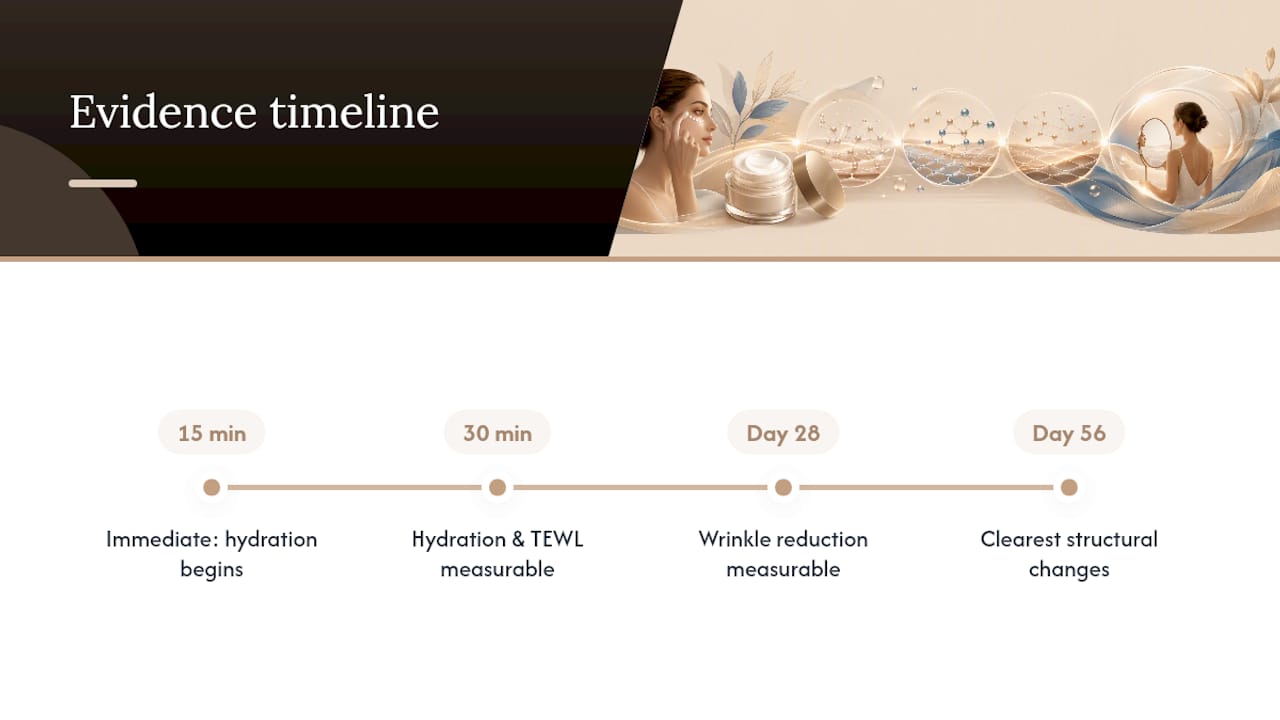
A separate instrumental and clinical evaluation tracked a topical cream across time points from 15 minutes out to 56 days, and the pattern it revealed is one every reader should understand before judging a product too early or too late. Hydration and TEWL improvements showed up almost immediately, within the first 30 minutes, because water content and barrier function respond fast to humectants and occlusives. Wrinkle reduction, by contrast, needed weeks to become measurable, with the clearest changes appearing between day 28 and day 56. That gap between “surface feels different” and “structure has actually changed” is the single most useful thing to take from the clinical literature.
Not every data point carries equal weight, and it’s worth being clear about which is which. Peer-reviewed instrumental studies, like the two above, use blinded measurement and standardised instruments, which makes their numbers trustworthy for the specific formulations tested. Brand-published user trials are a different tier entirely: one manufacturer trial for a collagen-targeted eye cream reported strong user-perceived improvements in puffiness and dark patches after 28 days, but that’s self-reported consumer perception data, not an independent clinical measurement, and it should be read as a company’s own results rather than proof of efficacy.
Sample sizes in eye cream research also tend to run small, often a few dozen participants per trial, and formulations vary enough between studies that you can’t cleanly generalise one product’s 18.81% elasticity gain onto a different cream with a different peptide blend. The 2024 review of eye cream ingredients makes this point explicitly, noting that while individual ingredients have decent evidence at the facial skin level, eye-specific trials remain comparatively scarce, and more work is needed before broad claims can be made with confidence.
Translated into a practical takeaway: if a product’s marketing cites a clinical trial, check whether the number refers to hydration (which changes fast and is usually easy to achieve) or collagen density and wrinkle depth (which take much longer and are harder to move). A cream that claims dramatic wrinkle reduction after one week is citing a timeframe the instrumented research doesn’t support. For a longer view on what sustained use looks like structurally, the evidence on collagen face cream benefits tracks a similar pattern: fast hydration, slower firmness.
How should you apply a collagen eye cream for best results?
Getting results close to what the trials report means matching your routine to how the actives actually work, not just applying cream whenever you remember.
- Split your routine by time of day. Morning products should lean on caffeine, antioxidants, and SPF to protect and de-puff; evening products should carry the heavier actives, retinoids and peptides, because skin repair activity peaks overnight.
- Use a genuinely tiny amount. A pea-sized quantity, roughly a grain of rice per eye, is enough. The under-eye skin is thinner than anywhere else on the face and doesn’t need, or benefit from, a thick layer.
- Apply with your ring finger, tapping gently. The ring finger naturally applies the lightest pressure of any finger, and tapping rather than rubbing avoids tugging on skin that’s already prone to creasing.
- Layer thinnest to thickest. If you’re combining vitamin C, retinol, and peptides across your routine, apply vitamin C first (morning), then peptides, then seal with the eye cream, and never apply retinol and vitamin C in the same application if your skin is sensitive.
- Stay consistent for at least 8 to 12 weeks before judging results. Structural changes, the elasticity and collagen gains, need that runway to show up on any instrument, let alone in the mirror.
- Wait before inserting contact lenses. Give any eye cream a few minutes to fully absorb before lenses go in, and apply make-up after, not before, absorption is complete.
Pro Tip: If your morning routine already includes an SPF moisturiser, apply your eye cream first and let it sink in for a minute before SPF. Layering it the other way round can dilute the eye cream and reduce how much actually reaches the skin.
Safety, tolerability and who should be careful
Most collagen eye creams are well tolerated, but the under-eye area is thinner and more reactive than facial skin generally, which raises the stakes on formulation choices.
- Watch for irritation signs: redness, stinging, flaking, or itching after application, particularly with retinoids or high concentrations of vitamin C, can signal early contact dermatitis.
- Patch test new actives on the inner forearm for a few days before applying near the eyes, especially with any product containing retinol.
- Introduce retinoids gradually: start two to three nights a week and build up, rather than applying nightly from day one.
- Pregnancy and breastfeeding: retinoids are generally advised against during pregnancy and breastfeeding; check with a clinician or midwife before using retinol-based eye products in either case.
- Contact lens wearers should let cream absorb fully before inserting lenses to avoid product migrating into the eye.
- Persistent swelling or dark circles that don’t respond to consistent product use over several months may point to allergies, sleep issues, or structural causes, and are worth raising with a GP or dermatologist rather than solving through more skincare.
If irritation persists beyond a few applications despite reducing frequency, stop the product and reassess rather than pushing through discomfort.
How soon will you see results?
Results arrive in layers, not all at once, and knowing the sequence stops you giving up on a product too early or expecting too much too soon.
Minutes to hours: hydration and surface smoothing appear almost immediately as humectants pull water into the skin, the effect the 30-minute instrumental data captured clearly.
1 to 4 weeks: early reductions in puffiness and improved brightness show up for many users, particularly with caffeine or niacinamide formulas, though this stage is where individual variation is highest.
4 to 12 weeks: this is where the meaningful structural evidence lives, measurable gains in elasticity, collagen density, and wrinkle depth, consistent with the 12-week collagen production data discussed earlier.
If you’ve used a product consistently for 12 weeks with no change in fine lines or firmness, it’s reasonable to switch formulations, particularly toward one with actives known to support collagen production rather than collagen as the headline ingredient. Persistent puffiness or dark circles that outlast several months of consistent use are a better candidate for professional assessment than another product swap, and readers past their mid-thirties often find the calculus shifts again, worth reading alongside guidance on collagen for mature skin.
Why we’re selective about which collagen formulas we stock
Our approach is straightforward: we favour formulations with ingredient transparency, ones where collagen sits alongside actives with actual mechanisms behind them, rather than collagen as the sole marketing hook. Polish skincare has a strong tradition of natural, ingredient-led formulation, and that’s the standard we hold our range to. Our blog and product pages break down what each formula actually contains, so you’re buying based on ingredients, not adjectives on a box. Polish skincare has a strong tradition of natural, ingredient-led formulation, and that’s the standard we hold our range to. Our blog and product pages break down what each formula actually contains, so you’re buying based on ingredients, not adjectives on a box.
— Krzysztof
A collagen cream worth considering for your eye area
If you’re weighing up which collagen formula actually fits your skin, the answer usually comes down to texture and where you’re using it. For daytime wear or lighter, mature skin that wants hydration without heaviness, the Celia Collagen + Algae 40+ lightweight moisturising cream absorbs quickly and layers well under SPF. For drier periorbital skin that needs a richer overnight barrier, the Celia Collagen + Vitamines 40+ cream is built with a heavier texture designed for nourishment while you sleep.

Both are part of a Polish skincare range, chosen for ingredient transparency rather than headline claims, and both sit within the same formulation logic covered throughout this article: hydration first, structural support from the actives that actually stimulate collagen. If you want to see the full anti-wrinkle formulation with eyebright and collagen combined, the Celia Collagen + Eyebright mask is worth a look for the face, neck, and décolletage together. Browse the current range and check today’s pricing to find the texture that suits your skin.
Sources
- In vitro, ex vivo, instrumental and clinical evaluation of a topical cream on the signs of periorbital ageing
- PubMed reference for a 12‑week clinical study