



Cosmetics item list: essentials and shop starter checklist
A practical cosmetics item list organises products by category and highlights a compact 8-item beginner kit for everyday use. Whether you are building your first makeup bag, studying product categories for retail, or stocking a small shop, this guide covers everything you need.
Your 8 item beginner essentials at a glance:
- Face base (foundation, tinted moisturiser, or BB cream)
- Concealer (for blemishes and under-eye coverage)
- Mascara (opens and defines the eyes)
- Brow product (pencil or clear gel)
- Blush or cream tint (adds warmth and dimension)
- One versatile lip product (tinted balm or lipstick)
- Gentle cleanser (to remove makeup and protect skin)
- One tool: a blending sponge or foundation brush
The sections below give you the full category-by-category inventory, a numbered beginner kit with rationale, a retail starter checklist with price-band guidance, UK safety basics, and storage tips.
Table of Contents
- What does a complete cosmetics item list actually include?
- Build your beginner kit: the 7–8 items that actually matter
- Starter inventory checklist for a small shop or online seller
- UK regulatory and safety basics: what to check before you buy or sell
- How to choose quality products and store them properly
- Key takeaways
- Why a smaller, quality-first kit is the smarter choice
- Polish cosmetics delivered to your door in the UK
- Useful sources for further reading
What does a complete cosmetics item list actually include?
Cosmetics span far more than lipstick and mascara. Regulatory frameworks, including those used by the FDA and the ASEAN Cosmetic Documents, group products into primary categories based on intended use and area of application. The table below maps each category to its most common items and the reason most people buy them.
| Category | Common items | Why people buy them |
|---|---|---|
| Skin care | Moisturiser, serum, face mask, eye cream, SPF | Hydration, protection, anti-ageing |
| Face colour cosmetics | Foundation, concealer, primer, setting powder, blush, bronzer, highlighter | Even skin tone, coverage, glow |
| Eye cosmetics | Mascara, eyeliner, eye shadow, brow pencil, brow gel, kajal | Definition, depth, framing |
| Lip cosmetics | Lipstick, lip gloss, lip liner, tinted balm, lip plumper | Colour, moisture, definition |
| Hair care | Shampoo, conditioner, hair mask, hair oil, styling cream, dry shampoo | Cleansing, conditioning, styling |
| Nail care | Nail polish, base coat, top coat, nail oil, cuticle cream, remover | Colour, strength, care |
| Fragrances | Eau de parfum, eau de toilette, body mist, solid perfume | Scent, personal expression |
| Bath and shower | Shower gel, bath salts, bath oil, body scrub, soap | Cleansing, relaxation |
| Oral hygiene | Toothpaste, mouthwash, whitening strips, breath spray | Cleaning, freshening, whitening |
| Shaving and grooming | Shaving cream, aftershave balm, pre-shave oil, depilatory cream | Preparation, soothing, hair removal |
| Tools and accessories | Brushes, sponges, eyelash curler, tweezers, makeup remover pads | Application, blending, removal |
Multipurpose formats worth knowing. Cream-to-powder sticks, tinted balms, and buildable cream blushes have grown significantly in popularity since 2024 because they reduce application complexity and cut the number of SKUs you actually need. A cream blush stick, for example, can double as a subtle eye shadow and a lip tint. If you are building a minimal kit or a tight retail range, these multi-use formats are worth prioritising over single-purpose products.
Pro Tip: When browsing a new makeup items list, start with the skin care and face colour categories first. These two alone cover the majority of everyday needs and give you the clearest picture of what a range is missing.
Build your beginner kit: the 7–8 items that actually matter
Practical guides consistently recommend building a makeup essentials list in stages: face first, then eyes and brows, then cheeks and lips, and tools last. A beginner kit of 8 items covers a functional everyday routine without unnecessary cost or clutter.
-
Face base — foundation, tinted moisturiser, or BB cream. This evens skin tone and provides the canvas everything else sits on. For dry skin, choose a hydrating cream formula; for oily skin, a mattifying long-wear formula with a setting powder keeps shine in check through the day.
-
Concealer — covers blemishes, redness, and under-eye circles with more precision than a base alone. A small pot or stick concealer is the most versatile format for beginners.
-
Mascara — the single item that makes the biggest visible difference for the least effort. It opens the eyes, adds definition, and works without any other eye product. Replace it every 3–6 months to avoid bacterial build-up.
-
Brow product — a pencil or clear gel. Defined brows frame the face and make the rest of the makeup look intentional. A pencil gives more control; a clear gel is faster and works on most brow types.
-
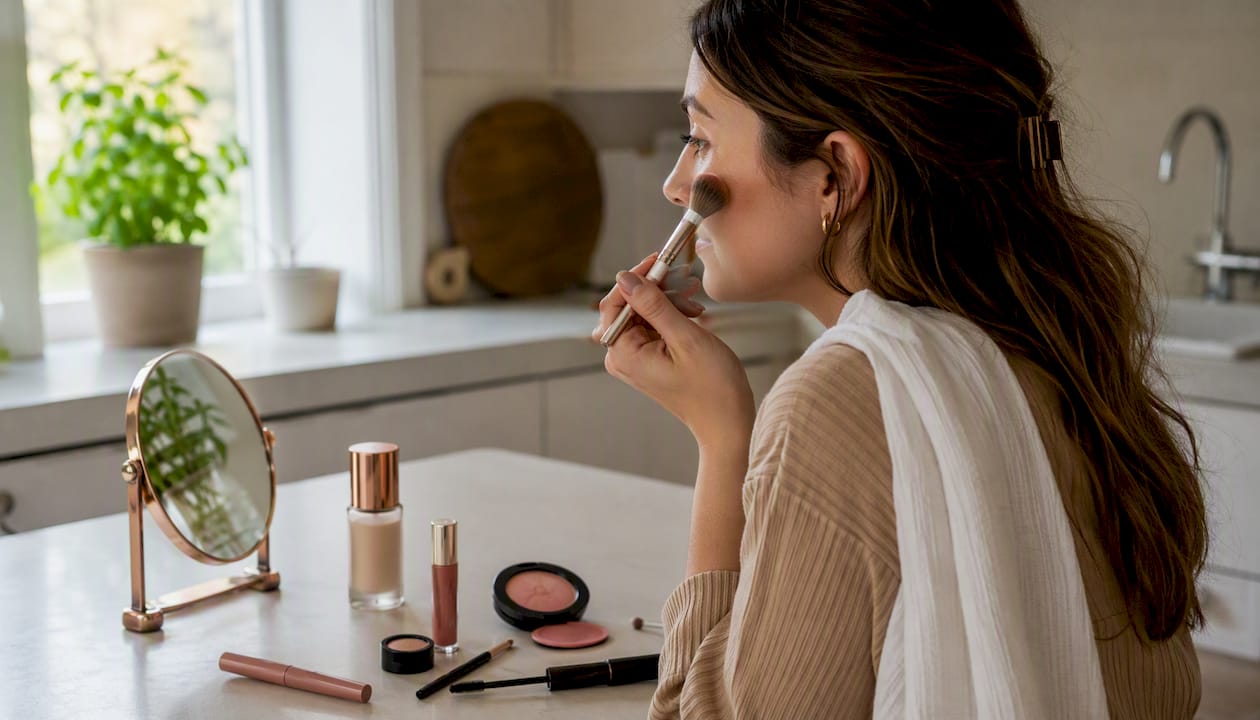
Blush or cream tint — adds warmth and stops a base-only face from looking flat. A cream blush stick is the most beginner-friendly format: it blends with fingers, doubles as a subtle lip colour, and travels well.
-
Versatile lip product — a tinted balm covers most occasions and keeps lips comfortable. If you want more colour payoff, a satin-finish lipstick in a neutral or your preferred shade is the next step.
-
Gentle cleanser — removing makeup thoroughly with a gentle, appropriate remover reduces the risk of irritation and breakouts, especially when using long-wear or waterproof formulas. A micellar water or a cream cleanser works for most skin types.
-
One tool: a blending sponge or foundation brush — beginner-focused resources recommend starting with a single high-quality sponge or brush rather than a full set of low-quality ones. A damp sponge blends base and concealer seamlessly and is easy to clean.
Application order for beginners: cleanser (to prep skin) → base → concealer → blush → brows → mascara → lip product. Tools go wherever they are needed in that sequence.
Pro Tip: Avoid buying a product in every finish and shade at once. One neutral blush and one everyday lip colour will serve you far better than five options you rotate rarely. Build the affordable skincare routine first, then layer colour on top.
Starter inventory checklist for a small shop or online seller
Stocking a small cosmetics shop means making decisions about which categories earn shelf space first. Practical retail guidance suggests starting with modest SKU counts, tracking which items sell fastest, and expanding only when real sales data supports it. Neutral palettes, dependable base products, and staple skincare items should anchor any starter range for general customers.

The table below gives a practical ordering template. Price bands are indicative: economy (under £5), mid (£5–£15), and premium (above £15).
| Category | Suggested starter SKUs | Priority price band | Notes |
|---|---|---|---|
| Complexion (base, concealer, primer) | 4–6 SKUs | Mid to premium | High-turn; neutral shades sell fastest |
| Eyes (mascara, liner, brow) | 4–5 SKUs | Economy to mid | Mascara and brow pencil are the fastest movers |
| Lips (lipstick, gloss, balm) | 4–6 SKUs | Economy to mid | Neutral and berry shades cover most buyers |
| Skincare (moisturiser, cleanser, serum) | 5–8 SKUs | Mid to premium | Repeat purchase category; drives loyalty |
| Hair (shampoo, conditioner, mask) | 3–5 SKUs | Economy to mid | Stock popular formats; avoid niche treatments early |
| Nails (polish, remover, base coat) | 4–6 SKUs | Economy | Seasonal colour swaps; keep neutrals year-round |
| Bath and shower (gel, soap, scrub) | 3–4 SKUs | Economy to mid | Gift-friendly; good for basket-building |
| Tools (sponges, brushes, pads) | 3–4 SKUs | Economy to mid | Consumables; reliable repeat purchases |
On packaging and labelling for UK retail: every product sold in the UK must carry an ingredient list (INCI format), a batch code, a responsible person’s name and contact address, a period-after-opening (PAO) symbol or best-before date, and any required allergen warnings. Check current requirements via gov.uk before placing a first order. Avoid stocking products that lack a UK-readable label, even if the formulation is sound, because non-compliant labelling is the most common reason products are pulled from sale.
UK regulatory and safety basics: what to check before you buy or sell
The UK follows its own retained cosmetics regulation, which mirrors the EU Cosmetics Regulation in most practical respects. For anyone buying or selling cosmetics in the UK, the following checks are non-negotiable.
Minimum label checks for every product:
- Ingredient list in INCI (International Nomenclature of Cosmetic Ingredients) format
- Batch code or lot number (for traceability)
- Responsible person’s name and UK address
- PAO symbol (the open-jar icon showing months of safe use after opening) or a best-before date
- Net weight or volume
- Any required warnings (e.g. “keep out of reach of children”, allergen alerts for fragrances)
The FDA’s product category codes offer a useful comparative reference for how regulators group cosmetics internationally, which helps when assessing imported products. For UK-specific guidance, the Office for Product Safety and Standards (OPSS) publishes current requirements on gov.uk.
Safety callouts worth remembering:
- Never apply eye-area products (mascara, eyeliner, kajal) to children without checking age suitability on the label.
- Patch-test new formulations, particularly those containing fragrances or active ingredients, 24–48 hours before full use.
- Remove eye makeup every night. Leaving mascara or liner on overnight increases the risk of eye irritation and blocked follicles.
- Dispose of expired products. An open jar of foundation used past its PAO is a contamination risk, not a bargain.
For product queries and stock that meets clear quality signals, M-shop’s range of European cosmetics safety standards guidance explains what to look for when buying Polish and European-made products in the UK.
How to choose quality products and store them properly
Choosing well starts before you open a product. A few simple rules cut through the noise on most cosmetics shelves.
Selection rules:
- Match the formula to your skin type. Hydrating cream formulas suit dry skin; mattifying, long-wear formulas and setting powders work better for oily skin.
- Prefer multi-use items when space or budget is limited. A cream blush that doubles as a lip tint, or a tinted SPF that replaces both moisturiser and base, reduces clutter without sacrificing coverage.
- Check for a preservative system on any water-based product (look for phenoxyethanol, sodium benzoate, or similar in the INCI list). Without one, water-based products spoil quickly once opened.
- If your skin is sensitive, fewer ingredients are often better. A short, clean ingredient list reduces the number of potential irritants.
A short ingredient checklist:
- Look for: hyaluronic acid (hydration), niacinamide (pore-minimising, brightening), collagen and algae extracts (firming, nourishing), SPF filters (protection), ceramides (barrier repair).
- Approach with caution if sensitive: high-fragrance formulas, alcohol denat. high on the list, essential oils near the top of the INCI.
Storage basics:
Store cosmetics away from direct sunlight and heat. A bedroom shelf or drawer is better than a bathroom cabinet, where steam and temperature fluctuations shorten product life. Keep lids tightly closed, never dilute products with water, and check the PAO symbol before each use. Once a product smells off or changes texture, it is past its safe use period regardless of the date on the label.
Pro Tip: Clean your brushes at least once a week with a gentle brush cleanser or mild shampoo, and store sponges dry and uncovered between uses. A damp sponge left in a closed bag grows bacteria within days. Replace mascara every 3–6 months, even if the tube is not empty.
Key takeaways
A compact 8 item kit built around quality, multi-use formulas delivers better everyday results than a large collection of single-purpose products.
| Point | Details |
|---|---|
| Start with 8 essentials | Base, concealer, mascara, brow product, blush, lip product, cleanser, and one tool cover everyday needs. |
| Prioritise multi-use formats | Cream blush sticks, tinted balms, and buildable formulas reduce SKU count for both personal kits and retail ranges. |
| Check UK labelling before buying or selling | Every product needs an INCI ingredient list, batch code, responsible person address, and PAO symbol. |
| Match formula to skin type | Hydrating creams for dry skin; mattifying, long-wear formulas and setting powders for oily skin. |
| M-shop for Polish cosmetics in the UK | M-shop stocks Polish skincare and cosmetics with natural ingredients, available to UK buyers with regular sale discounts. |
Why a smaller, quality-first kit is the smarter choice
The conventional wisdom in beauty is that more products equal more options. It does not. A large collection of mediocre formulas creates decision fatigue, wastes money, and often produces worse results than a tight set of well-chosen items. The logic is straightforward: when you know your five or six products well, you apply them faster, blend them better, and waste far less.
This is not a minimalist argument for its own sake. It is a practical one. Technique improves when you repeat the same steps with the same tools. A single high-quality foundation applied with a good sponge will outperform three mediocre ones applied inconsistently. The same holds for skincare: a cleanser, a moisturiser, and an SPF used daily beat a ten-step routine abandoned after a week.
For retailers, the same principle applies to stock selection. Stocking 40 SKUs across every category sounds thorough, but it ties up cash in slow-moving lines and makes the range harder to manage. Starting with 20–25 high-turn SKUs in the core categories, then expanding based on actual sales, is the approach that keeps margins healthy and shelves relevant.
The products that earn a permanent place in any kit or on any shelf share one quality: they do their job reliably, every time.
Polish cosmetics delivered to your door in the UK
If you are ready to start building your kit or stocking your shelves, M-shop brings high-quality Polish cosmetics directly to UK buyers. The range covers skincare, hair care, bath products, and nail care, with a focus on natural ingredients including collagen and algae. It is a family-run operation, which means the product selection is personal and considered rather than driven by volume.
Standout options include the Celia Collagen + Algae Lightweight Moisturising Cream, a practical everyday moisturiser that reflects the store’s ingredient philosophy, and the AA Oceanic fragrance-free cleansing gel, which suits sensitive skin and beginners building their first routine. Regular sales offer up to 15% off selected lines, making it a practical source for both personal shoppers and small retailers looking to trial Polish brands without a large upfront commitment. Browse the full range at M-shop.uk to find your starting point.
Useful sources for further reading
- FDA cosmetic product categories and codes — the official US regulatory category list; useful as a comparative reference when assessing product classification and labelling requirements.
- British Skin Foundation — UK charity with practical guidance on skin health, ingredient safety, and removal routines; consult for evidence-based skincare advice.
- Affordable makeup removal routine — M-shop’s practical guide to removing makeup safely and affordably in the UK.
- Budget makeup brands in the UK — overview of cost-conscious brand options for readers building a beginner kit on a budget.
- Find underrated European cosmetics in the UK — useful for discovering Polish and European brands available through M-shop, with product context.
- Gov.uk product safety and standards — the primary source for current UK cosmetics labelling and compliance requirements; check here before selling any product in the UK.