



How the polish perfume industry works in 2026
The Polish perfume industry is defined as an integrated manufacturing and distribution sector that moves a fragrance from concept brief through formulation, regulatory testing, and production to domestic retail and European export. The Polish fragrance market reached approximately $0.8–$1.0 billion in 2025 and is projected to hit $1.2 billion by 2030. Understanding how the Polish perfume industry works means understanding a supply chain that spans artisan workshops in Warsaw, contract factories producing 1.5 million units per month, and export routes into Germany, Belgium, and the Czech Republic. Poland is no longer a minor player in European perfumery. It is a rising production centre with both the scale and the certification standards to compete internationally.
What are the main steps in polish perfume production?
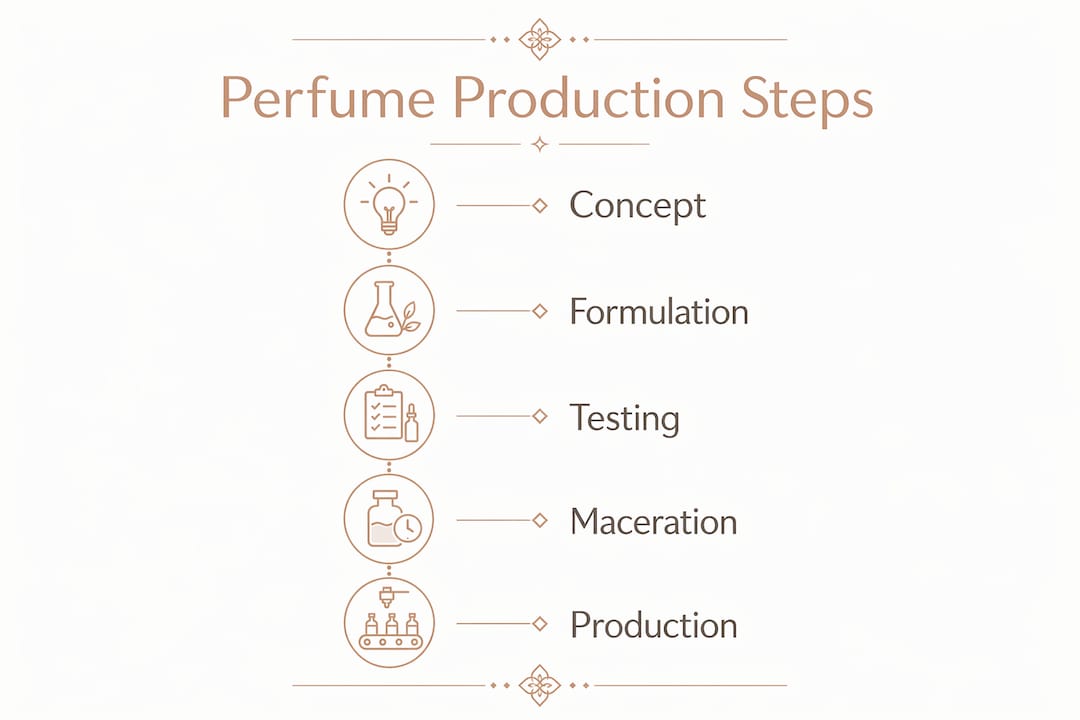
Polish perfume manufacturing follows a structured, repeatable cycle that contract producers like Canexpol and Perfect Perfume apply across thousands of product lines. Each step is distinct, and skipping any one of them compromises the final product.
-
Concept brief. A brand or client defines the fragrance family, target consumer, price point, and intended market. This brief drives every subsequent decision, from ingredient selection to bottle design.
-
Fragrance composition. A perfumer, sometimes called a “nose,” blends aromatic compounds to match the brief. Polish manufacturers source both natural materials and synthetic aroma chemicals, giving them flexibility across price tiers.
-
Raw material sourcing. Natural ingredients such as rose absolute, cedarwood, and citrus oils are sourced internationally, often from Grasse in France. Synthetic molecules are procured from major chemical suppliers and offer consistency that natural materials cannot always guarantee.
-
Safety and stability testing. Every formula must pass olfactory and stability evaluations before production begins. Tests cover temperature exposure, light sensitivity, and skin safety, all in compliance with EU REACH and CLP regulations.
-
Regulatory documentation. Polish producers prepare full product information files, safety assessments, and ingredient declarations required under EU cosmetics law. This paperwork is non-negotiable for retail access across Europe.
-
Maceration. The blended fragrance concentrate ages in controlled vats, allowing the aromatic molecules to harmonise. Skipping maceration produces a flat, unbalanced scent. Industrial producers vary in how strictly they observe this phase, and it is one of the clearest quality differentiators between manufacturers.
-
Production and filling. The matured concentrate is diluted with alcohol or a carrier, then filled into bottles at scale. Contract manufacturers like Perfect Perfume reach 1.5 million units per month at this stage.
-
Packaging and retail preparation. Bottles are labelled, boxed, and prepared for distribution. Packaging must comply with EU labelling requirements, including allergen declarations.
Pro Tip: When evaluating a Polish contract manufacturer, ask specifically about their maceration protocol. A producer who cannot describe the ageing period and temperature controls is likely cutting corners that will show up in the finished scent.
How is the polish perfume market evolving?

The Polish perfume market overview shows a sector accelerating on two fronts: domestic premiumisation and export growth. Both trends are reshaping how manufacturers invest and how brands position themselves.
| Metric | Current Figure | Projection |
|---|---|---|
| Total market value | $0.8–$1.0 billion (2025) | $1.2 billion by 2030 |
| Luxury sub-segment CAGR | 6–8% | $300–$400 million by 2030 |
| Export price per tonne | $24,020 (2024, up 17%) | Continued upward trend |
| Top export markets | Germany, Belgium, Czech Republic | 40% of total exports |
Median wages in Poland grew 6% year on year in 2024. That income growth is converting premium fragrance from an occasional treat into a routine purchase for urban Polish consumers. The luxury sub-segment is growing at 6–8% CAGR, which is nearly double the rate of the overall market.
Key trends shaping fragrance manufacturing in Poland right now include:
- Premiumisation. Consumers are trading up from mass-market eau de cologne to eau de parfum and niche concentrations.
- E-commerce acceleration. Online fragrance listings on platforms like Allegro grow 20–30% annually, pulling distribution away from physical retail.
- Export value growth. The 17% rise in export price per tonne in 2024 reflects Poland’s shift towards higher-quality, higher-margin products.
- Artisan and niche emergence. Workshops like Warsztaty Perfumeryjne allow consumers to create bespoke fragrances using professional materials sourced from Grasse, blurring the line between consumer and creator.
- Technological differentiation. Companies like FINEA are developing patented nanoemulsion technology that produces water-based perfumes for alcohol-sensitive consumers, opening a new product category entirely.
Poland’s cosmetics export growth is not accidental. It reflects deliberate investment in quality, certification, and product differentiation across the fragrance sector.
How do polish manufacturers ensure quality and compliance?
Quality in Polish perfume production is governed by EU law and enforced through certification. ELiX Group represents the benchmark: fully traceable, compliant with BRC GS, ISO, REACH, and CLP standards, and audited to meet the requirements of major European retailers. That level of compliance is what separates manufacturers who can access supermarket shelves in Germany from those who cannot.
REACH and CLP regulations require manufacturers to document every ingredient’s safety profile and label products with standardised hazard information. Polish producers who achieve full traceability and compliance gain access to markets that smaller, less-regulated competitors cannot enter. This is a structural advantage, not just a box-ticking exercise.
Stability testing is the unglamorous backbone of quality control. A fragrance that smells correct on day one but degrades after three months of shelf storage is a commercial failure. Polish manufacturers run temperature and light exposure tests over weeks to confirm that the formula holds. Olfactory panels then evaluate the aged sample against the original to confirm consistency.
FINEA’s water-based nanoemulsion perfume, protected under patent EP3586820, illustrates where Polish innovation is heading. Alcohol-free formulations serve consumers with skin sensitivities and open export opportunities in markets where alcohol-based cosmetics face regulatory or cultural restrictions.
Pro Tip: If you are researching Polish pharmacy cosmetics brands for quality benchmarks, look for BRC GS and ISO certification on the manufacturer’s profile. These are independently audited and far more reliable than self-declared quality claims.
What distribution channels shape the polish perfume industry?
Polish fragrances reach consumers through a layered distribution structure that spans mass-market retail, specialist perfumeries, and rapidly expanding digital channels. Each channel serves a distinct consumer segment and demands a different commercial approach from producers.
The retail landscape divides broadly into two tiers. Mass-market chains such as Rossmann and Hebe stock accessible price points and drive volume. Specialist perfumeries, including Douglas and independent boutiques, carry premium and niche lines where margin and brand story matter more than shelf velocity.
E-commerce has restructured this balance significantly. Allegro, with over 10 million Smart members, gives niche brands direct access to a national consumer base without the cost of physical retail. Notino.pl operates as a specialist online perfumery, offering a curated range that competes directly with bricks-and-mortar specialists. For consumers in the UK, platforms like M-shop make it straightforward to order Polish beauty products online without navigating Polish-language retail sites.
Social media and influencer culture are reshaping discovery. Polish fragrance enthusiasts on Instagram and TikTok surface niche brands that would never achieve placement in a national chain. A single review from a credible creator can generate enough demand to sell out a small-batch artisan release within days. This dynamic particularly benefits producers who operate at the intersection of quality and storytelling.
Cross-border travel also plays a role. Polish consumers returning from Western Europe bring back awareness of international niche brands, which then creates domestic demand that local distributors and e-commerce platforms move to satisfy. The result is a market that is simultaneously exporting Polish fragrances and importing fragrance culture, which raises the overall sophistication of the consumer base.
Understanding what polska kosmetyka means as a broader category helps explain why Polish fragrance brands carry credibility. Polish cosmetics have a strong reputation for natural ingredients and rigorous formulation, and that reputation extends to the fragrance sector.
Key takeaways
The Polish perfume industry operates through a structured, compliance-driven process from concept to export, supported by rising domestic incomes, growing e-commerce infrastructure, and increasing investment in quality certification.
| Point | Details |
|---|---|
| Production follows a fixed cycle | Concept, formulation, testing, maceration, production, and packaging are all non-negotiable stages. |
| Market is growing fast | The Polish fragrance market is projected to reach $1.2 billion by 2030, with luxury growing at 6–8% CAGR. |
| Compliance drives export access | BRC GS, ISO, REACH, and CLP certification determine which manufacturers can sell into major European markets. |
| E-commerce is reshaping distribution | Allegro and Notino.pl allow niche brands to reach national audiences without physical retail infrastructure. |
| Innovation is a genuine differentiator | FINEA’s nanoemulsion technology and artisan workshops show Poland competing on quality, not just price. |
Poland’s perfume sector: what the numbers don’t tell you
I have followed the Polish beauty and cosmetics sector for years, and the fragrance segment consistently surprises people who expect it to be a straightforward manufacturing story. The numbers are impressive. A market approaching $1.2 billion by 2030, export prices rising 17% in a single year, luxury growing at nearly double the overall rate. But the numbers obscure something more interesting.
Poland operates simultaneously at two extremes of the fragrance market. Contract manufacturers produce tens of millions of units annually for global brands who want European-standard quality at competitive cost. At the same time, artisan workshops in Warsaw let individual consumers blend their own scents using raw materials from Grasse. These two worlds rarely intersect in other European markets. In Poland, they coexist and reinforce each other.
The challenge I see ahead is consumer education. Polish buyers are becoming more sophisticated, but the gap between what a well-made macerated fragrance delivers and what a rushed, under-aged product offers is not yet widely understood. Producers who invest in maceration and stability testing are not always rewarded in the market because consumers cannot easily distinguish the difference at point of purchase. That will change as the niche segment grows and fragrance literacy improves, but it is a slow process.
The opportunity I find genuinely compelling is the alcohol-free category. FINEA’s nanoemulsion approach is not a gimmick. It addresses a real consumer need and opens markets that alcohol-based products cannot reach. If more Polish manufacturers move in this direction, Poland could carve out a distinctive position in European fragrance that goes well beyond competitive pricing.
— Krzysztof
Discover authentic polish beauty products at M-shop
Polish fragrance and cosmetics share the same manufacturing rigour, natural ingredient philosophy, and compliance standards that make the sector worth exploring. M-shop brings that quality directly to UK consumers, with a curated selection of trusted Polish brands sourced and verified by a family-run team with direct connections to Polish producers.

Whether you are new to Polish beauty or looking to expand your collection, M-shop stocks products that reflect the same standards described throughout this article. The Joanna Naturia Shower Gel is a strong starting point, combining natural ingredients with the kind of formulation quality that Polish manufacturers are known for. M-shop regularly offers up to 15% discounts during sales, making it straightforward to explore the range without overspending.
FAQ
What is the polish perfume market worth?
The Polish fragrance market reached approximately $0.8–$1.0 billion in 2025 and is projected to grow to $1.2 billion by 2030, with the luxury sub-segment growing at 6–8% CAGR.
How are perfumes made in poland?
Polish perfume production follows a structured cycle: concept brief, fragrance composition, raw material sourcing, safety and stability testing, maceration, production filling, and packaging, all compliant with EU REACH and CLP regulations.
Which countries buy polish perfumes?
Germany, Belgium, and the Czech Republic account for 40% of Polish perfume exports, with the average export price rising 17% in 2024 to $24,020 per tonne.
What makes polish perfume manufacturers competitive?
Producers like ELiX Group hold BRC GS, ISO, REACH, and CLP certifications, enabling access to major European retailers and meeting the traceability standards that global brands require.
Are there artisan perfume options in poland?
Yes. Workshops such as Warsztaty Perfumeryjne allow consumers to create bespoke fragrances using professional-grade materials sourced from Grasse, France, representing a growing niche alongside mass-market production.