



Why Poland's cosmetics exports are growing in 2026
Poland is the fastest-growing cosmetics exporter in the European Union, and the numbers confirm it. In 2024, exports reached EUR 6.0 billion, placing Poland 9th globally and 5th within the EU. A positive trade balance of EUR 2.3 billion signals that this is not a story of assembly-line volume alone. The Polish Cosmetics Industry Association and Trade.gov.pl data both point to structural advantages, from low production costs and EU compliance to accelerating digital distribution, as the real engine behind why Poland cosmetics export growing figures continue to outperform the broader market.
What are the main competitive advantages driving Poland’s cosmetics export growth?
Poland’s export competitiveness in cosmetics is built on four structural pillars that most competing markets cannot replicate quickly.
Cost-efficient production without quality compromise. Energy costs represent roughly 1.4% of production costs in Polish cosmetics manufacturing. That figure is exceptionally low by European standards and gives Polish producers a meaningful margin advantage over Western European rivals. Maintaining a cost and quality balance under strict EU compliance is the core source of sustained export competitiveness, not a temporary pricing tactic.

Manufacturer-controlled value chains. Strong domestic brands retain control over formulation, production, and distribution rather than outsourcing critical stages. This vertical integration reduces dependency on third-party suppliers and protects margins when raw material prices fluctuate. It also allows faster product iteration, which matters when international buyers demand rapid reformulation or packaging changes.
High entry barriers that protect incumbents. The Polish cosmetics sector has developed regulatory expertise, certified laboratories, and quality infrastructure over decades. New entrants from lower-cost regions cannot easily replicate this compliance capability, particularly when selling into the EU, the USA, or the Middle East, all of which impose rigorous product safety requirements.
Exchange rate sensitivity as a double-edged factor. A weaker Polish zloty historically makes exports more price-competitive internationally. However, rising labour costs and imported raw material prices denominated in euros or dollars can erode that advantage. The industry’s response has been to move up the value chain rather than compete purely on price.
- Production energy intensity: approximately 1.4% of total costs
- EU-compliant manufacturing infrastructure built over 20-plus years
- Vertical integration from formulation through to distribution
- Regulatory expertise covering EU, US, and Middle Eastern markets
Pro Tip: If you are evaluating Polish cosmetics suppliers for international distribution, request their EU Cosmetics Regulation compliance documentation upfront. Suppliers with in-house regulatory teams process new market approvals significantly faster than those relying on external consultants.
Which geographic markets are most important for Polish cosmetics exports?
The geographic distribution of Polish beauty products export reveals both the sector’s strength and its single largest strategic risk.
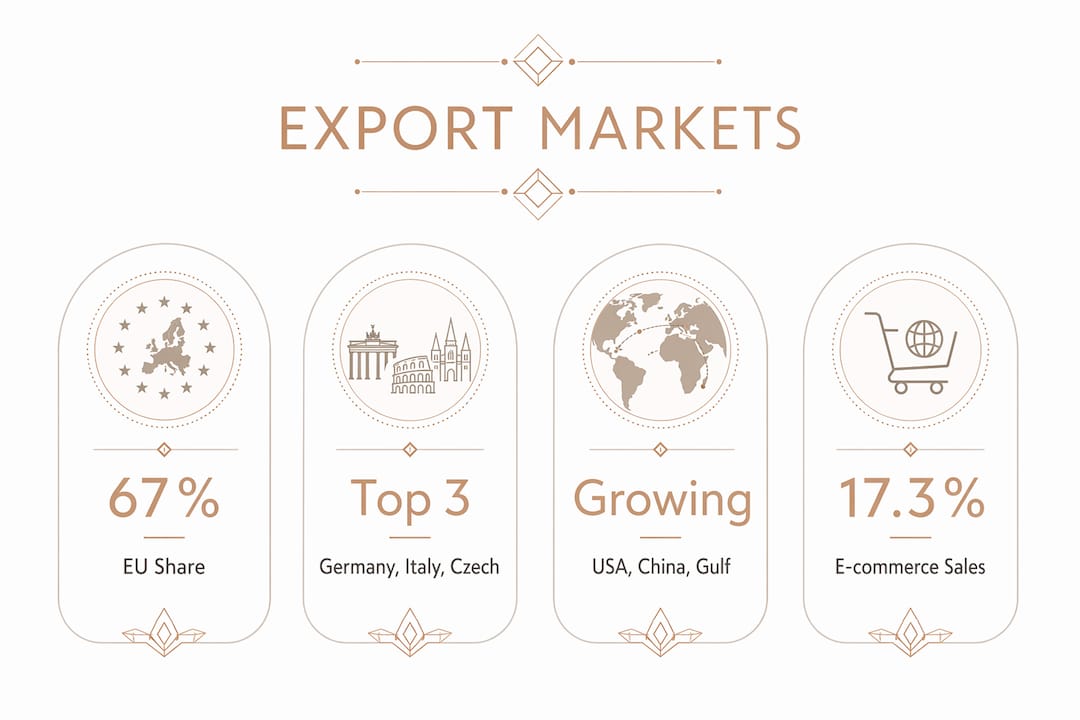
| Market | Share or status | Key driver |
|---|---|---|
| EU (total) | 67% of exports | Proximity, regulatory alignment, established supply chains |
| Germany | Top EU destination | Largest EU consumer market, strong retail infrastructure |
| Italy | Growing priority market | Premium positioning, Cosmoprof Bologna access |
| Czech Republic | Consistent EU partner | Geographic proximity, shared distribution networks |
| USA, China, Middle East | Expanding non-EU markets | Premiumisation demand, e-commerce growth |
Germany, Italy, and the Czech Republic collectively absorb the largest share of Polish exports within the EU. Italy deserves particular attention: Polish companies have actively used Cosmoprof Bologna to build distributor relationships in one of Europe’s most demanding beauty markets. Trade fair participation is not a branding exercise here. It is a direct pipeline to retail buyers who would otherwise take years to approach through conventional outreach.
Non-EU market expansion is accelerating. The USA, China, and Gulf states are all recording growth in Polish cosmetics imports, driven by rising demand for natural ingredient formulations and products with verifiable EU safety credentials. For buyers in these markets, the EU origin label functions as a quality signal that reduces perceived purchase risk.
The 67% EU concentration is both a strength and a vulnerability. Deep integration into European supply chains provides stability and repeat order volumes. It also means that any EU-wide economic slowdown, regulatory shift, or currency movement has an outsized impact on Polish export revenues. The industry’s current diversification push into non-EU markets is a direct response to this concentration risk.
Pro Tip: For analysts tracking export trends in Polish cosmetics, monitor the EU-to-non-EU export ratio annually. A sustained shift below 65% EU share would signal meaningful market diversification and reduced systemic risk for the sector.
How do industry structure and innovation contribute to export success?
The Poland cosmetics industry growth story is not a recent phenomenon. Exports have grown 11.4% annually since 2004, and the sector has maintained a positive trade balance for 23 consecutive years. Cosmetics export growth of 5.5% in 2024 outpaced general Polish foreign trade growth of 1.2% in the same year. That gap illustrates how the sector is structurally outperforming the broader economy, not simply riding a general export wave.
Four structural factors explain this sustained performance:
-
Dual manufacturing model. Polish companies combine contract manufacturing scale with premium brand development. Contract manufacturing generates volume and cash flow. Premium brand development builds margin and international recognition. This dual approach buffers the business against shifting buyer budgets and regulatory changes in any single market.
-
Premiumisation and natural cosmetics. Products featuring patented ingredients, sustainability claims, and natural formulations are gaining traction internationally. Premiumisation and natural cosmetics are driving higher average export values per unit, which matters more than volume growth for long-term margin health. Polish brands with collagen, algae, and botanical actives are particularly well-positioned for this trend.
-
Quality control and packaging compliance. International retailers, particularly in Germany and the UK, impose strict packaging, labelling, and shelf-life requirements. Polish exporters who have invested in automated quality control and multilingual packaging infrastructure win repeat contracts that smaller or less-prepared competitors lose.
-
R&D investment as the sector’s weak point. Investments in R&D, automation, and regulation are necessary to sustain export growth beyond marketing and product claims. The honest assessment is that R&D spending in Polish cosmetics remains below the levels seen in French or German counterparts. This constrains the sector’s ability to develop genuinely novel actives and patent-protected formulations, which are the highest-margin export categories.
Understanding what makes Polish skincare different from other European origins helps explain why international buyers return to Polish suppliers rather than switching to lower-cost alternatives.
What role does e-commerce play in Poland’s cosmetics export expansion?
Digital distribution is the fastest-growing channel for Polish beauty products export, and the 2024 data makes the scale of this shift concrete.
E-commerce accounted for 17.3% of Polish cosmetics sales in 2024, a figure that directly enhances export reach by removing the traditional dependency on physical retail infrastructure in target markets. A Polish brand that previously needed a German distributor and shelf space in a Frankfurt drugstore can now reach German consumers directly through a localised online storefront.
The practical implications for export growth are significant:
- Reduced market entry cost. Digital channels lower the capital required to test a new geographic market. A brand can launch in the UK or the Netherlands with a translated product page and a logistics partner before committing to a full distributor agreement.
- Faster consumer feedback loops. Online reviews and return data from international customers reach Polish manufacturers within days. This accelerates product reformulation and packaging decisions that would previously take months of distributor feedback to surface.
- Omni-channel logistics as a competitive differentiator. Polish exporters with fast replenishment logistics and reliable cross-border fulfilment win preferred supplier status with European e-commerce platforms. Logistics and distribution capabilities that ensure fast replenishment and regulatory compliance for global retailers are now as important as the product formulation itself.
- Digital marketing and brand recognition. Social commerce on platforms like TikTok and Instagram has given smaller Polish brands international visibility that was previously only accessible to companies with large advertising budgets.
Forecasts for 2026 and 2027 identify digital channels as a primary growth driver, with recommendations to expand e-commerce and premium private label segments specifically. For market analysts, the 17.3% e-commerce share is a floor, not a ceiling. Brands investing in digital infrastructure now are positioning for the next phase of Poland cosmetic market expansion.
Exploring how digital channels accelerate growth for Polish beauty brands provides a practical view of how this shift is playing out at the product level.
Key takeaways
Poland’s cosmetics export growth is structurally driven by low production costs, EU compliance infrastructure, a dual manufacturing model, and accelerating digital distribution, not by temporary pricing advantages.
| Point | Details |
|---|---|
| Export scale in 2024 | Poland reached EUR 6.0 billion in cosmetics exports, ranking 9th globally and 5th in the EU. |
| Core competitive advantage | Low energy intensity at 1.4% of costs and EU-compliant manufacturing sustain price-quality competitiveness. |
| Geographic concentration risk | 67% of exports go to EU markets; diversification into the USA, China, and the Middle East is accelerating. |
| E-commerce growth driver | Digital sales reached 17.3% of total cosmetics sales in 2024, reducing market entry barriers internationally. |
| R&D as the growth constraint | Limited R&D investment remains the sector’s primary obstacle to capturing higher-margin premium export categories. |
Poland’s export growth is real, but the next decade will be harder
I have been watching the Polish cosmetics sector for long enough to say this plainly: the growth figures are genuine, and the structural foundations are solid. But the narrative that Poland simply wins on cost is outdated and, frankly, dangerous for anyone making sourcing or investment decisions based on it.
The real story is that Polish manufacturers built a compliance and quality infrastructure over two decades that most lower-cost competitors cannot replicate in five years. That is the moat. The cost advantage is a bonus, not the strategy.
What concerns me looking at the 2026 data is the R&D gap. French cosmetics companies spend meaningfully more on ingredient research and patent development. German brands invest heavily in dermatological testing and clinical claims. Polish companies are catching up, but the premium export categories, the ones with 40% to 60% gross margins, still largely belong to Western European incumbents. Until Polish manufacturers close that gap, they will continue winning on volume and contract manufacturing while leaving the highest-value shelf positions to others.
The diversification push into the USA, China, and the Gulf is the right strategic move. But export success depends on logistics and distribution capabilities that ensure fast replenishment and regulatory compliance for global retailers. Those capabilities are expensive to build and slow to certify in non-EU markets. Companies that invest now will have a three to five year head start on those that wait.
My recommendation for analysts and buyers: watch the non-EU export share as the single most important leading indicator of whether Poland’s cosmetics sector is genuinely diversifying or simply riding EU demand cycles.
— Krzysztof
Discover Polish cosmetics at M-shop
The export growth driving Poland’s cosmetics reputation internationally is visible in the products themselves. Polish brands built for demanding European retail standards deliver the same quality to UK consumers through M-shop, a family-run specialist that selects products directly from Poland.
M-shop carries a curated range of Polish beauty tools and skincare products that reflect the quality standards behind Poland’s export success. The Donegal Chrome Charm tweezers are a precise example of Polish cosmetics manufacturing at its best, combining functional design with the quality control that earns Polish brands repeat orders from European retailers. Browse the full range at M-shop and experience the product quality that is driving Poland’s global cosmetics reputation, often at up to 15% off during sales.
FAQ
Why is Poland’s cosmetics export growing so fast?
Poland’s cosmetics exports grew to EUR 6.0 billion in 2024, driven by low production costs, EU-compliant manufacturing, and expanding digital distribution channels. The sector has maintained 11.4% annual export growth since 2004, consistently outperforming broader Polish trade figures.
Which countries buy the most Polish cosmetics?
Germany, Italy, and the Czech Republic are the top EU destinations, collectively accounting for the largest share of the 67% of exports that go to EU markets. Non-EU growth markets include the USA, China, and the Middle East.
How does e-commerce affect Polish cosmetics exports?
E-commerce accounted for 17.3% of Polish cosmetics sales in 2024, reducing the cost and complexity of entering new international markets. Digital channels allow Polish brands to reach consumers directly without requiring physical retail infrastructure in each target country.
What makes Polish cosmetics competitive internationally?
Polish cosmetics combine EU-standard quality with production costs that remain lower than Western European rivals, partly because energy represents only around 1.4% of manufacturing costs. Manufacturer-controlled value chains and strong regulatory expertise reinforce this competitive position.
Are Polish cosmetics popular in the UK?
Polish cosmetics are gaining recognition in the UK, particularly products featuring natural ingredients such as collagen and algae. Retailers like M-shop source directly from Poland to bring this quality to UK consumers, often at accessible price points.