



Descale in 15–20 Minutes: Citric Acid vs Vinegar for UK Appliances
Citric acid beats vinegar for most limescale jobs around the home, working faster and with far less lingering smell. Vinegar still earns its place for light, occasional descaling when that’s all you have to hand. Whichever you choose, check your appliance manual first, since some manufacturers restrict acid-based descaling to protect seals and warranties.
TL;DR:
- Citric acid descales kettles in 15 to 20 minutes, which is roughly half the time needed for vinegar, making it more efficient for quick cleaning.
- Its near-odorless property makes citric acid better suited for daily kitchen use, while vinegar’s strong smell lingers and can taint food products.
- Citric acid is generally cheaper per treatment in bulk and requires less storage space compared to bottled vinegar.
- It reacts faster with calcium carbonate due to its full dissociation and chelation ability, providing more effective limescale removal.
- Both acids should not be used on natural stone, aluminum, or sensitive rubber parts, and appliance manuals should be checked before use to avoid damage or warranty voiding.
Table of Contents
- Citric acid vs vinegar limescale removal: quick comparison
- Why does citric acid dissolve limescale faster?
- How to descale a kettle with citric acid step by step
- Which surfaces should you never clean with citric acid or vinegar?
- Citric acid or vinegar: pros, cons and when to choose each
- What concentrations and contact times actually work?
- Where to check before you start
- A practical note on choosing cleaning products
- Sources
- FAQ
Citric acid vs vinegar limescale removal: quick comparison
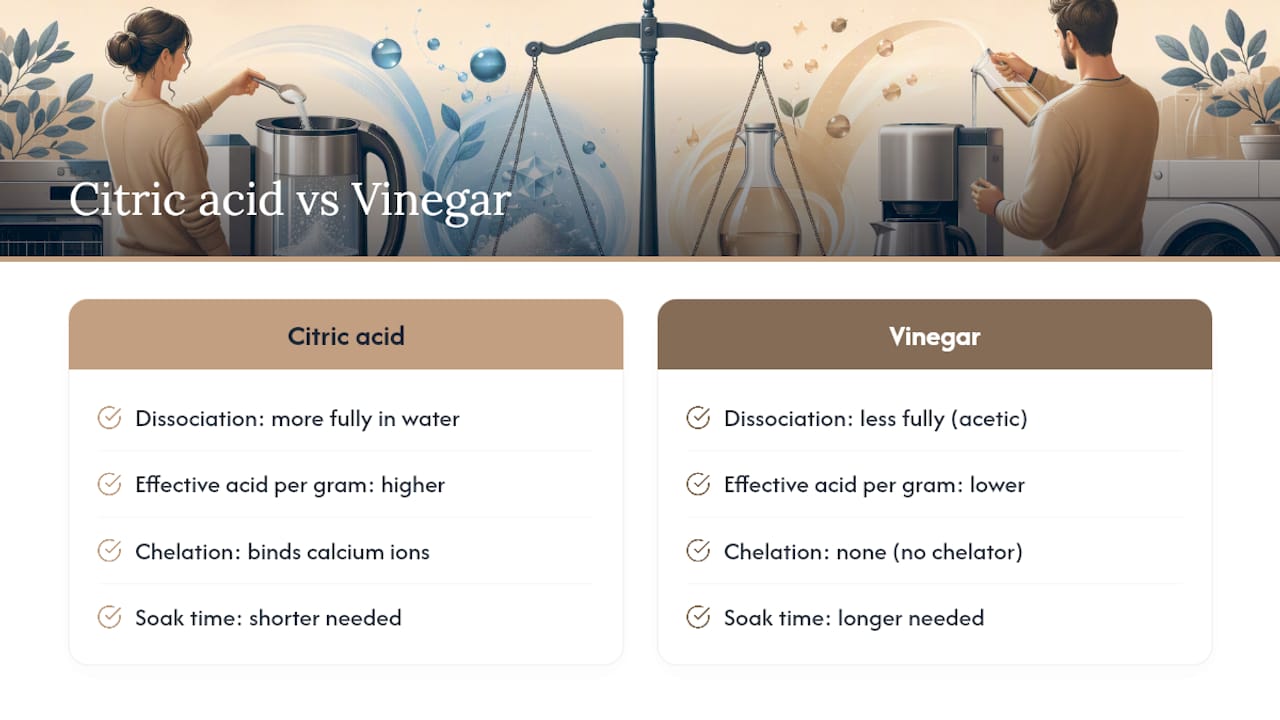
Citric acid generally wins on speed. Descaling a kettle with citric acid typically takes 15 to 20 minutes, while a vinegar soak for the same job often runs 30 to 60 minutes to shift comparable scale. That gap matters if you’re descaling before the school run rather than settling in for a weekend clean.
Smell is where the two really part ways. Vinegar’s sharp, sour odour clings to kitchens and can taint the next few brews from a coffee machine or kettle. Citric acid, used by home cleaners looking for a milder alternative, leaves barely a trace once rinsed.
- Speed: citric acid usually needs less contact time than vinegar for equivalent scale.
- Smell: citric acid is close to odourless; vinegar is pungent and persistent.
- Cost: bulk citric acid powder is often cheaper per treatment than bottled vinegar.
- Storage: powder measures out in grams and takes up little space; vinegar means storing bottles of liquid.
- Rule of thumb: reach for citric acid as your default, and keep vinegar as a backup for light scale when you’ve run out.
Why does citric acid dissolve limescale faster?
Limescale is mostly calcium carbonate, and acids break it down by reacting with the carbonate to form soluble compounds plus carbon dioxide, which is why you see fizzing on contact. How fast that happens depends partly on the acid’s strength, measured by its pKa value, a lower pKa meaning a stronger acid that releases hydrogen ions more readily.
Citric acid has three acidic groups and dissociates more fully in water than acetic acid, the active component in vinegar. On top of that, citric acid is a natural chelator: it grabs onto calcium ions and holds them in solution, stopping them redepositing as the water cools or evaporates. Comparative testing has found that citric acid releases more effective acid per gram than typical household vinegar, which is the main reason it needs a shorter soak. Warmth speeds up both acids, so a hot solution always clears scale faster than a cold one.
How to descale a kettle with citric acid step by step
Kettle: dissolve 15 to 30 g of citric acid in 500 ml of water, pour it in, and boil once. Let it stand for 15 to 20 minutes, then empty, rinse thoroughly, and boil a fresh batch of plain water before making a drink. Some kettle manufacturers, Tefal among them, specify around 25 g per 0.5 litre for their models, so check the manual if you have it.
- Mix the citric acid solution and pour it into the kettle.
- Boil, then leave to soak for the recommended contact time.
- Empty the kettle and rinse the interior at least twice with cold water.
- Boil plain water once more and discard before normal use.
Coffee machines are trickier: many manufacturers void warranties if you use anything other than their own descaler cartridges, so a bought descaling solution is often the safer route for warranty-sensitive machines. If your manual explicitly allows citric acid, use a weak solution and run it through the full cycle followed by two rinse cycles of plain water.
Washing machines benefit from an empty hot cycle with 100 to 150 g of citric acid added to the drum, run monthly in hard-water areas to keep the heating element and drum clear.
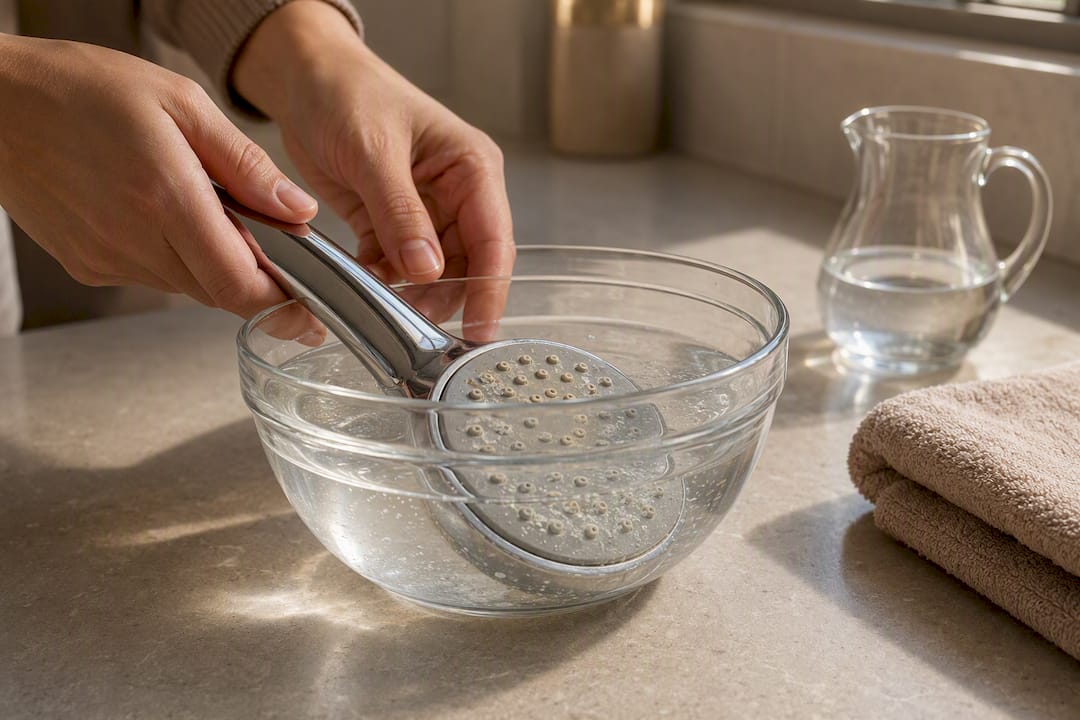
Showerheads and taps respond well to a soak: submerge the head in a citric acid solution for 30 to 60 minutes rather than spraying, since standing liquid reaches deposits inside the nozzle far more effectively than a surface spray.
Pro Tip: Never leave an acid solution in an appliance overnight. Extended contact can attack metal alloys and rubber seals, even at descaling-strength dilutions.
Always finish with a visual check and a rinse cycle; if scale remains visible, repeat rather than extending the first soak.
Which surfaces should you never clean with citric acid or vinegar?
Both acids are safe on most kitchen and bathroom fixtures, but a few materials react badly.
- Natural stone such as marble, travertine and limestone will etch permanently on contact with either acid, even brief exposure can dull the surface.
- Aluminium and some anodised coatings can discolour or pit with prolonged acid contact, so keep soaks brief and rinse fast.
- Rubber seals, gaskets and filters should be checked against the appliance manual, since manufacturers sometimes specify shorter contact windows for these parts.
- Products designed for tiles and grout are typically marked safe for glazed ceramic, porcelain, chrome and stainless steel, but not polished natural stone.
- Wear gloves, work in a ventilated room, dilute as directed, and pour used solution down a drain with running water rather than storing it.
Citric acid or vinegar: pros, cons and when to choose each
Citric acid’s biggest advantage is speed combined with almost no odour, which makes it the practical choice for kitchens used daily. Vinegar’s advantage is simplicity: it’s already in most cupboards, so it works as an emergency option when you’ve no citric acid on hand.
- Citric acid: fast, low smell, gentle on most non-stone surfaces, cheap in bulk.
- Vinegar: always available, cheap for occasional use, but slow and pungent.
- Manufacturer descaler: costs more but protects warranty on premium coffee machines and dishwashers.
Independent comparisons calculating acid strength per gram consistently rate citric acid as the more efficient dissolver of calcium carbonate than typical 5% vinegar, which is why most eco-cleaning guides list it first. For genuinely light, occasional scale, though, vinegar still does the job without a special trip to the shop.
What concentrations and contact times actually work?
The recipes above aren’t guesswork. They come from repeated small-scale comparisons of dosing and soak times across common kitchen appliances.
| Method | Concentration | Typical contact time |
|---|---|---|
| Citric acid | 15 to 30 g per 500 ml water | 15 to 20 minutes |
| Vinegar | diluted with water | 30 to 60 minutes |
The pattern holds across most tests: citric acid needs roughly a third to half the soak time that vinegar needs for similar scale build-up, largely down to its stronger acid dissociation. Always treat your appliance manual as the final word over any generic recipe, particularly for anything still under warranty.
Where to check before you start
For step-by-step kettle instructions, see this guide to descaling naturally and this UK hard-water breakdown. Check your appliance’s own manual before applying any acid treatment, especially on coffee machines still under warranty.
A practical note on choosing cleaning products
Citric acid earns its reputation the boring way: fewer surprises, less smell, faster results. That’s the same standard M-shop applies when curating home-care products alongside skincare, favouring what actually works over what’s simply familiar. If your appliance or surface falls outside the usual rules, check the manual first and treat product pages as a starting point, not gospel.
— Krzysztof
Sources
- How to descale your kettle and the best natural product to use
- How to descale a kettle properly (UK hard water guide)
- How to Clean a Kettle With Citric Acid: A Safe Step-by-Step Guide - CleanServant
- How to remove limescale better: vinegar, citric acid or a special descaler?
FAQ
Does citric acid descale better than vinegar?
Yes, for most household jobs. Citric acid typically clears kettle scale in 15 to 20 minutes versus 30 to 60 minutes for vinegar, thanks to its stronger acidity and chelating action on calcium.
What cleans better, vinegar or citric acid?
Citric acid generally cleans limescale faster and with less odour, while vinegar remains a reasonable backup for light scale. Independent comparisons rate citric acid as more efficient per gram at dissolving calcium carbonate than typical household vinegar.
Why are people avoiding citric acid?
Some households simply haven’t switched from vinegar out of habit, since vinegar is already in most kitchens. Citric acid also needs buying separately as a powder, though it’s widely available in UK supermarkets and brewing suppliers and works out cheaper per treatment once bought in bulk.
What should you not clean with citric acid?
Avoid natural stone entirely, since marble, travertine and limestone etch permanently on contact with acid. Also limit contact time on aluminium, certain coatings, and rubber seals, and always check the appliance manual before treating a warranty-covered machine.