



Cuticle Oil vs Cream: Which Is Better for Your Nails?
For most people, cuticle oil is the better daily choice, and cream is the best partner for it at night. Oil is thin, sinks in fast and reaches the nail itself. Cream is thicker, stays on the skin longer and seals moisture in. You do not have to pick one for life, but if you only buy one product, buy the oil. Polish nail oils are a good place to start, and we stock several at M-Shop, including NeoNail Vitamin Cuticle Oil.
TL;DR
- Oil is lighter, absorbs quickly and conditions both the cuticle and the nail. Use it once or twice a day.
- Cream is richer and sits on the skin for longer. It suits overnight use and very dry, rough skin.
- Best result: oil on bare cuticles, then your hand cream on top. Hand cream does not replace oil.
- Balm is the thickest option. It is usually a wax-and-oil mix that works like a cream.
- Cuticles that are red, swollen, painful or often bleeding need a doctor, not another product.
Table of Contents
- What the cuticle does, and why it dries out
- How cuticle oil works
- How cuticle cream and balm work
- Oil vs cream: the comparison
- Is oil really better than cream for cuticles?
- Oil, hand cream, or both?
- When to use which: a simple routine
- Flaky, white skin or just rough? Match the product to the problem
- What to look for on the label
- Polish cuticle oils worth knowing
- Why we recommend oil first
- Where to find them
- FAQ
- Sources
What the cuticle does, and why it dries out
The cuticle is the thin strip of skin at the base of your nail. A consultant dermatologist quoted by Women’s Health describes it as the nail’s protective seal, “like the grout in your shower”. When that seal cracks, bacteria can get in and cause paronychia, an infection with redness, swelling and tenderness.
Dry cuticles are common, and the causes are usually everyday ones. Healthline lists washing hands too often, hand sanitiser, nail polish remover, cold weather, nail-biting and simply not moisturising. In a British winter you can tick most of those by Tuesday. Central heating and frequent handwashing do the rest.
That is why the oil-or-cream question matters. The right product keeps the seal flexible so it does not split.
How cuticle oil works
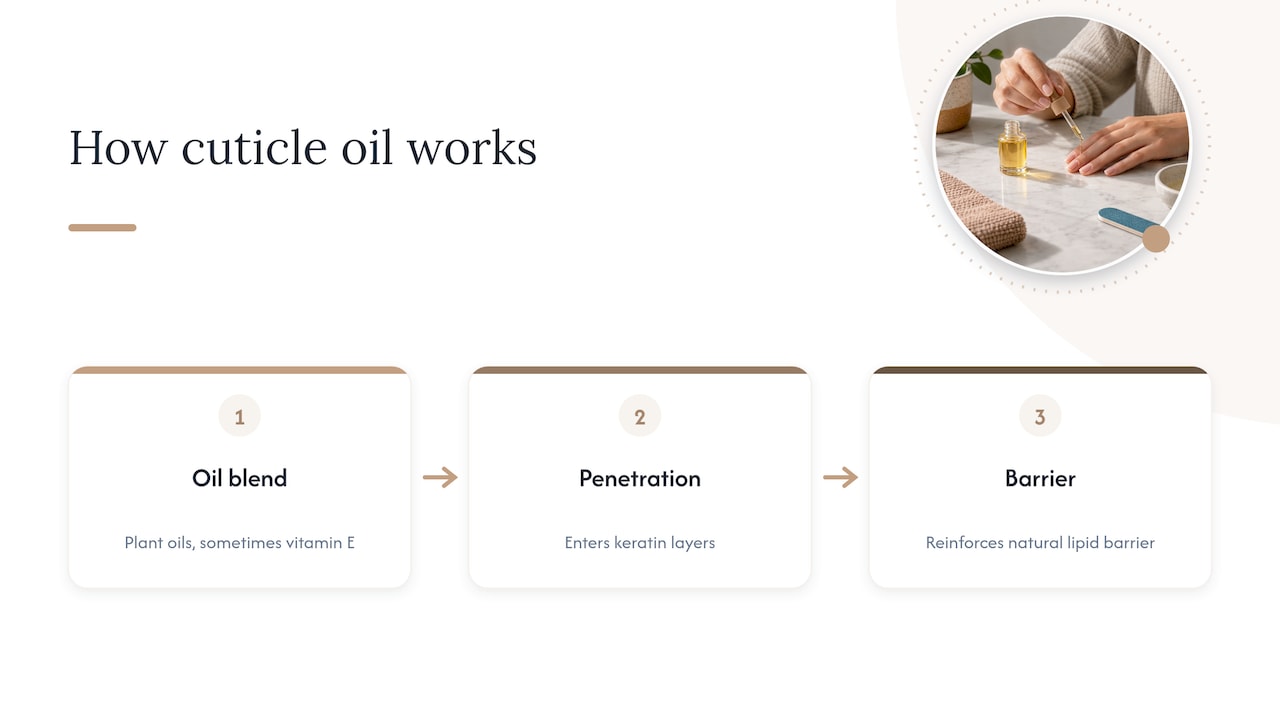
Cuticle oil is a blend of liquid plant oils, often jojoba, almond, avocado or sunflower, sometimes with vitamin E. The liquid is thin enough to move into the skin quickly and does not leave a heavy film.
The nail itself benefits too. Nails are built from layers of keratin that separate and weaken when they dehydrate. A nail artist quoted by Glamour UK explains that oil works by penetrating those layers and reinforcing the nail’s natural lipid barrier. She suggests oils rich in jojoba, vitamin E and almond oil, because they resemble the nail’s own oils.
Another reason oil is the daily favourite: Marie Claire UK says it keeps the skin around the nails moisturised to prevent breakage and hangnails, and keeps nails flexible so they bend rather than snap.
Best for: daily maintenance, brittle or peeling nails, anyone who wears polish or gel, and anyone who does not want greasy fingers during the day.
How cuticle cream and balm work
Cream is thicker. It combines butters, waxes and oils with some water, so it feels richer and stays put. Healthline describes cuticle cream as an emollient that nourishes and moisturises, and suggests looking for vitamins A, C and E along with almond or sunflower oil. Expert Reviews sums up the difference simply: oil is lighter and sinks in quickly, while cream feels richer and delivers moisture over a longer period.
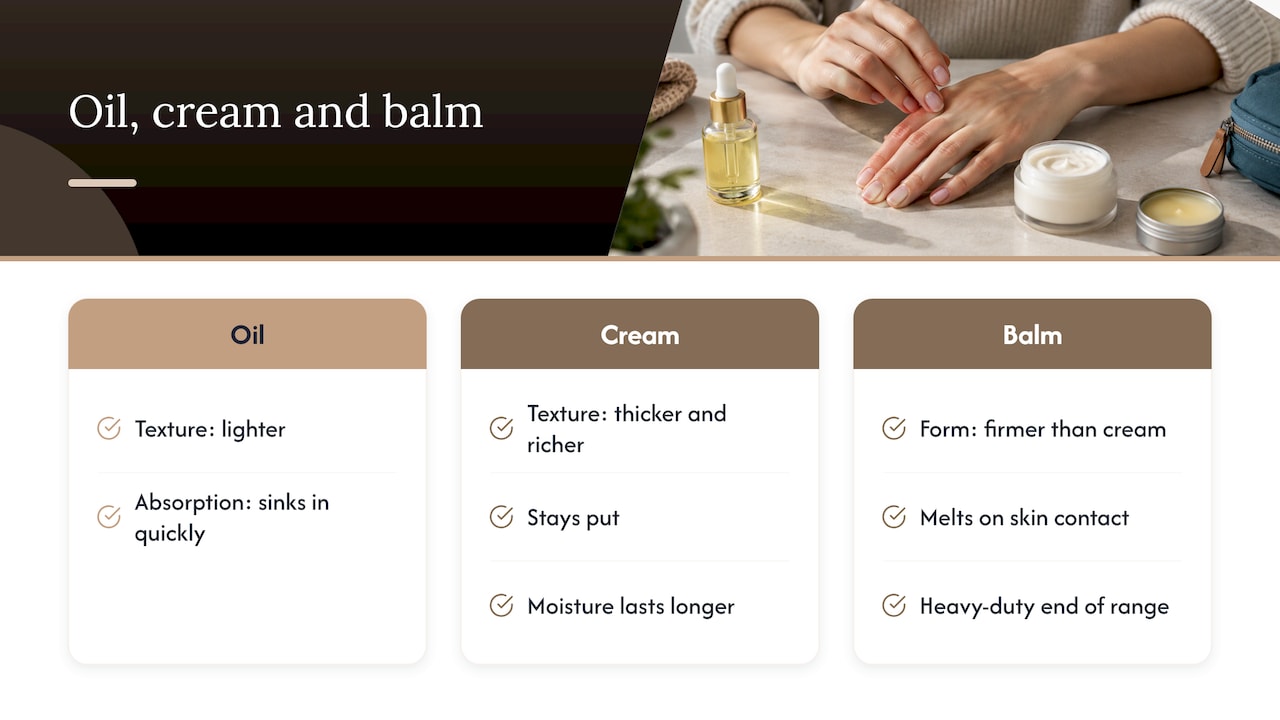
A balm is the same idea in a firmer form, usually a tin or stick that melts on contact with your skin. It has little or no water in it, so treat it as a cream-style product. Think of it as the heavy-duty end of the range.
Cream is not a lesser choice. A nail artist quoted by Byrdie says a cuticle cream can be just as restorative as a good oil, and that the choice is largely about texture. If you dislike the slippery feel of oil, cream is a perfectly good answer.
Best for: overnight treatment, very dry or rough cuticles, and people who prefer a thicker texture.
Oil vs cream: the comparison
| Cuticle oil | Cuticle cream or balm | |
|---|---|---|
| Texture | Thin, liquid | Thick, rich |
| Absorption | Fast | Slower, sits on the skin |
| Main job | Conditions cuticle and nail | Locks moisture in |
| Best time | Daytime and bedtime | Bedtime |
| Feel on hands | Light, slight sheen | Heavier, can feel greasy |
| Good for polish wearers | Yes, quick to absorb | Better kept for night |
| Portability | Pen, bottle or brush, easy to carry | Tin or tube, scoop or squeeze |
The pattern is clear. Oil wins on speed and on reaching the nail. Cream wins on staying power.
Is oil really better than cream for cuticles?
Experts do not all agree, and that is useful to know. A nail expert quoted by Byrdie prefers oils because creams are not absorbed as effectively by cuticle tissue. A dermatologist quoted by Women’s Health recommends a dedicated oil with jojoba because it absorbs faster than creams. WebMD reports dermatologists recommending thicker products such as ointments or creams, and notes that ointments are messy by day but fine at night.
Put those together and you get a practical rule rather than a contradiction. Oil is the best everyday tool because it absorbs quickly and works on the nail. Thicker products are best when the skin needs shelter, which usually means overnight. That is why the sensible routine uses both.
Oil, hand cream, or both?
Hand cream is made for the skin of your hands, and it does help with the feeling of dryness. It is not a replacement for oil, though. The manicurist quoted by Stylist says oil molecules are smaller than those in hand creams and can seep into the layers of the nail. Her comparison is memorable: using hand cream instead of cuticle oil is like expecting shampoo to do the job of conditioner.
A simple split works well:
- Through the day: hand cream after washing your hands.
- At night: cuticle oil first, so it can absorb and work for hours, then a thick layer of hand cream over the top.
That is also how the beauty editor at Marie Claire UK does it: oil several times a day, and always before bed under hand cream.
If your cuticles are very dry, you can go a step further with “nail slugging”. You seal everything in with a thick layer of petroleum jelly overnight, as described by Byrdie. Pull on cotton gloves if you do not want it on the pillow.
When to use which: a simple routine
- Wash or soak your hands. Moisture on the skin is what you want to seal in. Oil works best straight after hands have been in water, a point made by a nail expert in Byrdie.
- Apply one small drop of oil to each cuticle. More is not better. A drop per nail is enough.
- Massage it in across the cuticle, the nail plate and the skin at the sides. Massage helps absorption and circulation.
- Let it absorb before putting on hand cream or polish, as advised by Glamour UK.
- Repeat. Daily is ideal, and twice daily if your nails are very dry.
- At night, layer hand cream or a richer cuticle cream over the oil.
If you want a fuller weekly routine, including tidying the skin, we set out six steps in our cuticle care routine for UK hands. And if you are wondering whether a remover has a place beside oil, our guide to cuticle remover vs oil explains how they fit together.
Flaky, white skin or just rough? Match the product to the problem
Look at your cuticles before you pick a product.
- Tight, slightly rough, a bit peely: oil used daily is usually enough.
- Very dry, cracked or catching on clothes: add a rich cream or ointment at night over your oil.
- Brittle, splitting nails: oil is the priority, because it reaches the nail as well as the skin.
- Dryness that spreads over your hands: a good hand cream by day matters as much as the oil. If your whole body feels dull and dry in winter, a body scrub for dull skin can help you get your skin ready for moisturising.
One safety point. If the skin around a nail is sore, red, swollen or warm, that is not simple dryness. Healthline advises seeing a doctor if cuticles often bleed or look infected, with redness, swelling or pain. Book a GP appointment rather than adding more oil.
Also avoid cutting or tearing the cuticle itself. As the dermatologist in Women’s Health explains, it is the nail’s seal, and damaging it invites infection. Moisturising it is the safer route.
What to look for on the label
You do not need a long ingredients list. Four things are worth checking:
- Jojoba oil. Marie Claire UK points to jojoba because its lightweight properties let it penetrate the skin’s barrier.
- A blend of plant oils. A nail professional quoted by Expert Reviews recommends avocado, coconut and almond oils for nourishment.
- Vitamin E. The same expert says vitamin E formulas suit cuticles because vitamin E strengthens the nail bed.
- Shea butter, glycerin and ceramides in creams, which a consultant dermatologist at the Royal Free Hospital suggests in this expert guide.
Price rarely tells you more than the label does. Expert Reviews found that most products cost roughly £10 to £20 in its 2024 test, with the dearest at over £60. For a product you use every day, that is an argument for good value rather than a luxury price tag.
Polish cuticle oils worth knowing
Poland has a strong nail-care tradition, and its cuticle oils are formulated for daily use at friendly prices. At M-Shop we import directly from Poland, and our nail range includes:
- NeoNail Vitamin Cuticle Oil in a 6.5ml size, the straightforward daily choice.
- NeoNail Vitamin Cuticle Oil Intense for nails that need more.
- NeoNail Vitamin Cuticle Oil Soft and a floral-scented version, if you like a pleasant scent when you massage it in.
- Apis Night Fever Regenerating Oil for cuticles and nails with vitamin, a natural fit for the bedtime step.
- Eveline Nail Therapy Multi-nourishing Nail Oil with avocado oil.
A small bottle sits easily in a handbag or on a bedside table, so you will actually use it. That matters more than anything else on this page: the best cuticle product is the one you reach for every day.
Why we recommend oil first
We are a family-owned shop, and we choose what we sell with the same question we would ask for our own family: will you actually use it every day? For cuticles, that points to oil.
Oil is quick. You put a drop on each nail, massage it in, and you are done in under a minute. It sinks in rather than sitting on the surface, and it reaches the nail as well as the skin. Many of the Polish brands we import make exactly this kind of product, with vitamins and plant oils, and Polish customers often grew up with a bottle of nail oil in the bathroom.
Cream has a place too, and the best routine uses both: oil on bare cuticles, then your hand cream on top before bed. If you build the habit around a small oil you like the smell of, the rest follows. Many of our items come with discounts of up to 15% during sales, so it is easy to stock up and keep one by the sink, one by the bed and one in your bag.
Krzysztof
Where to find them
If you want a Polish cuticle oil delivered in the UK, you can browse the nail oils above or see the whole range, from skincare and hair care to bath and body, in the M-Shop store. Everything is selected by our family and brought in directly from Poland.

Many items are discounted by up to 15% during our sales, so it is worth checking the shop before you order.
FAQ
What is the best thing to put on your cuticles?
A cuticle oil with jojoba, almond or avocado oil is the easiest daily choice, because it absorbs quickly and conditions the nail as well as the skin. At night, add a richer cream, balm or petroleum jelly on top for extra protection. WebMD notes that the American Academy of Dermatology recommends petroleum jelly as an inexpensive option.
Is hand cream or cuticle oil better?
They do different jobs, so use both. Hand cream relieves dryness across your hands. Oil is made from smaller molecules that can seep into the nail layers, which is why a manicurist in Stylist calls hand cream the conditioner and oil the treatment. Oil goes on first, hand cream after.
Does cuticle cream actually work?
Yes, for dry cuticles. A cream is an emollient that moisturises and sits on the skin for longer, and Healthline lists cuticle cream and oil as the easiest ways to treat dryness. It works best when you use it regularly, especially overnight.
How often should I use cuticle oil?
At least once a day, according to Marie Claire UK. If your nails are very dry, twice a day suits them better. Apply it after washing your hands, and again at bedtime if you can.
What is the difference between cuticle balm and oil?
Oil is a liquid that absorbs fast. Balm is a thicker, firmer product that melts on the skin and stays there longer. Use oil by day and balm at night, or layer the two if your cuticles are very dry.
Sources
- Best cuticle oils and creams, Expert Reviews
- Dry Cuticles: Treatment, Causes, Prevention, Healthline
- Best Cuticle Oils, Marie Claire UK
- How To Apply Cuticle Oil, Glamour UK
- Best Products To Treat Dry and Damaged Cuticles, Stylist
- The 9 Best Cuticle Creams, Byrdie
- At-Home Nail Cuticle Care, Byrdie
- How to Care for Your Cuticles, Women’s Health
- Nails: How to Take Care of Your Cuticles, WebMD
- Best Cuticle Cream and Oil expert guide