



30–120 Second Rule: Cuticle Remover vs Oil for UK Nails
Use cuticle remover when dead, overgrown skin is sitting on the nail plate and needs softening away before polish or a tidy-up. Use cuticle oil every day, on skin that is otherwise healthy, to stop that dead tissue building up in the first place. Never apply either over broken, inflamed or infected skin. Rinse remover off exactly when the label says, then always follow with oil or a rich hand cream.
TL;DR:
- Cuticle remover is designed to loosen only dead tissue and should be used strictly within the product’s recommended contact time to avoid irritation.
- Daily cuticle oil helps prevent overgrown tissue by maintaining skin flexibility and should be part of a regular routine, not just used during manicures.
- Applying remover over broken, inflamed, or infected skin significantly increases infection risk and requires clinical attention instead of cosmetic treatment.
- Using a soft, non-metal tool to gently push back softened cuticles is safer than cutting or tearing, which can damage skin and lead to infection.
- The best routine combines occasional remover use only when necessary, with daily oil application and proper hygiene habits to support healthy nail and skin conditions.
Table of Contents
- Cuticle remover vs oil: roles, ingredients, speed and risk
- What is a cuticle remover and how does it work?
- What is cuticle oil and how does it help your nails?
- When should you reach for remover, and when for oil?
- How to use a cuticle remover safely, step by step
- How to build cuticle oil into your daily routine
- When cuticle care needs a clinician, not a cosmetic product
- What conventional nail advice gets wrong
- Two products worth keeping in your nail kit
- Sources
- FAQ
Cuticle remover vs oil: roles, ingredients, speed and risk
The two products aren’t interchangeable, and mixing up their jobs is where most home manicure mishaps start. Remover is a short-contact cosmetic treatment. Oil is a long-term conditioning habit. Put them side by side and the differences are stark.
- Primary purpose: remover chemically loosens dead cuticle tissue for cosmetic tidying; oil moisturises and conditions the living skin around the nail to prevent that tissue building up.
- Typical actives: removers commonly use low-strength alkaline agents or keratolytics such as potassium hydroxide, sometimes alongside gentler acids like lactic acid; oils rely on plant-based lipids such as jojoba, sunflower or avocado oil.
- Speed: remover works in minutes, softening tissue on contact for immediate use; oil works cumulatively, with benefits building over days and weeks of repeated application.
- Frequency: remover is an occasional, task-specific product, useful only when there’s visible excess tissue; oil is a daily or nightly habit regardless of how your cuticles currently look.
- Safety and follow-up: remover must be rinsed off within its stated contact time and followed by moisturiser; oil carries minimal irritation risk and is the correct aftercare step once remover has done its job.
- What it preps the nail for: remover clears the way for a neater polish line or manicure; oil keeps the surrounding skin flexible so hangnails and rough edges don’t reappear.
The practical read is simple. If you’re staring at flaky, overgrown skin encroaching onto the nail bed, that’s a remover job. If your cuticles look fine but feel dry, that’s an oil job, done before it becomes a remover job.
What is a cuticle remover and how does it work?
Cuticle remover works by chemically softening dead skin cells so they can be wiped or gently rolled away, rather than cut. That distinction matters more than most product labels let on: cutting the cuticle seal with scissors or a metal pusher opens a route for bacteria, while a remover simply loosens what’s already dead.
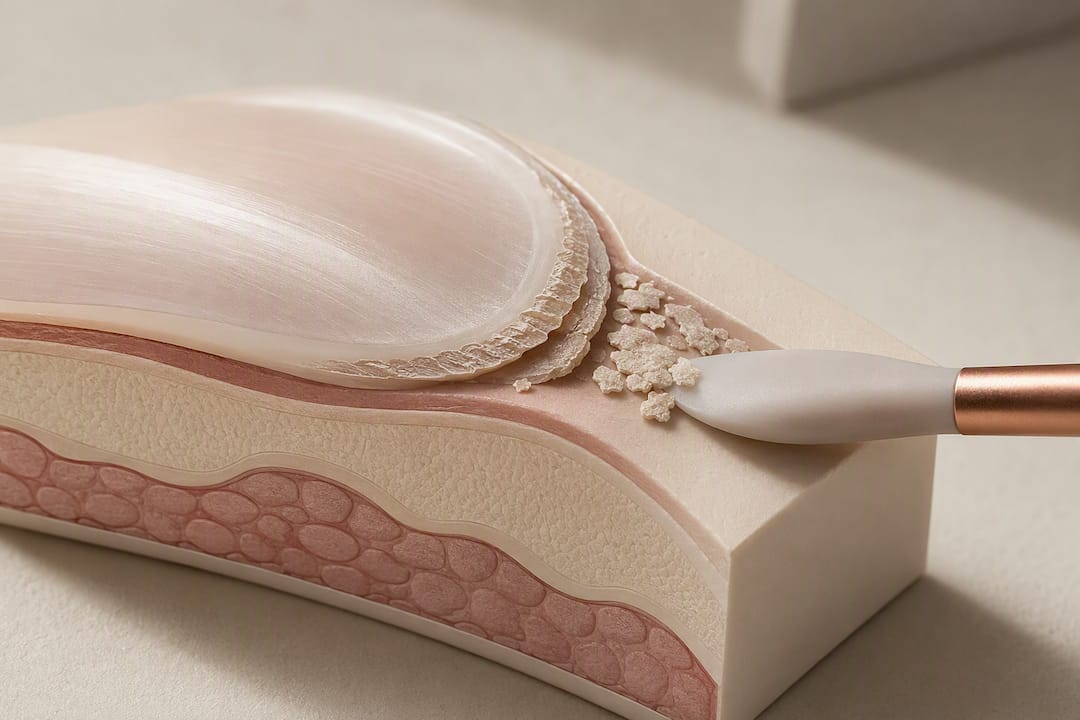
Most formulas lean on mild alkaline or keratolytic chemistry. Potassium hydroxide is one of the more common actives, and it’s specifically regulated in cosmetics because higher concentrations can cause real skin damage. An EU scientific opinion on potassium hydroxide as a callosity softener sets out why concentrations are capped and contact time restricted, precisely because this ingredient is effective at breaking down keratin but unforgiving if left on too long. Gentler alternatives, including lactic acid or urea based formulas, do a similar job more slowly and with a softer margin for error, which suits sensitive skin better.
The mechanism is exfoliation, not surgery. A remover swells and loosens the protein bonds holding dead tissue together. Once that’s done, even a soft, non-metal pusher can move it away without tearing living skin underneath.
Contact time is the part people get wrong most often. Industry safety review of these ingredients has flagged that prolonged skin contact with alkaline formulas increases irritation risk, which is why every remover bottle carries a specific timing instruction, usually somewhere between thirty seconds and a couple of minutes. Leaving it on “for good measure” doesn’t soften more tissue; it just irritates the skin around it. Applying it to skin that’s already dry, cracked or oily also throws off how the product behaves, which is one of the more common reasons people end up with redness after what should have been a routine step.
What is cuticle oil and how does it help your nails?
Cuticle oil is a leave-on conditioning product built to replace lipids in the skin around your nails, and it works by sitting on the surface and slowly absorbing rather than reacting chemically with anything. Jojoba oil mimics the skin’s own sebum closely enough to absorb fast without feeling greasy. Sunflower oil is rich in linoleic acid, useful for calming rough, flaky skin. Avocado oil sits heavier and suits particularly dry or cracked cuticles that need a thicker barrier overnight.
The benefit isn’t cosmetic polish, though that’s a welcome side effect. Consistently moisturised skin stays flexible, and flexible skin doesn’t split or catch on clothing the way dry skin does. That’s the actual mechanism behind fewer hangnails: you’re not treating the hangnail, you’re preventing the dryness that causes it. Nail plates also look and behave better when the surrounding skin isn’t cracked and pulling at the edges, which is part of why a coat of oil before polish tends to give a neater finish.
Berkshire Healthcare’s guidance on nail care backs this up directly: daily oiling and avoiding aggressive mechanical removal reduces hangnails and keeps nails more flexible over time. That’s the key word: over time. Oil doesn’t fix overgrown cuticles in one sitting the way remover can. It’s a slow, repeated habit that changes the baseline condition of your skin, which is exactly why it can’t substitute for remover when there’s already a build up of dead tissue sitting there.
When should you reach for remover, and when for oil?
Match the product to what’s actually in front of you, not to habit. A decision that takes ten seconds saves you from either over-treating healthy skin or under-treating a real problem.
- Preparing for a manicure or pedicure. If dead skin is visibly encroaching onto the nail plate and would spoil a clean polish line, a remover applied for its stated contact time clears the way.
- Routine daily maintenance. If cuticles look normal but feel dry or tight, skip remover entirely and apply oil. This is the default state most days should be in.
- Hangnails. Trim only the loose snag with clean nail scissors, never pull it, then follow immediately with oil to stop the surrounding skin drying out again.
- Chronic dryness. This calls for oil twice a day, possibly paired with a hand cream, rather than more frequent remover use. Reaching for remover here treats a symptom that oil actually prevents.
- Occasional overgrown cuticles with no redness or soreness. Use remover as directed, rinse thoroughly, then move straight into oil as the recovery step.
The combined routine, in order, looks like this: clean hands, remover only when there’s genuinely excess tissue to clear, a full rinse, then oil or a barrier cream to finish. Skipping the rinse or the oil step is where most irritation complaints come from.
How to use a cuticle remover safely, step by step
Getting the sequence right matters more than the specific brand you choose. A background routine echoed across NHS and dermatology guidance runs like this:
- Wash and dry your hands thoroughly before touching any product to your skin.
- Soften the skin first, ideally straight after a warm shower or a few minutes’ soak in warm water.
- Apply the remover exactly as the label directs, covering only the cuticle area, not the surrounding skin.
- Time it. Do not exceed the manufacturer’s stated contact window, even if the skin still looks slightly rough.
- Gently roll or push the loosened tissue away using a soft, non-metal tool such as a wooden stick or silicone pusher, never a sharp blade.
- Rinse or wipe the area completely clean, then dry and apply oil or a rich moisturiser straight away.
Use a single-use manicure stick where possible, or a pusher you sterilise between uses. Never share tools, and never force a dry, softened cuticle with pressure, since that’s how you tear living skin rather than remove dead skin.
Pro Tip: If you feel burning, stinging or notice redness spreading rather than fading within an hour, stop, rinse thoroughly, and skip remover on that finger next time. Persistent irritation is a sign the product was on too long or the skin underneath wasn’t as healthy as it looked.
Never apply remover over skin that’s inflamed, cracked or shows any sign of infection. The American Academy of Dermatology is explicit that cuticles should never be cut and should only be pushed back gently, after softening, never forced.
How to build cuticle oil into your daily routine
Oil earns its keep through repetition, not intensity. Apply it after washing your hands, since that’s when skin is most likely to feel tight and dry, and again at night before bed, when it has hours to absorb without being washed off or rubbed against fabric all day. Massage a small drop into each nail fold using circular pressure with your thumb. It takes about fifteen seconds per hand and makes a genuine difference to absorption compared with simply dabbing it on.
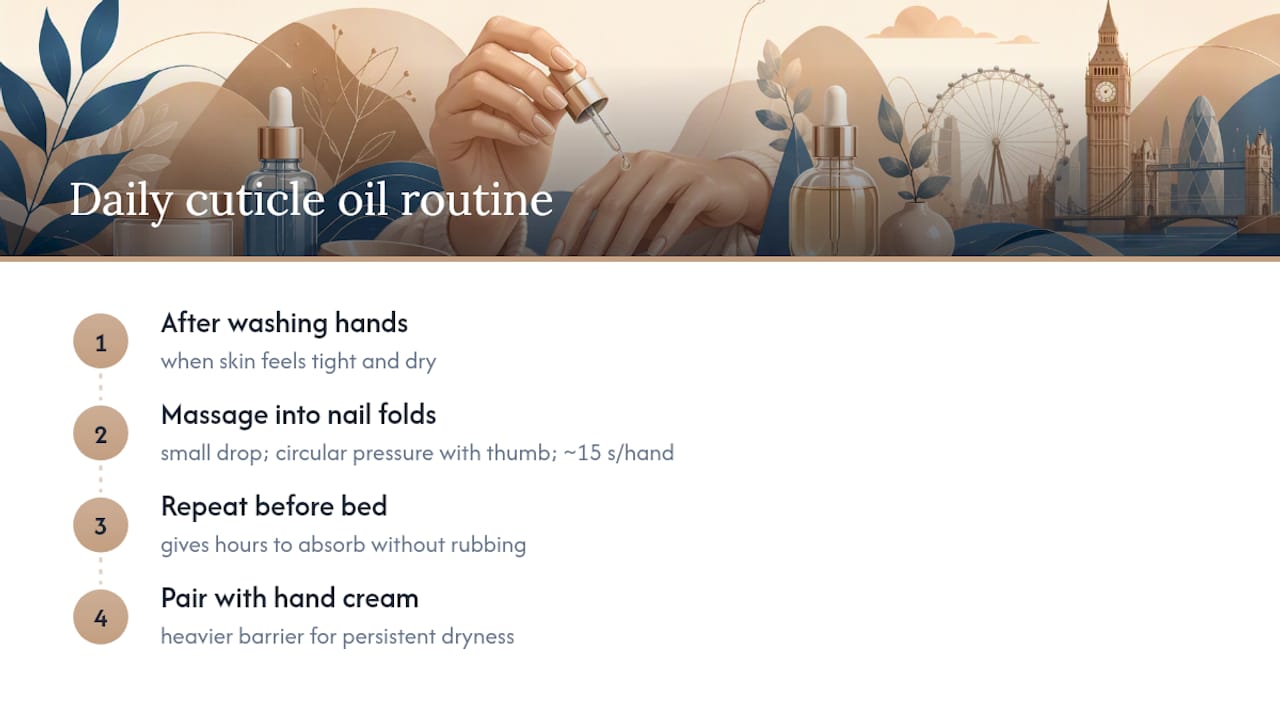
Pairing oil with a hand cream at night gives a heavier barrier for anyone dealing with persistently dry skin, particularly through winter. Dermatology sources are consistent on this: regular moisturising, including cuticle oils, is the primary preventive measure against the damage that leads people to reach for remover or scissors in the first place.
A few behavioural fixes matter as much as the product itself. Stop picking at loose skin, trim hangnails rather than tearing them, and patch test any new oil or cream on your inner wrist for a day before applying it near broken skin.
When cuticle care needs a clinician, not a cosmetic product
Swelling, pus, spreading redness or throbbing pain around a nail aren’t cosmetic problems, and no amount of oil or remover will fix them. These are the signs of paronychia, a nail infection that NHS clinical guidance advises should be assessed rather than treated at home. Warm salt water soaks help mild cases, but persistent or worsening infection often needs a course of antibiotics, and abscesses sometimes require drainage.
Cutting the cuticle seal is one of the more common ways people end up in this position. That thin strip of skin exists to keep bacteria out, and removing it deliberately, rather than gently softening and clearing already-dead tissue, raises infection risk for no real cosmetic benefit. If you notice pus, spreading warmth or pain that worsens rather than settles, stop all cosmetic treatment on that finger immediately and get it looked at.
What conventional nail advice gets wrong
Most cuticle care advice treats remover and oil as competing products, when they’re solving completely different problems. That framing pushes people towards whichever one is trending, rather than whichever one their skin actually needs that week.
The bigger issue is timing discipline. People are far more careless with contact time than with the product choice itself, and that’s where the real irritation risk sits, not in the ingredient list. A gentle remover left on twice as long as directed can do more damage than a stronger one used correctly.
What I’d prioritise first isn’t finding the “best” product. It’s building the habit of daily oil, because that’s what stops overgrown cuticles becoming a problem in the first place. Remover should be the exception you reach for occasionally, not a fix you rely on to undo weeks of dry, neglected skin. Treat it as maintenance for a problem, not a substitute for prevention.
— Krzysztof
Two products worth keeping in your nail kit
Once you’ve got the routine sorted, the products themselves are worth choosing carefully rather than grabbing whatever’s cheapest on the shelf. For daily hydration, Eveline Nail Therapy Multi-nourishing Nail Oil is built for exactly the after-wash and before-bed habit described above: a quick massage into each nail fold, absorbed fast enough not to leave hands greasy before you get on with your day.

For the occasional overgrown or noticeably dry cuticle that needs more than daily oil can manage, Paese Cuticle Milk is formulated specifically for that job, conditioning rather than aggressively stripping tissue away. Use it as the softening step before you gently clear dead skin, then follow straight away with the Eveline oil to lock in moisture. As with any new product going near broken or sensitive skin, patch test on your inner wrist first and give it a few days before applying near your nails properly.
M-shop is a family-run business bringing genuine Polish skincare into the UK, and every product listed carries its full ingredient information on the product page, so you can check exactly what you’re applying before you buy. Browse the wider skincare range if you want to build out a fuller hand and nail care routine alongside these two.
Sources
- CIR safety paper (industry safety guidance)
- Opinion on potassium hydroxide (KOH) as callosity softener/remover (EU publication)
- NHS Leicestershire clinical guidance (paronychia and nail infections)
- American Academy of Dermatology – Manicure and pedicure safety
- How to care for your cuticles, according to dermatologists and nail pros (Women’s Health)
FAQ
Why should you not push back your cuticles?
Pushing cuticles back forcefully, or cutting them, breaks the seal that keeps bacteria out of the nail fold. Dermatology guidance recommends gentle pushing only after softening, never cutting, and regular moisturising instead.
Why don’t nail salons do cuticles anymore?
Many salons have scaled back aggressive cuticle cutting because it raises infection risk without much cosmetic payoff. Current guidance from dermatologists favours gentle softening and pushing over cutting, which is why more salons now focus on conditioning rather than removal.
What happens if you leave cuticle remover on too long?
Leaving remover on beyond its stated contact time increases the risk of skin irritation, since the alkaline or keratolytic actives keep working on living skin once the dead tissue is gone. Industry safety guidance links prolonged contact directly to a higher chance of redness and discomfort. If this happens, rinse immediately and apply a soothing moisturiser.
Is it good to use a cuticle remover?
Cuticle remover is useful and safe when used correctly: applied only to healthy skin, for the exact time stated, then rinsed and followed by oil or moisturiser. It becomes a problem only when overused, left on too long, or applied to broken or inflamed skin.