



Fatty Acid Guide to Shea vs Cocoa Butter for Face, Body and Hair
For most faces and everyday moisturising, shea butter is the softer, more absorbent choice with lower pore‑clogging risk. Cocoa butter earns its place where you need a firm, long‑lasting seal against moisture loss, on heels, elbows, lips or in bars and sticks that must hold their shape. The exception that trips people up: refining grade changes both butters enough to flip a recommendation, and blending the two is often smarter than picking a single winner.
TL;DR:
- Shea butter is softer, more absorbent, and less likely to clog pores, making it ideal for facial use and daily skin hydration.
- Cocoa butter provides a firmer, occlusive barrier, making it better suited for very dry areas like heels, lips, and solid formulations that need to hold shape.
- Refining reduces both butters’ scent and nutrients, so unrefined versions offer more active compounds but have a shorter shelf life.
- Blending shea and cocoa butter allows formulators to balance melt behavior, texture, and firmness, often improving product performance.
- The choice of butter depends heavily on the skin part, desired texture, and formulation, not solely on the raw butter’s inherent properties.
Table of Contents
- Shea butter vs cocoa butter at a glance
- Why they behave differently: fatty acids, melting point and refining
- What each butter actually does for skin and hair
- Which to use where: face, body, hair and special cases
- How to substitute or blend shea and cocoa butter safely
- How to choose a product or grade: labels and sourcing cues
- The trade‑off nobody puts on the label
- Find the right shea or cocoa butter product on M-shop
- Sources
- FAQ
Shea butter vs cocoa butter at a glance
The two butters come from entirely different plants and it shows the moment you open the jar. Shea butter is pressed from the nut of the shea tree (Vitellaria paradoxa), native to West Africa, and unrefined versions carry a faint smoky, nutty smell. Cocoa butter comes from the roasted, pressed seeds of the cacao pod (Theobroma cacao), the same source as chocolate, which is exactly why it smells like chocolate in its unrefined state.
Texture separates them just as clearly. Shea is soft enough to scoop with a fingernail at room temperature and warms almost instantly on skin. Cocoa butter is hard and slightly brittle, closer to a solid chocolate bar than a body cream, and it needs real heat before it spreads.
Here’s the quick version for deciding what goes where:
- Face: shea butter, thanks to its lighter feel and lower comedogenic score.
- Body, especially dry patches: cocoa butter for heels, knees and elbows; shea for everyday all‑over use.
- Lips: cocoa butter, valued for its firm seal against chapping.
- Hair and scalp: shea butter for penetration and conditioning; cocoa mainly in bars and balms for hold.
- Structural formulations (soap bars, solid lotion bars, lip balm sticks): cocoa butter, because it sets hard and holds shape.
Comedogenic shorthand worth remembering: shea sits low on most comedogenic scales, cocoa butter sits moderate to high. That single fact explains most of the “which one for my face” debate before you even get to the chemistry.
Why they behave differently: fatty acids, melting point and refining
The difference between “melts into skin in seconds” and “sits there until you rub it in properly” comes down to fat chemistry, not marketing. Shea butter carries a higher share of oleic and linoleic acids, the same unsaturated fatty acids found in olive and sunflower oil, which is why it feels lighter and absorbs faster. Cocoa butter is dominated by stearic and palmitic acids, saturated fats that pack tightly together and sit on the skin’s surface longer, forming a firmer occlusive layer.
That fatty acid mix also explains melting behaviour. Cocoa butter has a sharper, more defined melting point, close to body temperature, so it holds a solid shape in the jar and then melts almost all at once against warm skin. That’s the “snap” chocolatiers rely on, and the same property that makes cocoa butter useful in solid balms and bars. Shea butter melts more gradually across a wider temperature range, which is why it never quite sets as hard and feels softer to the touch even straight out of the fridge.
A few numbers worth knowing:
- Shea butter is softer and higher in oleic acid, making it more absorbent and gentler on clogged pores.
- Cocoa butter is harder, more occlusive, and dominated by stearic and palmitic acids, the fats responsible for its firmness.
- Unrefined shea butter retains more of its characteristic scent and trace nutrients than refined versions, which are deodorised for neutral‑smelling formulas.
Refining changes more than the smell. Refined cocoa butter and refined shea butter both lose most of their natural aroma and some of the trace vitamin and phenolic content along the way. That trade brings a longer shelf life and a scent‑free base that plays nicely with added fragrance, but it also strips out some of what made the unrefined version distinctive in the first place. Cleveland Clinic notes that “cacao” often refers to a less-processed form than the cocoa butter used in most skincare, and refining removes aroma along with some trace nutrients. If you’re buying a butter specifically for its natural actives rather than as a blank canvas for other ingredients, unrefined is usually the better call.
What each butter actually does for skin and hair
Shea butter’s strongest evidence sits with basic dryness and barrier support. It’s rich in vitamins A and E and its fatty acid profile helps limit transepidermal water loss, the process by which skin loses hydration to the surrounding air. People with eczema often find it comforting on flare‑prone patches, though it isn’t a substitute for prescribed treatment. Peer‑reviewed literature on plant fats and skin barrier function backs shea most consistently for straightforward chronic dryness, while flagging that comfort from a moisturiser is not the same thing as treating inflammatory skin disease.
Cocoa butter’s case rests on sheer occlusion. Its fatty acid structure forms a thicker barrier on the skin’s surface, which is genuinely useful on areas that lose moisture fast, like cracked heels or windburned lips. It also contains polyphenols, plant compounds with antioxidant properties, though their skin benefit is modest compared with cocoa butter’s basic emollient function rather than a headline reason to choose it.
Where hair is concerned, the two butters split roles rather than compete directly:
- Shea butter penetrates hair shafts more readily and conditions without the heavy build‑up that weighs fine hair down.
- Cocoa butter shows up mainly in solid hair balms and bar‑format conditioners, where its hardness helps the product hold shape rather than doing heavy conditioning work on its own.
- Curly and coily hair types often do best with shea used sparingly, since a little goes a long way on strands prone to dryness.
Pro Tip: If a product lists fragrance high up the ingredient list alongside either butter, patch test on your inner forearm for 48 hours before applying it to your face. Added fragrance, not the butter itself, causes most reactions people blame on shea or cocoa butter.
Formulation matters more than most people expect. A “100% cocoa butter” balm behaves nothing like a cocoa butter body lotion cut with water and emulsifiers, and dermatologist commentary consistently stresses that both butters should support, not replace, medical therapy for diagnosed skin conditions. Read past the marketing claim on the front of the jar and check what percentage of the actual butter you’re getting.
Which to use where: face, body, hair and special cases
-
Facial skin. Favour shea butter as your default, particularly in a lightweight cream rather than a pure butter melt. If you’re prone to breakouts, be cautious with cocoa butter on the face altogether, since it sits higher on most comedogenic scales and can sit on top of oil‑prone skin rather than absorbing. Patch test any new product on your jawline for three to five days before working it into your full routine, watching for small bumps or persistent redness.
-
Body, dry patches specifically. This is cocoa butter’s home turf. Heels, elbows, knees and knuckles benefit from its heavier occlusive seal, especially applied straight after a shower while skin is still slightly damp. For the rest of the body, shea butter’s lighter feel makes it easier to layer under clothing without that greasy residue some cocoa formulas leave behind.
-
Lips. Cocoa butter is the better bet here, since lips have no oil glands of their own and need a firm barrier that survives talking, eating and weather. A cocoa‑based balm outlasts a shea‑only one in cold or windy conditions.
-
Hair and scalp. Reach for shea butter when you want actual conditioning and penetration into the hair shaft. Cocoa butter’s role is mostly structural, giving solid hair bars enough firmness to hold together, rather than delivering deep conditioning itself.
-
Eczema‑prone or highly sensitive skin. Unfragranced shea butter is generally the gentler starting point, though anyone with diagnosed eczema should treat either butter as comfort care alongside, not instead of, a dermatologist’s plan.
-
Babies and infants. Choose fragrance‑free, unrefined shea in small amounts and always patch test first; a baby’s skin barrier is thinner and reacts faster to new ingredients than adult skin.
-
Oily or acne‑prone skin. Skip cocoa butter on the face entirely and use shea sparingly, ideally in a cream that also contains lighter, non‑comedogenic oils rather than as a standalone thick layer.
How to substitute or blend shea and cocoa butter safely
Swapping one butter for the other in a homemade balm or cream isn’t a straight one‑for‑one job, because you’re also swapping hardness and melting behaviour. Cocoa butter needs melting in a double boiler before it will blend into anything; trying to mix it cold just leaves hard lumps. Shea butter, by contrast, whips easily at room temperature with a hand mixer, which is how most whipped body butters get their fluffy texture without any heat at all.
A few practical rules worth keeping in mind:
- Replacing cocoa with shea in a recipe that needs firmness (a lip balm stick, a solid lotion bar)? Add roughly 5 to 15% of a harder wax, such as beeswax or candelilla wax, or increase the proportion of another firm butter to compensate.
- Replacing shea with cocoa in something meant to stay soft and spreadable? Cut back slightly on liquid oils in the recipe, since cocoa butter’s extra hardness can otherwise leave the finished product too stiff to spread easily.
- Blending the two directly is common practice among formulators, since a small proportion of cocoa butter raises the overall melting point and helps a soft shea‑based bar hold its shape without losing shea’s lighter feel.
Pro Tip: Store any DIY blend in a cool, dark place. Unrefined shea in particular can turn gritty or develop an off smell faster than refined cocoa butter, which holds up longer thanks to its more stable fat structure.
If your recipe contains water, aloe gel or hydrosols alongside either butter, you’re making an emulsion, not a simple balm, and it needs a proper broad‑spectrum preservative. Skipping this step because “it’s natural” is how homemade creams grow mould within weeks rather than lasting months.
How to choose a product or grade: labels and sourcing cues
Reading the ingredient list properly saves you from buying the wrong grade for your needs. Shea butter appears on ingredient labels as Butyrospermum Parkii, while cocoa butter is listed as Theobroma Cacao Seed Butter. If either name sits buried near the bottom of a long list, the product contains only a trace amount, not enough to deliver the benefits discussed above.
Unrefined versus refined is the next decision, and it depends on what you actually want from the product:
- Choose unrefined when you want the fullest nutrient and antioxidant content and don’t mind a natural scent, whether that’s shea’s nutty note or cocoa’s chocolate aroma.
- Choose refined when you have sensitive skin that reacts to natural fragrance compounds, or you want a neutral base that layers cleanly under other scented products.
- Check the colour: unrefined shea is typically ivory to pale yellow; a bright white shea butter has usually been refined and bleached.
- Look for sourcing information where it’s available. Shea butter production supports thousands of West African cooperatives, and ethically sourced batches tend to carry fair‑trade or cooperative certification on the packaging.
- Always patch test a new product on your inner forearm and wait 48 hours before applying it to your face, especially with fragranced or unrefined versions.
- Store both butters away from direct sunlight and heat; cocoa butter holds up longer at room temperature, while shea benefits from a cooler spot if your home runs warm.
The trade‑off nobody puts on the label
Most comparisons treat this as a straight contest with a single winner, and that framing misses the real lesson: shea and cocoa butter aren’t competing for the same job. The genuinely useful question isn’t “which is better” but “better at what, and on which part of your body.” Shea’s oleic‑rich profile makes it the sensible default for faces and everyday use precisely because it does less, in the sense that it sits lighter and clogs fewer pores. Cocoa butter’s stiffer, more occlusive nature is a feature on a cracked heel and a liability on an oily forehead.
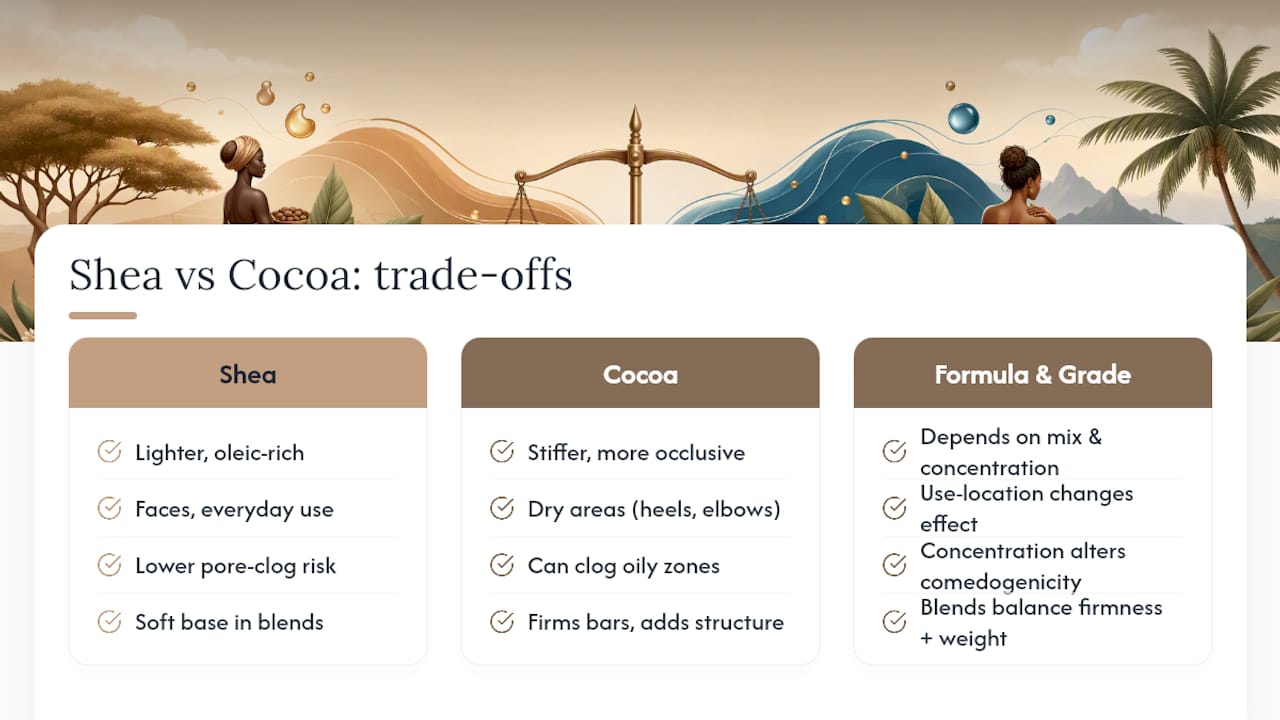
Where I think most buying advice goes wrong is treating comedogenicity as a fixed property of the raw butter rather than the finished formula. A cocoa butter balm cut with lighter oils and applied only to elbows behaves completely differently from a thick, unrefined cocoa butter smeared across an already oily T‑zone. The ingredient matters less than the concentration and the context it’s used in, and refining grade shifts that calculation again by trading nutrient content for a longer shelf life and gentler scent profile.
The blending option gets underrated too. Formulators reach for a mix of the two for good reason: a touch of cocoa butter firms up a soft shea‑based bar without making the whole product feel heavy. If you’ve been agonising over picking a single “best” butter, that’s often the wrong question. The better one asks what job the product needs to do, on which part of the body, and whether the grade on the label actually matches your skin’s tolerance.
— Krzysztof
Find the right shea or cocoa butter product on M-shop
Once you know which butter suits your skin, the next step is finding a formula that hits the right concentration and grade rather than guessing from a vague label. M-shop stocks Polish skincare brands that spell out their ingredients clearly, so you can check the INCI list before you buy rather than after a reaction.
For very dry areas that need cocoa butter’s occlusive strength, the Ziaja cocoa butter body balm gives a richer, longer‑lasting layer suited to heels, elbows and knees, while the Ziaja cocoa butter body lotion offers a lighter version for all‑over daily use without the heaviness of a pure balm. If your skin leans oily or acne‑prone and you’d rather steer clear of heavier butters on your face altogether, the Pharmaceris T sebostatic day cream is formulated specifically to normalise oilier skin without clogging pores. For anyone wanting to compare formulation choices further, M-shop’s own guide on layering body butter against lotion walks through when each texture actually earns its place in a routine. Whichever you choose, patch test on your forearm first and check the ingredient order before applying anything new to your face.
Sources
- Shea butter vs cocoa butter: One cracks, one melts
- Cocoa Butter vs. Shea Butter: Which Is Better for Your Skin?
- Cocoa butter: What it is, benefits & uses (Cleveland Clinic)
- PMC article relevant to plant oils and skin barrier (NCBI/PMC)
FAQ
Which is better for skin, shea butter or cocoa butter?
Neither wins outright. Shea butter suits facial and everyday use best thanks to its lighter, more absorbent feel and lower pore‑clogging risk, while cocoa butter performs better on very dry areas like heels and lips where you need a firmer, longer‑lasting seal.
Do black people use shea butter or cocoa butter?
Both are widely used across many communities and skin types, with shea butter having deep roots in West African skincare traditions specifically. Choice generally comes down to skin type and the part of the body being treated, not any single group’s preference.
Can I substitute cocoa butter for shea butter?
Yes, but expect a firmer, less spreadable result, since cocoa butter is harder and more occlusive than shea. In a homemade recipe, cut back slightly on other liquid oils to keep the finished texture from becoming too stiff.
What is the disadvantage of cocoa butter for skin?
Its heavier, more occlusive nature sits higher on the comedogenic scale, which makes it more likely to contribute to clogged pores or breakouts when used on oily or acne‑prone facial skin. It’s also harder and slower to absorb than shea, so it can feel greasy if applied too thickly.
Is shea butter or cocoa butter better for hair?
Shea butter generally works better for actual conditioning, since it penetrates the hair shaft more readily, while cocoa butter’s role tends to be structural, holding solid hair bars and balms together rather than deeply conditioning strands.