



What is drugstore skincare? Your UK guide for 2026
Drugstore skincare refers to affordable skincare products sold at everyday retailers that contain clinically proven active ingredients comparable to those found in luxury brands. The term “drugstore” is borrowed from American English. In the UK, the equivalent category covers products sold at Boots, Superdrug, and online retailers, often labelled as pharmacy or high street skincare. Brands like CeraVe, The Ordinary, and La Roche-Posay sit firmly in this category. They deliver retinoids, niacinamide, and ceramides at concentrations that dermatologists actually recommend, and they do it without the luxury price tag.
What is drugstore skincare and what makes it effective?
Drugstore skincare is defined by accessibility and price, not by a lower standard of formulation. The active ingredients that drive real skin results, including retinoids, niacinamide, and ceramides, appear in drugstore products at concentrations that match or closely mirror those in premium lines. This is not a coincidence. Drugstore brands are often owned by the same parent companies as luxury brands and share similar formulation expertise. L’Oréal, for instance, owns both the mass-market brand Garnier and the premium line Lancôme.
Regulatory standards in the UK and across the EU require that cosmetic products are safe and that any claims are substantiated. This means a drugstore moisturiser containing ceramides must actually contain ceramides in a functional form. The Ordinary built its entire brand identity on publishing exact ingredient concentrations, which forced the wider industry to be more transparent. That shift benefited every shopper looking for affordable skincare products with real results.
Clinical evidence supports the effectiveness of specific actives at specific doses. Drugstore serums with 10% niacinamide and 1% zinc reduce pores and oil production visibly within 2–4 weeks. That result does not depend on the price of the product. It depends on the concentration and your consistency in applying it.
“The primary difference between drugstore and luxury skincare lies in cosmetic elegance, not clinical results.” — Dr. Lauren Ploch, dermatologist
Pro Tip: When scanning a drugstore product label, look for the active ingredient listed in the top half of the ingredients list. Position indicates concentration. If niacinamide appears near the bottom, the dose is likely too low to produce visible results.
How does drugstore skincare compare to luxury brands?
The honest answer is that drugstore and luxury skincare produce comparable clinical results for most people. Dr. Lauren Ploch confirms that the performance gap between the two categories is largely about cosmetic elegance. Cosmetic elegance describes how a product feels on the skin, how it layers under makeup, and how pleasant the texture is. These factors matter for enjoyment and adherence, but they do not determine whether your skin barrier repairs itself.
Luxury products invest heavily in packaging, fragrance, and marketing. Those costs are passed on to the shopper. A £90 serum from a prestige counter and a £12 serum from Boots may contain the same 0.1% retinol. The prestige version may feel silkier and come in a weighted glass bottle. The clinical outcome for your skin, however, is driven by the retinol, not the bottle.
| Factor | Drugstore skincare | Luxury skincare |
|---|---|---|
| Active ingredient concentration | Comparable in most cases | Comparable in most cases |
| Clinical efficacy | Proven for key actives | Proven for key actives |
| Texture and feel | Functional, sometimes basic | Often refined and elegant |
| Packaging | Practical, minimal | Premium, weighted, decorative |
| Price per ml | Low | High |
| Transparency on concentrations | Variable | Variable |
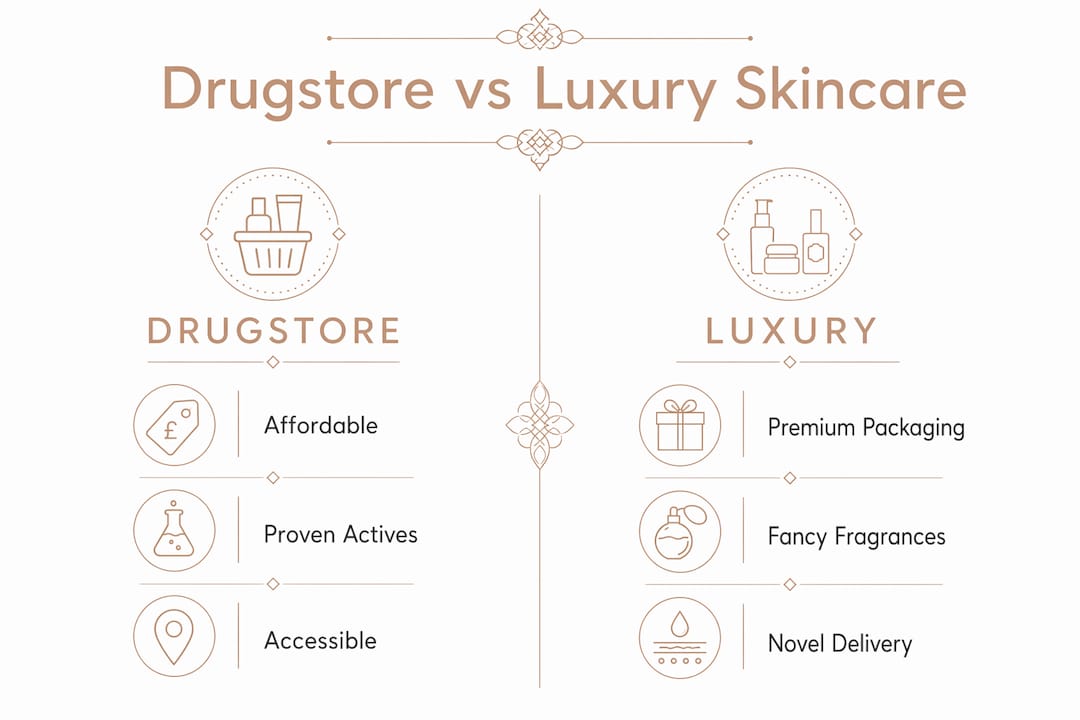
The one area where luxury products sometimes hold a genuine edge is in novel delivery systems, such as encapsulated retinol or liposomal vitamin C, which can improve stability and skin penetration. These technologies do occasionally trickle down to drugstore lines, but the gap exists. For most people building a solid daily routine, that gap is not worth the price difference.
How to build a drugstore skin care routine in the UK
A complete, effective drugstore skin care routine covers four steps: cleansing, treatment, hydration, and sun protection. A full routine using drugstore products can be built for the equivalent of under £80 total, with individual products costing under £15 each. That figure includes a cleanser, an active treatment serum, a moisturiser, and an SPF. For UK shoppers, this translates to brands like CeraVe, The Ordinary, Neutrogena, and Altruist.
Here is a practical daily routine structure:
- Cleanser. Use a gentle, low-pH cleanser morning and evening. CeraVe Hydrating Cleanser and La Roche-Posay Toleriane Hydrating Gentle Cleanser are both widely available at Boots and Superdrug. Use only a quarter-sized amount with lukewarm water. Over-cleansing strips the skin barrier regardless of how good the product is.
- Treatment serum. Apply your active ingredient here. The Ordinary Niacinamide 10% + Zinc 1% targets oiliness and enlarged pores. For anti-ageing, The Ordinary Retinol 0.2% in Squalane is a well-tolerated starting point.
- Moisturiser. Lock in hydration and support the skin barrier. CeraVe Moisturising Cream contains ceramides 1, 3, and 6-II alongside hyaluronic acid. It costs under £15 for a large tub.
- SPF (morning only). Altruist Dermatologist Sunscreen SPF 50 costs under £2 and is formulated by a dermatologist. Skipping SPF undoes the work of every other product in your routine.
For those building a complete step-by-step routine, product layering order matters as much as product choice. Apply from thinnest to thickest consistency.
Pro Tip: When introducing retinoids into your drugstore skin care routine, start twice weekly and build to nightly use over six weeks. This reduces the risk of irritation and peeling, which is the most common reason people abandon retinol prematurely.
Common misconceptions about affordable skincare products
The most persistent myth about drugstore skincare is that a lower price signals lower quality. This is false. Price reflects marketing spend, packaging costs, and brand positioning, not the potency of the active ingredients inside. Consistency in applying affordable, science-backed products is more important than product cost for long-term skin health. A £10 moisturiser used every day outperforms a £100 cream used twice a month.
A second misconception is that every product labelled with an active ingredient delivers a therapeutic dose of it. This is where caution is warranted. Drugstore packaging may highlight active ingredients without disclosing their concentrations. There is no regulatory requirement in the UK or US to publish exact percentages. A product can legally state “contains retinol” with a trace amount that produces no clinical effect.
The third myth is that night creams are a category worth investing in heavily. Dr. Engelman warns against unproven night creams and recommends relying on well-researched ingredients like OTC retinol for effective anti-ageing care instead. A plain moisturiser used at night alongside a retinoid will outperform most premium night creams with vague “renewal complex” claims.
Key myths to stop believing:
- “Drugstore means diluted.” Shared parent companies mean shared formulation science. Many drugstore actives match luxury concentrations.
- “Expensive products work faster.” Speed of results depends on the active ingredient and your skin type, not the price.
- “More products means better skin.” A four-step routine with proven actives beats a twelve-step routine of unproven products.
- “Natural always means safer.” Natural ingredients can cause allergic reactions. Efficacy depends on evidence, not origin.
Affordable products aid long-term adherence by removing financial barriers. Dermatologists consistently emphasise that the best skincare routine is the one you actually follow every day.
Key takeaways
Drugstore skincare delivers comparable clinical results to luxury products when it contains proven actives at effective concentrations, making consistency and ingredient knowledge the two most important factors for any UK shopper.
| Point | Details |
|---|---|
| Ingredients drive results | Retinoids, niacinamide, and ceramides work at drugstore prices when present at effective concentrations. |
| Price reflects packaging, not potency | The clinical gap between drugstore and luxury skincare is minimal; the cosmetic elegance gap is real. |
| Check concentration signals | Look for actives in the top half of the ingredients list; avoid products that name actives without dose hints. |
| Consistency beats cost | A £10 product used daily produces better long-term results than an expensive one used irregularly. |
| Build a four-step routine | Cleanser, treatment serum, moisturiser, and SPF cover every evidence-backed skincare need. |
Why I stopped feeling guilty about buying drugstore skincare
I spent years assuming that spending more meant caring more about my skin. That assumption cost me money and, frankly, produced no better results than what I use now. The turning point was reading the ingredient lists side by side. The ceramides in a CeraVe tub and the ceramides in a £80 department store cream are the same molecules. The skin does not read the price tag.
What I have found genuinely matters is picking products with disclosed or clearly signalled concentrations, introducing actives gradually, and not skipping SPF. The feel of a product matters too, because if you dislike the texture, you will stop using it. That is a legitimate reason to spend a little more on a formulation you enjoy. But it is a preference, not a clinical necessity.
The affordable European skincare brands available in the UK today, including Polish lines like Pharmaceris and Celia, offer genuinely well-formulated products at prices that make daily use sustainable. Sustainability is the point. Skin health is a long game, and the best routine is the one you can afford to maintain every single day.
— Krzysztof
Clinically backed skincare at M-shop: where to start
M-shop brings a curated selection of Polish skincare to UK shoppers, with a focus on clinically supported formulations at prices that make daily use realistic.

For those dealing with acne-prone skin, the Pharmaceris T Sebostatic Day cream combines anti-acne normalising actives with SPF protection in a single product, covering two routine steps at once. For mature or dry skin, the Celia Collagen + Algae 40+ cream delivers lightweight hydration with natural collagen and algae. Both products reflect M-shop’s approach: effective ingredients, transparent formulations, and prices that do not require a compromise. Many products carry up to 15% off during sales, making it straightforward to build an affordable routine without overspending.
FAQ
What does “drugstore skincare” mean in the UK?
Drugstore skincare is the American term for affordable skincare products sold at everyday retailers. In the UK, this covers products available at Boots, Superdrug, and online pharmacies, including brands like CeraVe, The Ordinary, and La Roche-Posay.
Is drugstore skincare as effective as luxury skincare?
For most people, yes. Dermatologist Dr. Lauren Ploch confirms that the primary difference between drugstore and luxury skincare is cosmetic elegance, not clinical results. Active ingredients like retinoids and niacinamide work at the same concentrations regardless of price.
What are the best drugstore skincare ingredients to look for?
Retinoids, niacinamide, ceramides, and hyaluronic acid are the most evidence-backed actives available in drugstore products. A serum with 10% niacinamide and 1% zinc produces visible pore and oil reduction within 2–4 weeks.
How do I know if a drugstore product has enough active ingredient?
Check the ingredients list. If the active ingredient appears in the top half of the list, the concentration is likely functional. Drugstore brands are not required to disclose exact percentages, so ingredient position is your best guide.
Can drugstore skincare for acne actually work?
Yes. Products containing niacinamide, salicylic acid, and SPF are clinically supported for acne-prone skin. Consistency matters more than price. A daily routine using affordable, targeted products will outperform an expensive but irregular one.