



What is import cosmetics saving? A UK guide
Import cosmetics saving is the financial advantage consumers and businesses gain by purchasing beauty products directly from international markets, bypassing the local retailer markups that inflate UK shelf prices. For UK buyers interested in Polish skincare, this means accessing brands like Pharmaceris and Donegal at prices significantly closer to their origin cost. Savings of 40 to 45% are achievable when buying directly from source markets rather than through local third-party resellers. The mechanics behind those savings involve freight forwarding, customs duties, HS code classification, and VAT calculations. Understanding each component is what separates a genuinely good deal from a costly mistake.
How do import cosmetics savings occur?
The core reason import cosmetics savings exist is a price gap between what a product costs at its origin and what a local retailer charges after adding logistics, storage, and profit margin. Local boutiques and beauty counters in the UK routinely add markups of 40 to 45% on top of the original manufacturer price. Buying directly from Poland or the US removes that layer entirely.
Several specific mechanisms drive these savings on imported cosmetics:
- Lower base prices at origin. Polish skincare brands such as Pharmaceris and Bielenda are priced for a domestic market with lower average wages and retail overheads. UK importers benefit from that structural price difference before any other factor is considered.
- Freight forwarding and consolidation. Consolidating multiple orders into a single shipment through a freight forwarder reduces the per-item shipping cost substantially, because freight forwarders charge a base fee per package rather than per product.
- Tax-free purchase addresses. Using a US-based freight forwarder address allows buyers to avoid US state sales tax, which can represent a 7 to 10% cost reduction before the item even leaves the country of origin.
- HS code optimisation. Accurate classification of cosmetics under the correct Harmonised System codes can save 5 to 12% in duty payments on products such as lipsticks and perfumes. That figure is not trivial across a regular order.
- Logistics efficiency. Businesses that reduce logistics costs by 30% through better freight management see those gains flow directly into their margins or passed on to customers.
Customs duties, VAT, and brokerage fees do eat into the gross saving. The UK charges 20% VAT on cosmetics imports, and orders over £135 attract customs duty on top of that. Calculating the total landed cost before purchasing is the single most important habit any importer can develop.
Pro Tip: Use an online shipping calculator to estimate VAT, import duty, and brokerage fees before you commit to any order. Underestimating destination costs is the most common reason a seemingly good deal turns out to be no saving at all.

Comparing costs: importing cosmetics vs buying locally in the UK
The real-world difference between importing and buying locally becomes clear when you put actual numbers side by side. Consider a Polish skincare product such as the Pharmaceris T Sebostatic Day cream, which retails in Poland for approximately £8 to £12 depending on the outlet. The same product, when stocked by a UK beauty retailer, typically sits at £18 to £22 after local distribution and retail margin are applied.
The table below illustrates a representative cost breakdown for a single imported item versus buying the equivalent locally.
| Cost component | Imported (from Poland) | Local UK retail |
|---|---|---|
| Product price at origin | £10.00 | N/A |
| Shipping and freight | £4.50 | Included in retail price |
| UK customs duty (where applicable) | £1.20 | Included in retail price |
| UK VAT (20%) | £3.14 | Included in retail price |
| Total landed cost | £18.84 | £20.00 to £22.00 |
| Estimated saving | £1.16 to £3.16 per item | Baseline |
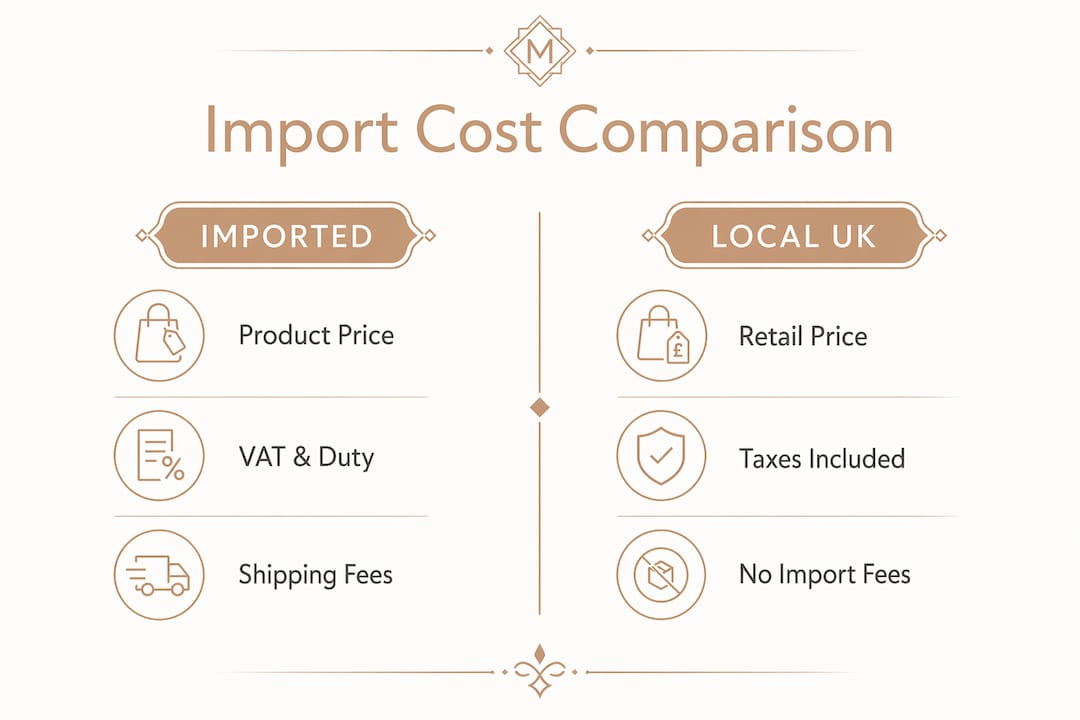
The saving on a single item looks modest. The picture changes dramatically when you consolidate a haul of ten or fifteen products into one shipment, because the fixed shipping and brokerage fees are spread across the entire order. Buying directly from origin markets consistently delivers authentic products at substantially lower prices once that consolidation effect kicks in.
Savings are maximised when you order high-value items, buy in volume, and choose products with low or zero customs duty rates. Savings shrink when you import a single low-cost item, because the fixed fees consume the price advantage. For Polish cosmetics specifically, many products fall under EU manufacturing standards that simplify UK import documentation post-Brexit, which reduces the risk of costly delays eating into your margin.
Pro Tip: If you are buying Polish skincare for personal use, aim for a minimum basket value of £60 to £80 before factoring in shipping. Below that threshold, the per-item logistics cost tends to cancel out the price advantage. Check the affordable European skincare guide at M-shop for curated options that make consolidation straightforward.
What practical steps can UK consumers take to maximise savings?
Knowing that import cosmetics savings exist is one thing. Capturing them reliably requires a repeatable process. The following steps reflect what experienced importers actually do, rather than what sounds good in theory.
- Use a freight forwarder for consolidation. Services that provide a foreign delivery address let you shop from multiple Polish or US retailers and combine everything into one outbound shipment. Package consolidation makes the total cost per unit significantly cheaper, particularly for value-sized beauty items where the product-to-weight ratio is favourable.
- Classify products with the correct HS codes. Incorrect HS codes are the most common cause of customs delays and financial penalties. Spend ten minutes confirming the right code for each product category before submitting your import declaration. A lipstick and a lip balm sit under different codes and attract different duty rates.
- Use proxy shopping services where needed. Some Polish retailers do not accept non-Polish payment cards or ship internationally. Proxy shopping platforms act as a local buyer on your behalf, then forward the goods to your freight forwarder address. This removes a common barrier without adding significant cost.
- Calculate total landed cost before every order. Add the product price, outbound shipping to the forwarder, international freight, UK customs duty, VAT, and any brokerage fee. Only the final number tells you whether the import cosmetic cost saving is real. Many buyers skip this step and are surprised at the border.
- Keep import documentation complete and accurate. Safety data sheets, ingredient lists, and proof of origin are required for cosmetics entering the UK. Missing paperwork causes delays that can add days or weeks to delivery and, in some cases, result in goods being held or destroyed.
The budget cosmetics haul checklist at M-shop is a practical reference for organising your order before you commit to shipping costs.
Pro Tip: Build a simple spreadsheet with columns for product price, shipping share, duty, and VAT. Run every potential order through it before purchasing. After two or three orders, you will have a reliable sense of which product categories deliver the best landed-cost savings.
What are the key challenges of importing cosmetics in 2026?
The advantages of importing cosmetics are real, but 2026 presents a more complex regulatory environment than previous years. Buyers who ignore these challenges risk turning a saving into a loss.
- De minimis exemption removed. Since the 2025 elimination of de minimis rules, virtually every international cosmetic shipment requires full customs clearance regardless of value. There is no longer a low-value threshold below which imports pass through unchecked. Every order, even a single moisturiser, now needs a formal declaration.
- Increased documentation requirements. Importing cosmetics now demands detailed safety and ingredient compliance documentation. UK customs authorities scrutinise cosmetic imports more closely than general merchandise, particularly for products containing active ingredients such as retinol, AHAs, or SPF compounds.
- VAT and duty on orders over £135. UK customs charges both import duty and 20% VAT on cosmetic orders exceeding £135 in declared value. Buyers who do not account for this in advance will face an unexpected bill at the point of delivery, which can wipe out the saving entirely on a mid-sized order.
- Misclassification penalties. Using the wrong HS code is not a minor administrative error. Penalties can be substantial, and repeat misclassification can trigger enhanced scrutiny on future shipments, adding time and cost to every subsequent order.
- Post-Brexit Polish cosmetic imports. Polish products no longer benefit from frictionless EU-to-UK movement. They are subject to the same third-country import rules as any non-UK product. That said, Polish manufacturers generally meet UK cosmetic safety standards, which simplifies the compliance documentation compared to imports from markets with different regulatory frameworks.
Understanding these challenges does not make importing impractical. It makes it manageable. Buyers who treat compliance as part of the cost calculation from the start consistently achieve better outcomes than those who treat it as an afterthought.
Key takeaways
Import cosmetics saving is real and repeatable, but only when total landed cost is calculated accurately and compliance requirements are met from the outset.
| Point | Details |
|---|---|
| Core saving mechanism | Bypassing local retailer markups of 40 to 45% is the primary driver of import savings. |
| Consolidation is critical | Combining multiple products in one shipment spreads fixed freight costs and maximises per-item savings. |
| HS codes matter | Correct classification saves 5 to 12% in duty and prevents costly customs delays or fines. |
| De minimis rules are gone | All shipments since 2025 require full customs clearance, regardless of order value. |
| Calculate before you buy | Total landed cost including VAT, duty, and brokerage fees must be confirmed before every order. |
Why import savings are changing how UK buyers shop for beauty
I have watched the UK beauty market shift noticeably over the past few years, and the import cosmetics conversation has moved from niche to mainstream faster than most industry observers expected. What used to be a strategy for dedicated beauty enthusiasts willing to navigate freight forwarders and customs forms is now something everyday shoppers are actively researching.
What strikes me most is how Polish skincare in particular has benefited from this shift. Brands like Pharmaceris, Bielenda, and Ziaja have strong reputations built on dermatological credibility and natural ingredients, including collagen and algae formulations, that hold their own against far more expensive Western European alternatives. When UK buyers discover they can access these products at prices closer to their Polish retail cost, the reaction is almost always the same: why did nobody tell me this sooner?
The honest answer is that the savings are genuine but not automatic. The removal of de minimis thresholds in 2025 added a layer of complexity that catches out buyers who assume small orders slip through unchecked. They no longer do. Anyone who has had a shipment held at the border because of incomplete documentation understands very quickly that compliance is not optional.
My view is that the buyers who will consistently benefit from import cosmetics savings in 2026 and beyond are those who treat it as a system rather than a one-off experiment. Build your landed-cost calculator, learn the HS codes for the product categories you buy regularly, and consolidate your orders. The savings are there. They just require a bit of discipline to capture reliably. For those who want the price advantage of Polish cosmetics without the import administration, M-shop offers a straightforward alternative worth considering.
— Krzysztof
Discover Polish cosmetics at M-shop without the import complexity
M-shop brings authenticated Polish skincare and beauty products directly to UK buyers, removing the customs paperwork, freight coordination, and compliance burden that direct importing requires. The range includes dermatologist-trusted brands available at competitive prices, with up to 15% off during sales.

Whether you are building an affordable skincare routine or looking for a specific product, M-shop’s family-run operation means every item is personally selected from Polish suppliers. The Pharmaceris T Sebostatic Day cream is one of the most popular choices for UK buyers seeking effective, affordable skincare with visible results. Browse the full range at M-shop and access the import cosmetics benefits of Polish beauty without the logistics overhead.
FAQ
What is import cosmetics saving in simple terms?
Import cosmetics saving is the cost difference between buying a beauty product directly from its country of origin and paying the inflated local retail price. The saving comes primarily from eliminating distributor and retailer markups, which can reach 40 to 45% on popular products.
How much can I realistically save importing cosmetics to the UK?
Savings depend on the product, order size, and logistics costs, but consolidating a multi-item order of Polish skincare can reduce the per-unit cost by 20 to 35% compared to UK retail prices once shipping, VAT, and duty are included.
Do I still pay customs duty on small cosmetics orders?
Yes. Since the removal of de minimis rules in 2025, all cosmetic shipments entering the UK require full customs clearance. Orders over £135 attract both import duty and 20% VAT regardless of the number of items.
Why are Polish cosmetics particularly good value to import?
Polish skincare brands are priced for a domestic market with lower retail overheads, and many use high-quality natural ingredients such as collagen and algae. The combination of strong formulations and lower origin prices makes them one of the better-value categories for UK importers.
What is the biggest mistake first-time cosmetics importers make?
The most common error is failing to calculate the total landed cost before purchasing. Shipping, VAT, customs duty, and brokerage fees must all be included. Buyers who only compare the product price at origin with the UK retail price routinely underestimate what the import actually costs.