



Buy bulk skincare products UK: the 2026 compliance guide
Buying bulk skincare products in the UK means sourcing wholesale quantities of cosmetics from suppliers who hold valid safety documentation, maintain authorised supply chains, and can demonstrate regulatory compliance under UK law. Whether you are stocking a salon, building a retail range, or simply reducing your cost per unit, the suppliers you choose and the paperwork they carry determine whether your products are legal to sell or use. Brands such as Naturally Balmy and Prime Skincare Ltd operate in this space, offering pre-assessed wholesale skincare that is ready to brand and resell. Getting this right from the start saves you from costly recalls, compliance failures, and wasted stock.
What compliance requirements must bulk skincare buyers understand?
Compliance is the single most important factor when you buy bulk skincare products in the UK. The rules are not optional, and they apply regardless of order size.

The UK Responsible Person
Every cosmetic product sold in the UK must have a designated UK Responsible Person (UK RP). This is the legal entity accountable for ensuring the product meets UK cosmetic regulations. The UK RP must maintain a Cosmetic Product Safety Report (CPSR), notify the relevant authorities, keep a Product Information File (PIF), and respond to any safety concerns promptly. If you are importing products from Poland or elsewhere in Europe, you need a UK RP in place before a single unit reaches a customer.
What is a CPSR and why does it matter?
A Cosmetic Product Safety Report is the core safety document for any cosmetic product sold in the UK. It confirms that the formulation has been assessed by a qualified safety assessor and is safe for its intended use. Without a valid CPSR, a product cannot legally be placed on the UK market. Bulk buying compliance depends on formulation-specific safety reporting, not simply on order quantity. Buying more units does not reduce your compliance obligations.
CPSR scope and product variants
One important detail that catches many buyers out: a single CPSR can cover multiple product variants if the formulation and skin exposure profile remain the same. Packaging differences and minor colour variations may fall under the same report. However, changes to the fragrance, preservatives, or allergen profile typically require a new CPSR assessment. This matters when you are ordering bulk skincare bundles with slight variations across a product line.
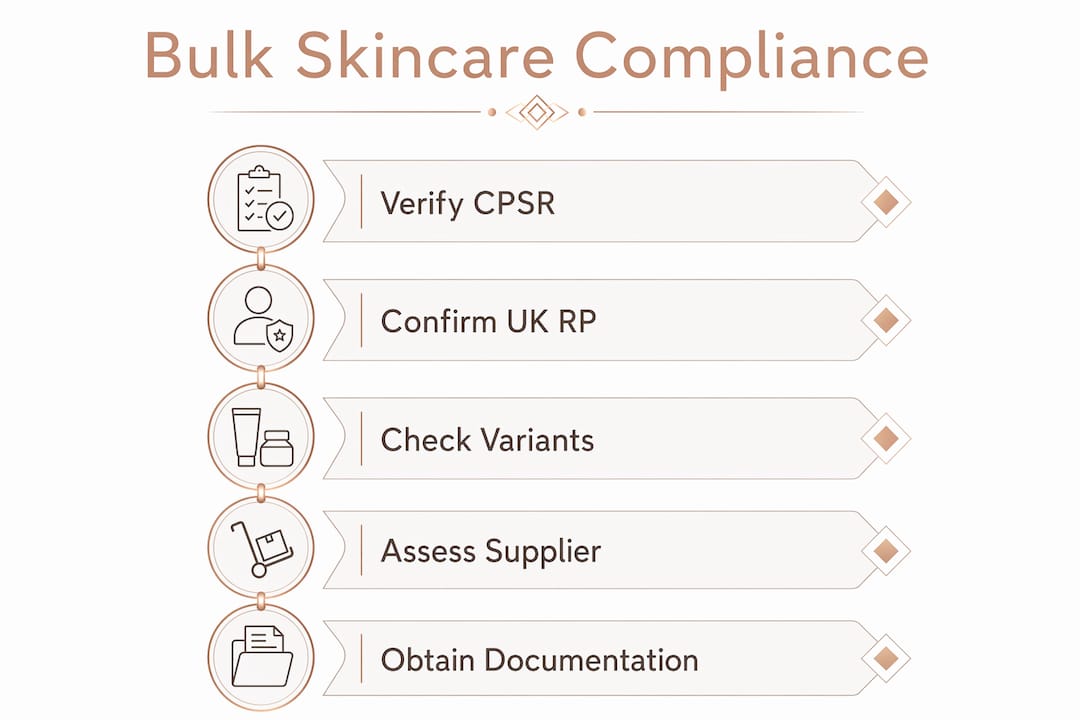
Key compliance documents to request from any supplier:
- CPSR covering the specific formulation you are purchasing
- Product Information File (PIF) including ingredient lists and manufacturing details
- Stability testing evidence confirming shelf life and product integrity
- UK Responsible Person details including contact information and registration
Pro Tip: Always ask a supplier to confirm in writing which product variants are covered by their CPSR. A vague answer is a red flag.
How to identify reliable UK bulk skincare suppliers
The wholesale skincare market in the UK includes a wide range of suppliers, from small artisan producers to large authorised distributors. Quality varies considerably, and marketing claims are not a substitute for documentation.
What to look for in a supplier
Start with compliance credentials. A trustworthy bulk skincare supplier will provide CPSR documentation without hesitation. Naturally Balmy, for example, offers a CPSR-approved range that is stability-tested and ready for branding, removing the need for buyers to commission their own safety reports. Prime Skincare Ltd positions itself as an authorised distributor offering competitive wholesale prices and UK-wide delivery. Both models represent legitimate routes into compliant bulk purchasing.
Evaluating product quality beyond the label
Marketing language is not evidence of quality. When assessing a supplier, request the following:
- Stability test results showing the product performs correctly across its stated shelf life
- Confirmation of the UK Responsible Person and their registration details
- Batch traceability records linking each unit back to its manufacturing run
- A sample order before committing to a large minimum order quantity (MOQ)
- Clear documentation of which ingredients are locked and which can be varied
Pro Tip: Cross-reference supplier claims against their actual documentation. If a supplier describes themselves as “authorised” but cannot produce a supply chain certificate, treat that claim with caution.
| Supplier type | Compliance support | Customisation | Best for |
|---|---|---|---|
| Pre-assessed wholesale (e.g. Naturally Balmy) | Full CPSR and stability testing included | Limited, within CPSR scope | Resellers wanting fast market entry |
| Authorised distributor (e.g. Prime Skincare Ltd) | Product-level compliance, buyer holds UK RP | None | Retailers buying established brands |
| Private label manufacturer (e.g. Wordsworth UK Ltd) | Buyer commissions own CPSR | High | Custom brand development |
| Flexible CPSR provider (e.g. Revega) | Frame formulation CPSR with locked ingredients | Moderate | Buyers wanting minor customisation |
What practical steps should you follow when buying in bulk?
A structured approach to wholesale skincare purchasing reduces errors and protects your investment. The steps below apply whether you are buying discount skincare in bulk for personal use or building a resale business.
-
Define your product requirements. List the skin types, product categories, and ingredient preferences you need. This narrows your supplier search and prevents you from being distracted by attractive products that do not fit your range.
-
Set your budget and minimum order parameters. Calculate your target cost per unit, your maximum upfront spend, and the minimum order quantity you can absorb. Compare low-MOQ pre-assessed options against custom private label routes, which typically require larger upfront commitments.
-
Verify CPSR coverage before ordering. Contact the supplier directly and confirm which formulations are covered by their CPSR, whether your intended variants fall within scope, and who holds the UK Responsible Person designation. Get this in writing.
-
Request samples and test for stability. Before placing a bulk order, test samples under realistic storage conditions. Check for separation, colour change, and odour drift over several weeks.
-
Negotiate pricing, delivery, and returns. Confirm lead times, delivery costs to your UK address, and the supplier’s policy on damaged or non-conforming stock. Document everything in a written agreement.
-
Maintain a compliance file. Store all CPSRs, PIFs, stability test results, and supplier correspondence in a single, organised folder. If you later rebrand or resell the products, this documentation is your legal protection.
| Purchasing stage | Key action | Document to obtain |
|---|---|---|
| Supplier selection | Verify CPSR and UK RP details | CPSR, UK RP contact |
| Sample evaluation | Test stability and skin compatibility | Stability test report |
| Order negotiation | Confirm MOQ, pricing, and delivery | Written purchase agreement |
| Compliance filing | Archive all safety documentation | PIF, batch records |
Common mistakes when purchasing bulk skincare and how to avoid them
Bulk skincare purchasing errors tend to cluster around compliance gaps rather than product quality failures. The most costly mistakes are preventable.
-
Assuming one CPSR covers everything. Buyers often purchase a range of variants assuming the supplier’s CPSR covers all of them. Formulation changes to fragrance or preservatives invalidate existing reports. Always confirm scope in writing.
-
Ignoring the UK Responsible Person requirement. Some buyers, particularly those importing from EU suppliers, assume the overseas manufacturer handles UK compliance. They do not. You need a UK RP designated before the product is placed on the UK market.
-
Skipping stability testing evidence. A product without stability test data may degrade before its stated expiry date. This creates safety risks and potential liability. Always request test results, not just a shelf-life claim.
-
Purchasing from suppliers without traceability. Authorised supply chains provide batch-level traceability. Suppliers who cannot trace a product back to its manufacturing batch are a compliance risk.
-
Overlooking fragrance and preservative details. These two ingredient categories most commonly trigger the need for a new CPSR. If a supplier offers to swap a fragrance at no extra cost, ask whether the CPSR has been updated to reflect that change.
“Compliance drift happens gradually. A small ingredient substitution here, a fragrance swap there. Before long, the product you are selling no longer matches the CPSR you hold. Change control is not bureaucracy. It is your legal protection.”
Pro Tip: When using flexible CPSR frameworks from providers like Revega, confirm which ingredients are locked and which are variable. Never substitute a locked ingredient without commissioning a new assessment.
Key takeaways
Buying bulk skincare products in the UK requires valid CPSRs, a designated UK Responsible Person, and documented supply chains before any product reaches a customer.
| Point | Details |
|---|---|
| CPSR is non-negotiable | Every product needs a valid safety report covering its specific formulation before UK sale. |
| UK Responsible Person is a legal requirement | Designate a UK RP before importing or reselling any cosmetic product in the UK. |
| CPSR scope covers variants carefully | Fragrance or preservative changes typically require a new assessment, even within the same product line. |
| Pre-assessed wholesale simplifies entry | Suppliers like Naturally Balmy offer CPSR-approved ranges that reduce compliance burden for new resellers. |
| Document everything | Maintain a compliance file with CPSRs, PIFs, and stability test results to protect your business. |
Why I think most bulk skincare buyers get the compliance question backwards
Most buyers I speak with treat compliance as the final step, something to sort out after they have chosen their products and negotiated their price. That is the wrong order entirely. The compliance question should come first, before you fall in love with a product or commit to a supplier.
The buyers who get this right focus on pre-assessed, CPSR-approved ranges when they are starting out. They accept slightly less customisation in exchange for a clear compliance path. Once they understand how CPSRs work and have a UK RP in place, they can move into more flexible options like frame formulations from providers such as Revega.
The other thing I have learned is that the lowest price is rarely the best value. A supplier offering steep discounts but vague documentation will cost you far more in the long run than one who charges a fair price and hands you a complete compliance file on day one. Build your affordable skincare routine around quality and compliance first. The savings follow naturally when you are not dealing with recalls or legal queries.
— Krzysztof
M-shop makes buying quality Polish skincare in the UK straightforward
M-shop sources high-quality Polish cosmetics directly for UK shoppers, with a focus on natural ingredients such as collagen and algae. The range includes products from trusted brands with visible results and competitive pricing, with up to 15% discounts available during sales.

Whether you are looking to stock up on a favourite formula or try something new, M-shop offers a carefully selected range suited to a variety of skin types and budgets. The Pharmaceris T anti-acne normalising cream is one example of a quality, ready-to-purchase product available through the store. For shoppers building a considered skincare collection, M-shop’s family-run approach means personal product knowledge and reliable UK delivery. Browse the full range at M-shop and find your next skincare staple at a price that makes sense.
FAQ
What does a UK Responsible Person do for cosmetics?
The UK Responsible Person ensures a cosmetic product meets UK safety regulations. They maintain the CPSR and Product Information File, notify authorities, and handle any safety issues that arise.
Can one CPSR cover multiple product variants?
A single CPSR can cover multiple variants if the formulation and skin exposure profile are identical. Changes to fragrance, preservatives, or allergens typically require a new safety assessment.
What is the difference between pre-assessed and private label bulk skincare?
Pre-assessed wholesale skincare comes with an existing CPSR, allowing buyers to brand and resell without commissioning new safety reports. Private label requires the buyer to fund their own formulation development and CPSR.
Where can I buy bulk skincare products in the UK with compliance support?
Suppliers such as Naturally Balmy offer CPSR-approved, stability-tested wholesale ranges. Authorised distributors like Prime Skincare Ltd provide established branded products with competitive wholesale pricing.
Do I need a CPSR if I am buying skincare for personal use only?
No. CPSR requirements apply when products are placed on the UK market for sale or professional use. Personal use purchases do not require you to hold compliance documentation.