



Ceramides vs peptides: what each does and how to layer both
Ceramides repair and seal the skin’s barrier; peptides signal deeper structural repair, prompting collagen and elastin production. They are not rivals fighting for the same shelf space. They work at different depths of the skin, which is exactly why using both, in the right order, tends to outperform picking just one.
The practical move is simple: apply a peptide serum first, while skin is still slightly damp and most receptive, then follow with a ceramide-rich moisturiser to lock everything in. Ceramides sit on top and slow moisture loss; peptides need to get in before that seal goes on.
Here’s a quick way to decide where to start if you’re pressed for time:
- Severe dryness, flaking, or a compromised barrier — reach for ceramides first and let the skin settle before adding anything else.
- Fine lines, sagging, or loss of firmness — bring peptides into the mix; they target structural signalling that ceramides don’t touch.
- Both concerns at once — layer peptide serum, then ceramide moisturiser, and give it several weeks before judging results.
- Sensitive or reactive skin — start with ceramides alone for a week or two, then reintroduce peptides gradually.
Key Takeaways
Ceramides repair the skin’s physical barrier with strong clinical backing, while peptides signal deeper structural repair with more limited but promising evidence, and using both in the right order beats relying on either alone.
| Point | Details |
|---|---|
| Different jobs, not rivals | Ceramides seal and protect the barrier; peptides signal collagen and elastin production. |
| Layer peptides first | Apply peptide serum on damp skin, then follow with a ceramide moisturiser to lock it in. |
| Evidence strength differs | Ceramides have solid RCT support; most peptide research is smaller-scale or in vitro. |
| Fix the barrier before adding actives | During flares or dryness, prioritise ceramides alone before reintroducing peptides. |
| Patch test and consult before injectables | Always patch test new actives, and speak to a clinician before considering any injectable peptide. |
| Where to buy well-formulated options | M-shop stocks Polish-made ceramide and collagen-support creams, including the Celia range, suited to mature and dry skin. |
Table of Contents
- Ceramides vs peptides: what ceramides actually do in the skin
- What peptides are and how they differ from ceramides
- How do ceramides and peptides compare side by side?
- What does the research actually show about benefits?
- How should you layer ceramides and peptides in a routine?
- Which should you prioritise for your specific skin concern?
- How do you spot an effective ceramide or peptide product?
- Are ceramides and peptides safe, and what myths should you ignore?
- What do the studies actually add up to?
- Why I’d rather see people combine these than debate which one “wins”
- Where to find ceramide and peptide skincare that actually delivers
- Where to read more on ceramides and peptides
- Frequently asked questions about ceramides vs peptides
- Sources
Ceramides vs peptides: what ceramides actually do in the skin
Ceramides are lipids. Specifically, they’re a class of sphingolipids that make up roughly half of the fatty material holding your outermost skin layer, the stratum corneum, together. Picture bricks and mortar: skin cells are the bricks, and ceramides are a major part of the mortar that keeps water in and irritants out.
That mortar has a precise recipe. Ceramides work alongside cholesterol and free fatty acids in a balanced molar ratio to form the lamellar structure that governs transepidermal water loss, or TEWL. Get that ratio badly out of balance, through ageing, harsh cleansers, or conditions like eczema, and the barrier leaks. Skin feels tight, looks dull, and reacts to things it used to tolerate fine.
This is where the clinical evidence genuinely stands out. Topical ceramide formulations have shown measurable benefit in randomised controlled trials for atopic dermatitis and TEWL reduction, giving ceramides one of the stronger evidence bases of any barrier ingredient on the market. That’s not a small claim in skincare, where most “clinically proven” claims rest on a single small trial funded by the brand itself.
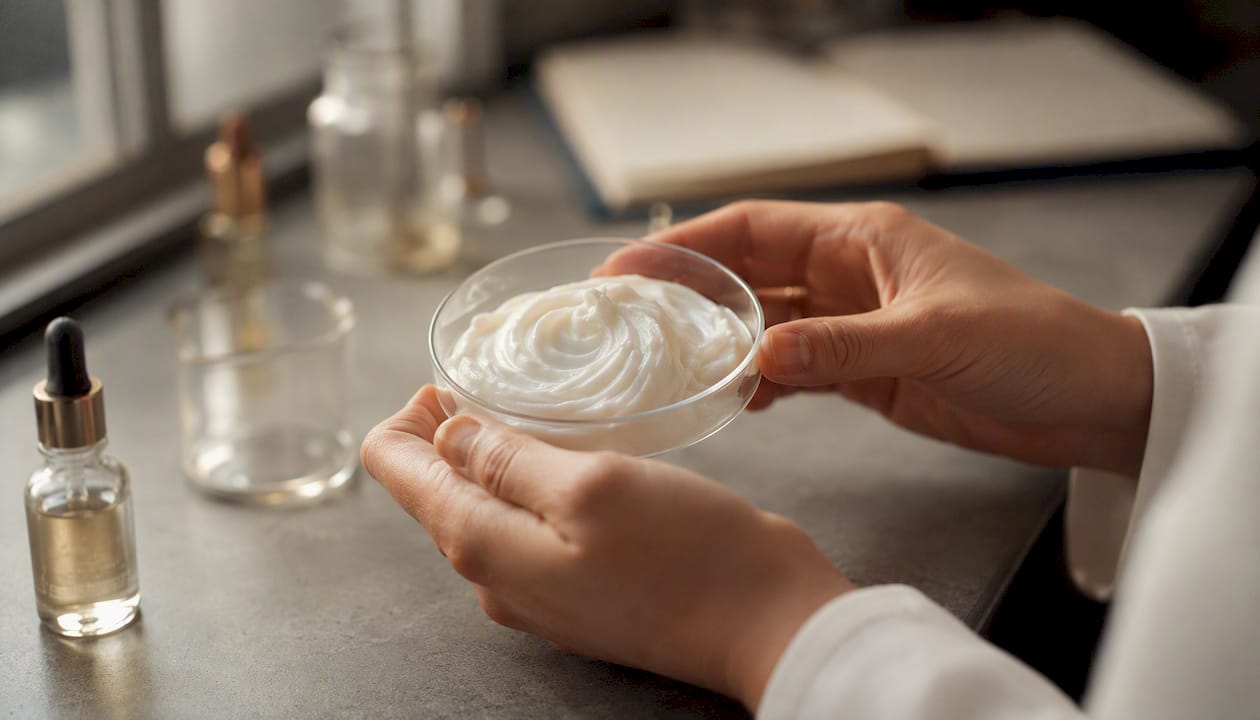
Where you’ll find them: ceramides show up most often in creams, barrier balms, and richer emollients rather than watery serums, because the vehicle they’re carried in matters enormously. A ceramide dissolved in a silicone-heavy, occlusive-only base may sit on the skin’s surface without ever intercalating into the lipid matrix it’s meant to repair. Formulation quality, not just the ingredient list, decides whether a ceramide product does anything at all.
Pro Tip: Look for ceramide creams that also list cholesterol and fatty acids nearby on the ingredients list. That trio working together is what mimics your skin’s own barrier chemistry, rather than one lipid working alone.
What peptides are and how they differ from ceramides
Peptides are short chains of amino acids. Where ceramides physically patch the barrier, peptides act as messengers, essentially tapping skin cells on the shoulder and telling them to behave as though they’d been injured, triggering the collagen and elastin production that follows real wound repair.
Cosmetic peptides fall into a handful of functional families, and knowing which is which helps you read labels with some confidence:
- Signal peptides — encourage collagen synthesis by mimicking fragments of collagen breakdown.
- Carrier peptides — deliver trace minerals like copper to support enzyme activity in skin repair.
- Neurotransmitter-inhibiting peptides — soften the look of expression lines by limiting muscle contraction signals, similar in concept (though far milder) to injectable treatments.
- Enzyme-inhibiting peptides — slow the breakdown of existing collagen rather than building new collagen.
The honest caveat, and the one most peptide marketing glosses over: penetration is a real hurdle. Many functional peptides, including common ones like palmitoyl pentapeptide-4, sit above the roughly 500 Dalton threshold generally considered the ceiling for passive penetration through intact skin. Formulators get around this with tricks like palmitoylation, attaching a fatty acid tail so the peptide can slip through the lipid barrier more easily, or encapsulation in liposomes. Whether any given product does this well is rarely obvious from the label alone.
That’s also why calibrated expectations matter here. Promising mechanistic data on peptides exists, but meaningful dermal collagen synthesis from topical peptides in healthy human skin hasn’t been established at scale the way ceramide barrier repair has.
Pro Tip: A peptide’s position on the ingredients list matters. If it’s buried in the last third of a long INCI list, it’s likely present at a concentration too low to do much. Meaningful peptide products tend to feature them in the first half.
For a fuller breakdown of which peptide formulations tend to earn their price tag, M-shop’s guide to peptides in affordable skincare is worth a look.
How do ceramides and peptides compare side by side?
| Dimension | Ceramides | Peptides |
|---|---|---|
| Primary function | Physically restore the lipid barrier, reducing water loss | Signal skin cells to produce collagen and elastin |
| Best for | Dryness, barrier damage, eczema-prone or reactive skin | Fine lines, loss of firmness, early signs of ageing |
| Common forms | Creams, balms, occlusive moisturisers | Serums, lightweight lotions |
| Evidence strength | Strong, backed by RCTs in barrier repair and TEWL | Mechanistically plausible, but mostly small studies or in vitro data |
| Compatibility with actives | Pairs well with almost everything, including retinoids | Generally compatible; best kept separate from strong acids or high-strength retinoids at first |
| Tolerance profile | Very low irritation risk | Well tolerated, though efficacy varies hugely by formulation |
On raw evidence, ceramides win outright for barrier repair. On concept, peptides have a compelling mechanism, but the human trial data simply isn’t at the same stage yet, a gap that comparative reviews consistently point out.
A few things worth taking from that table:
- Neither ingredient blocks the other, so there’s no chemical reason to choose one over the other permanently.
- Ceramides are the safer bet if you only have budget or shelf space for one product right now.
- Peptides are worth adding once your barrier is in reasonable shape, not before.
What does the research actually show about benefits?
The strongest, most repeatable finding in this whole comparison is that topical ceramide products reduce transepidermal water loss and improve symptoms in atopic dermatitis across multiple controlled trials. That’s a rare thing in skincare: an ingredient class with genuinely consistent clinical backing rather than a single flattering study.
Peptides sit in a different evidence category entirely. Most of what we know comes from smaller cosmetic trials and in vitro cell studies, not the large randomised trials that back ceramides. That doesn’t make peptides useless. It means the claims on the jar are running ahead of what’s been proven in living human skin at scale, something the broader therapeutic peptide research field also acknowledges as it continues to expand into new territory.
Dermatologists tend to frame this less as a competition and more as division of labour: apply the peptide serum first while it can still reach living cells, then follow with a ceramide-rich moisturiser to seal and protect what’s underneath. That sequencing advice shows up consistently in dermatology-backed skincare guidance, precisely because the two ingredients don’t compete for the same job.
If you want to understand the biology behind why sequencing matters this much, the role of barrier repair in overall skin health is worth reading in full.
How should you layer ceramides and peptides in a routine?
The rule that governs almost all skincare layering applies here too: thinnest to thickest. A peptide serum should go on cleansed, slightly damp skin, before anything heavier has a chance to block it. Only once that’s absorbed should a ceramide moisturiser follow, since its job is to sit on top and hold moisture in, not to sink in itself.
Morning routine: cleanse, peptide serum, ceramide moisturiser, sunscreen. Evening routine: cleanse, peptide serum, ceramide moisturiser, and, if you use one, a retinoid layered in on alternate nights once skin has adjusted.
Retinoids and vitamin C both play reasonably well with this pairing, but timing matters:
- Retinoids can increase sensitivity, so many dermatologists suggest applying a ceramide moisturiser afterwards (or mixed with the retinoid) to buffer irritation, rather than skipping the ceramide step on retinoid nights.
- Vitamin C works best in the morning under sunscreen and doesn’t conflict with either ingredient, though it’s usually applied before the peptide serum since its ideal pH is lower.
- Hyaluronic acid layers happily anywhere in the sequence and often gets applied just before the ceramide moisturiser to add an extra hydration boost underneath the seal.
If your skin is mid-flare, red, flaking, stinging, drop peptides temporarily and focus purely on ceramides until the barrier calms down. Reintroduce peptides gradually, every other night at first, once things feel stable again.
- AM: peptide serum → ceramide moisturiser → sunscreen.
- PM: peptide serum → ceramide moisturiser (± retinoid, alternate nights).
- During a flare: ceramide moisturiser only, twice daily, until skin normalises.
Pro Tip: A thick ceramide balm applied before a peptide serum can physically block the peptide from ever reaching the skin. If you only remember one layering rule from this whole article, make it this one.
For a broader walk-through of where every other active fits into this order, M-shop’s guide on skincare layering covers the full sequence in more depth.
Which should you prioritise for your specific skin concern?
Not every skin concern calls for the same starting point, and guessing wrong wastes both money and patience.
- Dryness or eczema-prone skin: start with ceramides. Barrier repair has to come first, or nothing else you apply afterwards will absorb properly anyway.
- Sensitivity or reactivity: ceramides again, since they carry a very low irritation risk and calm things down before you introduce anything more active.
- Fine lines and loss of firmness: peptides are the more relevant tool here, since they target collagen signalling rather than hydration.
- Acne-prone skin: both are generally fine, but favour lighter, non-comedogenic ceramide formulations and gel-based peptide serums over rich creams.
- Post-retinoid irritation: ceramides, without question, to rebuild what retinoid use temporarily strips away.
Both ceramide and peptide levels in skin decline naturally with age, though they solve different parts of that decline, ceramides for dryness and barrier weakening, peptides for elasticity and fine lines, so it’s worth thinking of them as addressing two separate symptoms of the same underlying process.
A simple prioritisation checklist:
- Assess your dominant concern: is it dryness/irritation, or firmness/lines?
- If barrier symptoms are present, treat those first with ceramides alone for one to two weeks.
- Once skin feels calm, introduce a peptide serum underneath your existing ceramide moisturiser.
- Reassess after four to six weeks and adjust concentration or frequency as needed.
How do you spot an effective ceramide or peptide product?
Reading an ingredients list properly takes about thirty seconds once you know what to look for, and it saves you from buying products that look right but do very little.
For ceramides: check for named subclasses such as Ceramide NP, Ceramide NS, or Ceramide EOS rather than a vague “ceramide complex.” Look for cholesterol and fatty acids nearby on the list, since that trio working together is what actually mimics the skin’s natural lipid structure. And consider the vehicle: a rich cream or balm is more likely to deliver ceramides into the lamellar matrix than a thin, alcohol-heavy toner.
For peptides: note where the peptide sits on the ingredients list, earlier generally means a higher concentration. Signs of delivery technology, palmitoylation, encapsulation, or a stabilising base, suggest the formulator has thought about getting the peptide past the skin’s surface rather than just adding it for the label.
Red flags worth avoiding:
- Ceramides listed but formulated in a silicone-only, purely occlusive base with no lipid-friendly carrier.
- Peptides appearing in the final third of a long INCI list, suggesting trace amounts.
- Products claiming “clinically proven” results without naming the study, sample size, or publication.
Pro Tip: Buy travel or sample sizes first, especially for peptide serums, and patch test on your inner forearm for 48 hours before applying to your face. Efficacy varies so much by formulation that even a well-reviewed product can behave differently on your skin than expected.
For deeper context on the biology behind why formulation quality changes outcomes this much, this primer on skin barrier function is a useful companion read.
Are ceramides and peptides safe, and what myths should you ignore?
Ceramides carry a very low irritation risk, they’re structurally similar to lipids your skin already produces, so adverse reactions are rare even on sensitive skin. Topical peptides are also generally well tolerated, though how well they actually work depends heavily on formulation and dose rather than the ingredient itself being risky.
One myth worth killing outright: peptides are not interchangeable with prescription retinoids. They can be a genuinely useful, low-irritation alternative for people who can’t tolerate retinoids, but the evidence supporting retinoid efficacy for collagen stimulation is far more established than anything currently backing topical peptides.
The bigger safety concern sits outside your bathroom cabinet entirely. Injectable and grey-market peptide products sold online for anti-ageing purposes lack robust human-safety data, and medical professionals have raised specific concerns about the safety of unregulated injectable peptide trends. If a peptide is being marketed for injection rather than topical use, that’s a different regulatory category entirely, and one that warrants a conversation with a qualified clinician, not a checkout button.
- Ceramides: low irritation risk, safe for daily long-term use.
- Topical peptides: well tolerated, but results vary by formulation and delivery.
- Injectable peptides: unregulated, poorly studied, and not something to source online without medical oversight.
What do the studies actually add up to?
Strip away the marketing and three things hold up: ceramides have solid, repeated RCT evidence for barrier repair and TEWL reduction; most peptide research remains smaller-scale or in vitro rather than large human trials; and formulation, the vehicle, the delivery technology, the actual concentration, determines whether either ingredient does anything once it’s on your skin.
None of this makes peptides a wasted purchase. It means the honest framing is “promising and mechanistically sound” for peptides, versus “clinically demonstrated” for ceramides, and that distinction should shape how much you expect from each, not whether you buy either.
That gap in evidence quality is exactly why dermatology guidance leans towards combining both rather than picking a winner. Ceramides do the job the data can already prove; peptides do a job that’s plausible, increasingly studied, and likely to catch up as more trials are published.
Why I’d rather see people combine these than debate which one “wins”
The framing of ceramides versus peptides as a contest misses what’s actually going on beneath the skin. Ceramides do structural repair work with strong clinical backing; peptides do signalling work with weaker but genuinely promising evidence. Treating that as a rivalry, the way a lot of skincare marketing does, pushes people towards buying one expensive serum instead of building a routine that actually reflects how skin ages.
What I find most underappreciated is how much the sequencing question gets glossed over. People will spend serious money on a peptide serum and then slather a heavy ceramide balm on top before the peptide has had any chance to absorb, effectively wasting half the purchase. The order matters as much as the ingredients themselves, and that’s rarely spelled out clearly on packaging.
I’d also push back gently on the idea that you need to “graduate” from ceramides to peptides as some kind of skincare upgrade. That’s backwards. Ceramides are not a beginner ingredient you outgrow, they’re the foundation that determines whether anything else you apply, peptides included, actually gets to do its job. Skip the barrier repair and you’re applying serums onto compromised skin that can’t hold onto them anyway.
If you want a deeper look at product-level choices once the fundamentals click, M-shop’s guide to skincare routine order goes further into where every other active fits.
Where to find ceramide and peptide skincare that actually delivers
M-shop stocks Polish-made creams and serums built around exactly this pairing, collagen-supporting actives alongside barrier-repairing ceramides, sourced directly rather than through several layers of distributors.

If mature or dry skin is your main concern, the Pharmaceris T Sebostatic Day cream is a solid place to start for readers dealing with both barrier weakness and breakout-prone skin, a combination that’s genuinely difficult to formulate for well. For firmer, more collagen-focused support, the Celia Collagen and Vitamins 40+ rich anti-wrinkle cream pairs collagen-supporting ingredients with the kind of rich, occlusive base that ceramides need to actually work. Browse the current range and check today’s prices, including seasonal discounts sometimes available, directly on M-shop.
Where to read more on ceramides and peptides
- PubMed 39912256 covers the clinical trial evidence behind ceramide barrier repair and TEWL reduction.
- PubMed 39113291 explains why ceramide formulation and vehicle determine real-world effectiveness.
- Harvard Health’s peptide safety overview sets out safety concerns around injectable and unregulated peptide products.
- FormBlends’ comparative review breaks down where ceramide and peptide evidence quality diverges.
- Prevention’s dermatologist-backed guide offers practical layering advice for mature skin specifically.
Frequently asked questions about ceramides vs peptides
Can you use ceramides and peptides in the same routine? Yes. Dermatologists commonly recommend combining them: apply a peptide serum first, then a ceramide-rich moisturiser to seal it in, since the two work at different depths of the skin rather than competing for the same job.
Which is better for anti-ageing, ceramides or peptides? Neither alone. Peptides target collagen signalling and firmness; ceramides address the dryness and barrier weakening that also come with age. Most visible ageing involves both, so combining them tends to outperform choosing one.
Do ceramides help with acne? They can, particularly for skin left dry or irritated by acne treatments. Choose lighter, non-comedogenic ceramide formulations rather than very rich creams if you’re prone to breakouts.
Are peptides safe to use every day? Topical peptides are generally well tolerated for daily use. Injectable peptides are a different matter entirely and lack the same safety data, so they warrant medical guidance rather than a routine purchase.
How long before you see results from ceramides or peptides? Ceramides tend to show visible improvement in hydration and texture within one to two weeks. Peptides usually need four to six weeks of consistent use before any change in firmness becomes noticeable.
Sources
- PubMed 39912256
- Ceramides Vs. Peptides: Which One Is Better for Mature Skin?
- Peptide vs Ceramide: Which Skin Barrier Ingredient Wins? | FormBlends
- PubMed 39113291
- Peptides: What they are, potential benefits, and safety concerns - Harvard Health