



Hydration in days, firmness in 8–12 weeks: Collagen face cream benefits for UK skin
A collagen face cream reliably plumps fine lines and boosts surface hydration within days, and it will make skin feel firmer to the touch. What it will not do is rebuild the collagen scaffolding sitting deep in your dermis. Formulations built on hydrolysed peptides or micronised collagen technology can push those surface benefits further, but the mechanism stays the same: conditioning skin you already have, not manufacturing new structural fibres underneath it.
TL;DR:
- Collagen creams provide temporary surface hydration and plumping, but do not rebuild the deep collagen structure in the dermis.
- Hydrolysed collagen and micronised collagen improve skin conditioning and hydration but cannot penetrate the skin barrier to stimulate dermal collagen.
- Clinical trials show surface hydration and elasticity gains with consistent use of micronised collagen, but no evidence of actual new collagen fiber formation.
- Actives like retinoids and peptides support collagen production and skin repair, often working better in combination than collagen alone.
- Choosing a product should focus on supporting ingredients and texture suited to your skin type, not just on the word “collagen” on the label.
Table of Contents
- What benefits does a collagen face cream actually deliver?
- Why can’t topical collagen rebuild deep skin structure?
- What does the clinical evidence actually show?
- Which ingredients actually change how collagen behaves?
- How do you pick the right collagen face cream for your skin?
- How should you use a collagen cream, and when will you see results?
- Why trust this guidance on collagen skincare?
- Which M-shop collagen creams match this guidance?
- Sources
What benefits does a collagen face cream actually deliver?
The honest answer sits somewhere between “miracle” and “moisturiser with a marketing budget.” Most of what a collagen cream does happens in the top layers of skin, and that is not a small thing. It is just not the thing the packaging usually implies.
Collagen molecules and their fragments are film-forming humectants. They sit on the skin’s surface, pull in moisture, and slow transepidermal water loss, which is the technical term for how fast water escapes through skin into the air. Less water loss means plumper, more supple-looking skin within hours of application.
That plumping effect explains most of the “instant results” collagen creams get praised for:
- Fine lines look softer because hydrated skin reflects light more evenly.
- Texture feels smoother, which improves how foundation or concealer sits.
- Skin looks less dull, largely because dehydrated skin scatters light unevenly.
- Tightness or firmness sensation appears almost immediately, driven by the film the cream leaves behind.
Here is the distinction worth holding onto: perceived firmness and structural firmness are not the same thing. What you are feeling is a temporary surface effect, comparable to what a good primer does for makeup longevity. What is happening in the dermis, where actual collagen fibres provide long-term scaffolding, is a much slower and separate process.
Some of these benefits do build gradually with consistent use, particularly hydration and surface smoothness, which tend to improve over two to four weeks as skin barrier function stabilises. Firmness claims tied to elasticity, though, need a different kind of evidence, which is where formulation technology starts to matter more than the word “collagen” on the front of the jar.
Why can’t topical collagen rebuild deep skin structure?
Native collagen is a large molecule, too large by a wide margin to pass through the outer skin barrier and reach the dermis where your body’s own collagen network lives. This is not a formulation failure. It is basic skin physiology: the stratum corneum evolved specifically to block large molecules from getting in, whether they are pathogens or protein supplements in a jar.
That is why most modern formulations do not rely on whole collagen at all.
- Hydrolysed collagen and collagen peptides are broken down into smaller fragments. They cannot rebuild dermal fibres, but they improve conditioning and hydration properties and may carry mild signalling effects that encourage skin cells to behave as though repair is underway.
- Micronised collagen takes a different route, mechanically reducing particle size so fibres sit closer to the epidermis without claiming to cross into the dermis itself.
- Delivery systems and carriers (liposomes, encapsulation technology) increasingly matter more than the raw ingredient list, because they determine how much of an active actually stays on skin long enough to work.
The difference between micronised and hydrolysed approaches is not cosmetic semantics. Micronised fibrillar collagen aims to place larger, more structural-like fibres near the epidermis, while hydrolysed peptides are deliberately tiny fragments designed for conditioning rather than rebuilding. Neither replaces what your body makes on its own, but the technology behind each shapes how convincing the results end up being.
The label test: if a product’s ingredient list shows “collagen” high up with no mention of peptide size, hydrolysis, or micronisation, that alone tells you very little about what it can do. The presence of the word is not evidence of anything happening below the surface.
What does the clinical evidence actually show?
The strongest data point in this category comes from a controlled trial of a topical micronised collagen face cream, which is worth understanding in some detail because it shows both the promise and the ceiling of this category.
The study tracked measurable endpoints, not just participant opinion. Researchers used cutometer readings for skin elasticity, profilometry for surface texture, and standard hydration assays across the trial period. Results showed statistically significant improvement in hydration, firmness, and elasticity with consistent use, which is a genuinely good outcome for a topical product.

The important caveat: those gains reflect enhanced surface hydration and conditioning, not dermal reconstruction. The cream made skin behave better. It did not add new collagen fibres to the dermis.
Separate clinical work on topical treatments for facial lines and wrinkles backs this pattern. Controlled trials using cutometer and profilometry measurements have recorded perceived tightening and objectively measured texture improvement with certain formulations, reinforcing that surface-level benefits are real and repeatable, even if they are not the whole story.
Read any positive collagen cream trial with three questions in mind: what did they actually measure, how many participants took part, and who funded it? Hydration and elasticity readings from a cutometer are meaningfully different from a marketing claim of “visibly reduces wrinkles by 40%” with no stated method behind it.
Watch for these limitations whenever a brand cites a study:
- Small sample sizes are common in cosmetic trials, often two to three dozen participants.
- Study duration is frequently short, sometimes just four to eight weeks.
- Sponsor-funded research is standard in this space and does not automatically invalidate results, but it warrants a slightly more sceptical read of how endpoints were chosen.
The practical takeaway: a well-designed trial showing hydration and elasticity gains is genuinely reassuring. A vague claim with no measured endpoint is marketing copy, not evidence.
Which ingredients actually change how collagen behaves?
If structural firmness is the goal, collagen itself is rarely the ingredient doing the heavy lifting. A handful of actives have real trial support for influencing collagen production or its visible effects, and they work best in combination rather than alone.
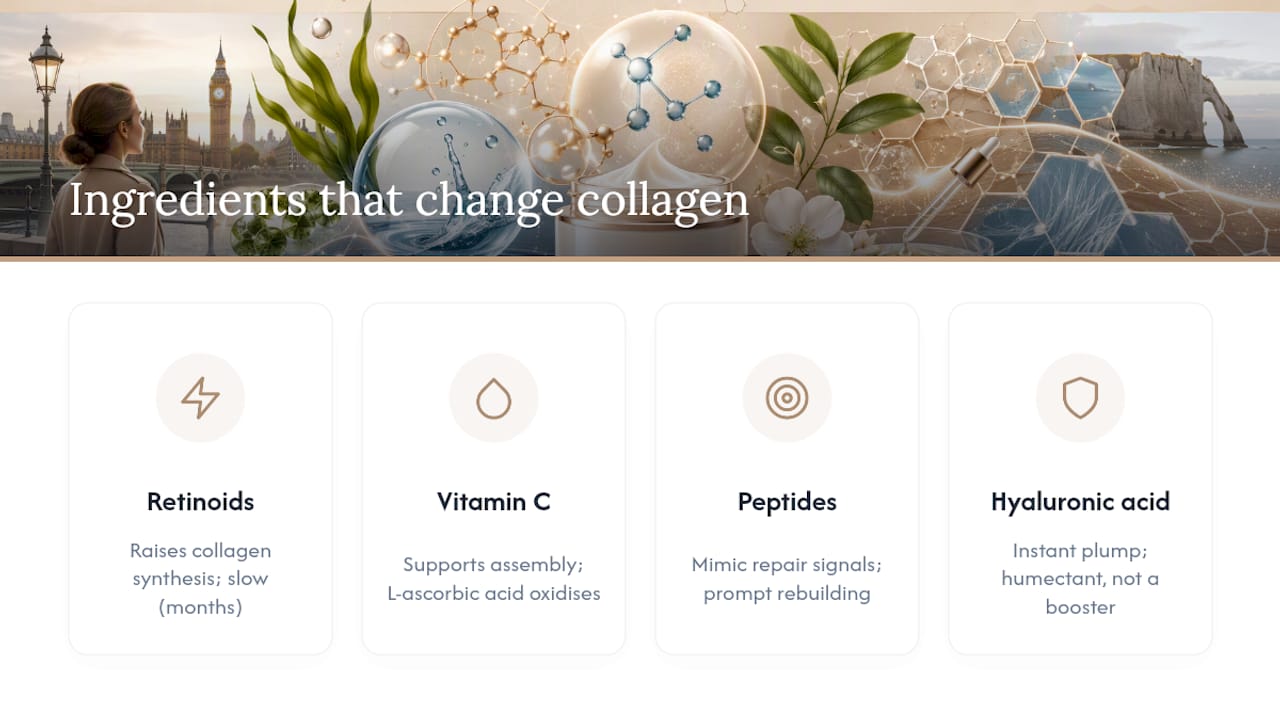
Retinoids carry the strongest evidence base here. Clinical trials on photoaged skin show retinoids genuinely increase collagen synthesis, though the effect is gradual and typically needs consistent use across several months before showing up in elasticity measurements. Tolerability is the trade-off. Expect some dryness and possible irritation as skin adjusts.

Vitamin C plays a supporting role in collagen assembly at a cellular level, though formulation stability is a genuine concern. L-ascorbic acid oxidises quickly once a bottle is opened, so packaging and storage matter as much as concentration.
Signalling peptides, such as palmitoyl tripeptide-1 (commonly known by its trade name Matrixyl), work differently from whole collagen. They mimic fragments your skin produces during natural repair, prompting cells to behave as though rebuilding is already underway, rather than supplying raw material directly.
Hyaluronic acid delivers the immediate plumping effect that collagen creams get credited for. It is a humectant, not a collagen booster, but it complements collagen-rich formulations well because the two work on different timescales: instant hydration alongside slower conditioning.
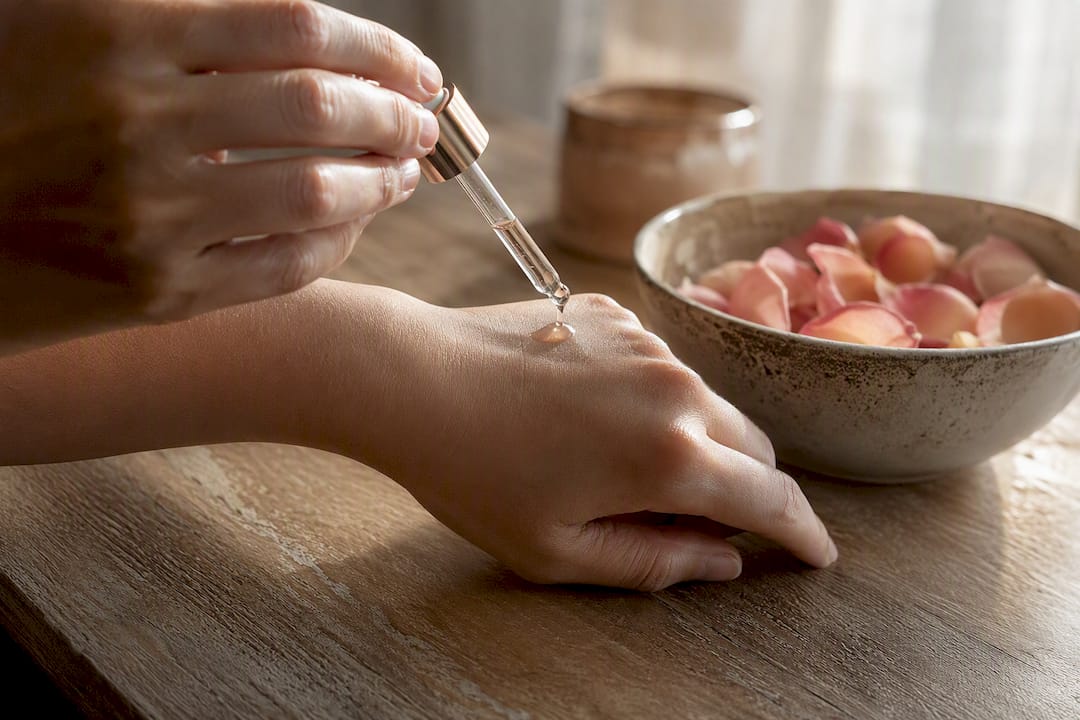
Pro Tip: Layer actives by molecule size and purpose, lightest first. A hyaluronic acid serum goes on before a richer collagen cream, and retinoids are best introduced on alternate nights until skin builds tolerance. If you’re combining prescription-strength retinoids with anything else active, it’s worth a quick chat with a dermatologist first.
For a deeper comparison of how retinoids stack up against collagen-focused products, see this breakdown of retinol versus collagen.
How do you pick the right collagen face cream for your skin?
Choosing well comes down to matching texture and supporting actives to your actual skin, not to whichever product has the boldest claim on the box.
- Match texture to skin type first. Gel or jelly textures suit oily and combination skin because they hydrate without adding occlusive weight. Richer creams suit dry or mature skin that needs a heavier barrier to lock moisture in overnight.
- Check the supporting cast, not just the headline ingredient. A cream listing peptides, vitamin C, or humectants alongside collagen is doing more for your skin than one relying on the word “collagen” alone.
- Avoid heavy, occlusive creams if you’re acne-prone. Rich formulations can trap oil and debris in pores, which is why non-occlusive textures are commonly recommended for sensitive or breakout-prone skin.
- Look for non-comedogenic labelling and fragrance disclosure. These details matter more for reactive skin than most people assume, and they are usually listed clearly on reputable product pages.
- Add SPF into your daytime routine regardless of the cream you choose. No collagen cream competes with sunscreen for preserving the collagen you already have.
- Patch-test before committing. Apply a small amount to your inner forearm for two to three days before putting anything new on your face.
If you want a fuller comparison of topical, oral, and procedural options for ageing skin, this guide to collagen for mature skin goes further into the treatment tiers beyond creams alone.
How should you use a collagen cream, and when will you see results?
Getting the sequencing and timeline right prevents both irritation and disappointment.
- Patch-test first. Apply a small amount behind the ear or on the inner arm and wait 48 hours. Redness, itching, or breakouts mean stop and try a different formulation.
- Apply after cleansing, before heavier occlusives. Morning routines should end with SPF; evening routines can end with the collagen cream itself if it’s the richest step.
- Layer lightest to heaviest. Serums with hyaluronic acid or vitamin C go on first, followed by the collagen cream, then SPF during the day.
- Track results honestly. Hydration improvement usually shows within days. Surface texture changes tend to appear over two to four weeks. Measurable firmness or elasticity gains, when they happen at all, typically need eight to twelve weeks of consistent use alongside actives like retinoids.
- Know when to stop. Persistent redness, breakouts, or stinging beyond the first few uses means the formulation is not right for your skin, regardless of how good the ingredient list looks on paper.
Pro Tip: Take a photo under the same lighting on day one. Memory is unreliable for gradual change, and a side-by-side at week eight is far more convincing than trying to recall how your skin looked a month ago.
Why trust this guidance on collagen skincare?
M-shop has spent years sourcing Polish skincare for UK customers as a family-owned operation, which means every collagen product on the shelf gets chosen with the same question in mind: does the formulation, not just the ingredient name, actually support what it claims? That focus on ingredient substance over marketing language shapes everything recommended here.
Evaluation prioritises evidence quality, how supporting actives are combined, and genuine fit across skin types rather than headline claims alone. None of this replaces a conversation with a dermatologist for persistent skin concerns, and M-shop’s customer service team is available directly through the M-shop product pages for anyone who wants help matching a formulation to their specific skin.
— Krzysztof
Which M-shop collagen creams match this guidance?
Everything above points towards one conclusion: texture and supporting actives matter more than the word “collagen” alone, and that’s exactly how M-shop’s Celia range is built.

The Celia Collagen + Algae Lightweight Moisturising Cream suits normal to combination skin that wants hydration and surface plumping without a heavy finish, the gel-leaning texture this guide recommends for anyone wary of clogged pores. For drier or more mature skin, the Celia Collagen + Vitamins Rich Anti-Wrinkle Cream pairs collagen with vitamin support in a heavier base designed to lock in moisture overnight, aimed specifically at skin over 40 that needs more from its barrier support.
Both formulations are built around the same principle covered throughout this article: collagen as a conditioning and hydrating agent, backed by supporting actives, rather than a false promise of dermal reconstruction. Browse either cream directly, compare the texture against your skin type using the guidance above, and choose the one that fits how your skin actually behaves, not just how old you are.
Sources
- Immediate and Long Term Clinical Benefits of a Novel Topical Micronized Collagen Face Cream
- Immediate and Long-term Clinical Benefits of a Topical Treatment for Facial Lines and Wrinkles