



Leave-In Conditioner vs Hair Mask: Which Does Your Hair Need?
A leave-in conditioner and a hair mask do different jobs, so the real question is which job your hair needs done. A leave-in stays on after washing as a light layer for smoothness, softness and easier brushing. A hair mask is a richer treatment that you leave on for a set time, then rinse out, to put moisture back into dry or damaged lengths. If your hair is dry, dyed, heat-styled or tangled, the mask is the step that does the heavy lifting, and a good rinse-out conditioner is the everyday step that goes with it. Here is how to tell them apart, how to use each one and how often.
TL;DR
- A leave-in conditioner is a light, everyday product that stays in your hair. A hair mask is a deep treatment that you leave on for a while and then rinse out.
- A mask goes on freshly washed hair, on the lengths and ends only, never the roots.
- Frequency depends on how often you wash: weekly is a common starting point for dry or damaged hair, and less often for fine, healthy hair.
- Rinse-out conditioner and leave-in conditioner are made differently, so never swap one for the other or dilute one to make the other.
- For dry, dyed or heat-damaged hair, a mask used regularly alongside your usual conditioner is a straightforward routine to follow.
Table of Contents
- The short answer: two products, two jobs
- Leave-in conditioner, hair mask and rinse-out conditioner side by side
- Why you cannot swap rinse-out and leave-in conditioner
- How to use a hair mask properly
- How to use a leave-in conditioner
- Which one suits your hair type
- Can you use a mask and a leave-in together?
- How often should you use a hair mask?
- Do you need to wash with a different shampoo or co-wash?
- Polish hair masks for your wash day
- FAQ
- Sources
The short answer: two products, two jobs
Both products condition your hair, which is why people confuse them. The difference is time, strength and where they sit in your routine.
A leave-in conditioner is a daily helper. Dermatologists at the American Academy of Dermatology say the benefits of a leave-in are visible straight away: less frizz, easier brushing, less breakage and hair that feels smoother immediately.
A hair mask is a treatment. UK dermatology site Skin + Me explains that masks are left on longer than a usual conditioner, so the ingredients have more time to work. Emollients such as shea butter and oils such as argan and jojoba soften the hair and lock moisture in.
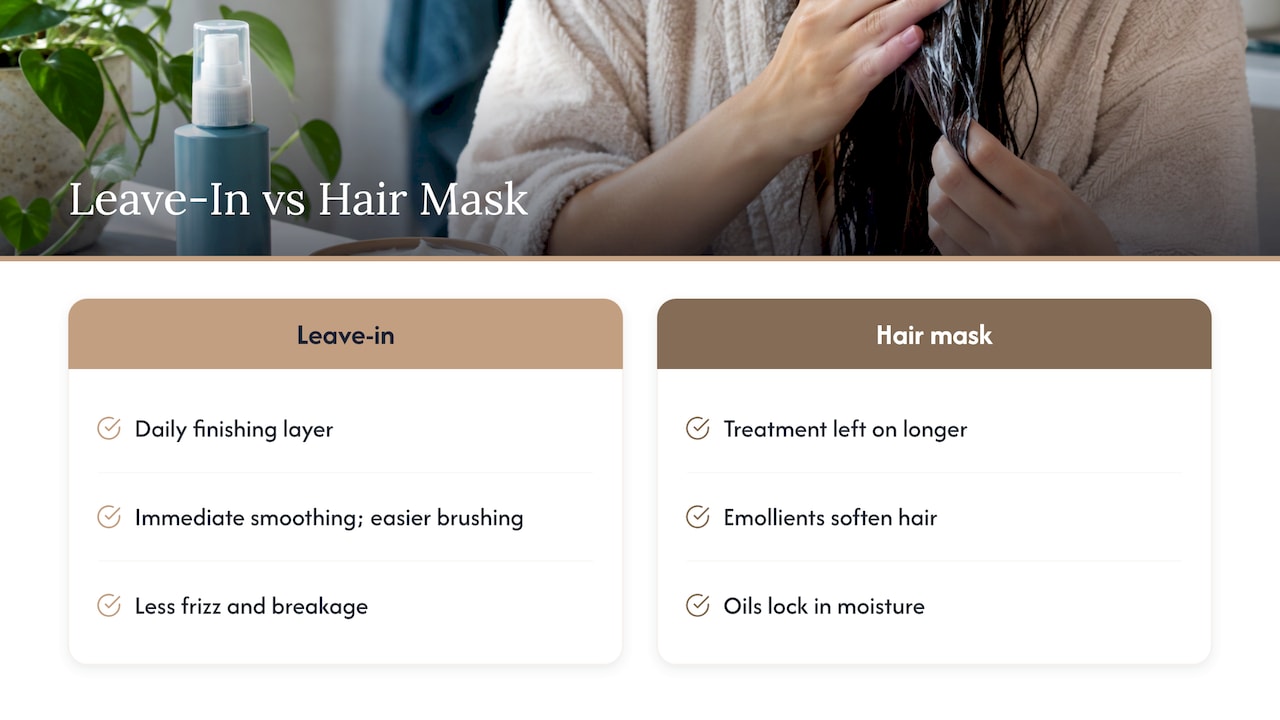
Think of it this way. Rinse-out conditioner is your everyday step in the shower. A leave-in is a light finishing layer after it. A mask is the weekly reset for dry, dyed or heat-styled hair.
Leave-in conditioner, hair mask and rinse-out conditioner side by side
| Rinse-out conditioner | Hair mask | Leave-in conditioner | |
|---|---|---|---|
| Main job | Smooths the cuticle, detangles, adds softness and shine | Intense moisture and repair for dry or damaged hair | Light, ongoing moisture, detangling and frizz control |
| How long it stays on | One to two minutes | 15 to 30 minutes, or as the label says | Stays in until your next wash |
| Where it goes | Mid-lengths to ends | Lengths and ends, not the roots | Mid-lengths to ends, on damp hair |
| How often | Every wash | Usually once or twice a week, less for fine hair | As often as you style or wash |
| Rinsed out? | Yes | Yes | No |
The timings for conditioner and mask come from dermatologist Dr Ruben Bhasin Passi, who says a mask stays on for 15 minutes to half an hour versus one to two minutes for a conditioner. The frequencies are starting points and we cover them below. Always follow the directions printed on your own product.
Why you cannot swap rinse-out and leave-in conditioner
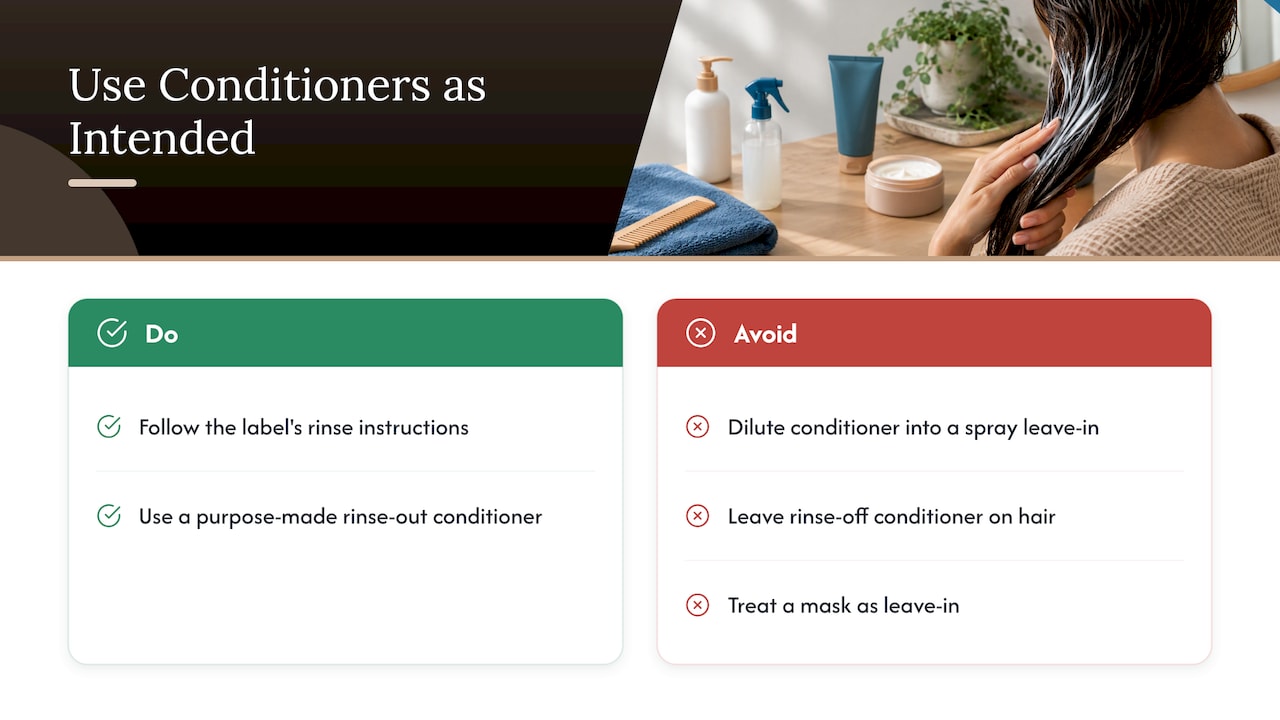
It is tempting to dilute your usual conditioner in a spray bottle and call it a leave-in. Dermatologists advise against it. The AAD explains that the two products have different chemistry: one is made to be rinsed out and the other to stay on the hair. Rinse-off conditioners often contain detergent, so leaving one on can damage hair, and the diluting hack can do more harm than good.
The same logic applies to masks. A mask is designed to be rinsed. The texture of a product tells you little. A thick cream can be a leave-in and a light-looking product can still need rinsing, so the label’s instructions decide what it is.
If you want a rinse-out step that is simple and made for the job, we stock the Apis Trichology Care Line Conditioner for Medium Porosity Hair, a Polish formula that is rinsed out after a minute or two like any conditioner.
How to use a hair mask properly
Most mask disappointment comes from application, not from the product. This is the routine to follow.
- Wash first. Masks go on freshly washed hair. Shampoo, then rinse thoroughly.
- Squeeze out the water. Towel-dry gently so the hair is damp, not dripping. A very wet strand dilutes the mask.
- Apply to lengths and ends. Dr Passi advises applying a mask to the lengths only, never the roots. Work it through with your fingers or a wide-tooth comb.
- Leave it on for the time on the label. Typically 5 to 30 minutes depending on the product. A shower cap or warm towel is optional.
- Rinse until the hair no longer feels slippery. Trichologist Shab Reslan warns that leaving the slippery residue in causes build-up that can lead to scalp issues, hair loss and dull hair.
- Style as normal. If you use a leave-in afterwards, a small amount goes on the mid-lengths and ends only.
Choose the mask for the problem. Skin + Me advises picking one that targets a specific issue such as dryness, frizz or breakage. Our Joanna Professional Silk Smoothing Mask for Dry and Damaged Hair 500g suits dryness and rough ends, and comes in a large pot for regular use. For hair that is brittle and dull, look at the Joanna Reconstructing Keratin Mask for Damaged and Dull Hair. If you colour your hair, the Radical Nourishing Color Protection Mask for Dyed Hair is made for dyed hair.
Not sure whether your hair wants more moisture or more strengthening? Our guide to protein and moisture balance shows how to read your hair, and the guide on keratin versus protein treatments explains which to reach for first.
How to use a leave-in conditioner
If you do add a leave-in, the AAD’s method is simple:
- Shampoo and condition in the shower, then towel-dry so your hair is still a bit damp.
- Take a small amount and apply it from the mid-strands to the ends. For a cream or lotion, rub it between your palms and run it through only where hair is dry, frizzy, brittle or tangled. For a spray, mist it and work it through with your hands.
- Keep it off the scalp to avoid build-up.
The AAD also says to wash the leave-in out with shampoo and water after about a week, which is a good reason to keep your regular wash day going. If your products contain silicones and your hair starts to feel coated, our guide to avoiding silicone build-up explains when to clarify and how to match it to your hair type.
Which one suits your hair type
The AAD lists the hair that benefits most from a leave-in: colour-treated or permed, heat-styled, long, curly, dry or brittle, fine and limp, or tangled and frizzy hair. It adds that fine, straight hair needs a lighter formula so it does not look limp and greasy, while curly hair needs more conditioning.
Masks follow a similar pattern, with more nuance on frequency. Live That Glow quotes a dermatologist describing a mask as an intense conditioner for dryness, heat damage and chemical damage that penetrates deep into the hair shaft. Another expert there suggests a mask once a week for curly or coily hair but only once or twice a month for finer, straighter hair.
Here is a quick way to match your situation:
- Dry, rough ends or frequent heat styling: a weekly mask, plus your usual conditioner at every wash.
- Dyed or bleached hair: a mask made for coloured hair, used regularly, as chemical processing leaves hair needing more moisture.
- Fine or thin hair: a mask only once or twice a month, using a small amount on the ends, with a light conditioner the rest of the time.
- Curly or coily hair: a weekly mask and a generous, evenly raked-through conditioner. Curl specialist Chantell Carrtherol, quoted in Glamour UK, recommends lightweight water-based formulas for fine curls and cream-based products with butters and oils for thick, coarse curls.
- Normal, healthy hair with little heat styling: Skin + Me says a good shampoo and conditioner is really all you need, with a mask now and then as a treat.
Can you use a mask and a leave-in together?
Yes, and they work at different points. In an expert routine in Who What Wear, one stylist recommends a hydrating mask once or twice a week to nourish the ends, with a leave-in a welcome addition for dry hair or lots of tangles. Dr Passi stresses that masks and conditioners should be used in combination rather than one replacing the other, because the mask is reparative and conditioner works on the surface.
A sensible week for dry or damaged hair looks like this:
- Wash day 1: shampoo, mask on the lengths for the time on the label, rinse, then a light finishing product if you use one.
- Other wash days: shampoo, your usual rinse-out conditioner, style as normal.
If you cannot decide where to begin, begin with the mask and a rinse-out conditioner. Our article on hair mask versus conditioner walks through the same decision in more detail.
How often should you use a hair mask?
Not daily. Trichologist Shab Reslan says a mask is not supposed to be used every day because its heavier protein ingredients can cause protein overload. Her rule of thumb is to base mask frequency on how often you wash:
- Wash daily: mask weekly.
- Wash every other day: mask every other week.
- Wash less often: mask even less.
That is one expert’s guide, and the label on your mask takes priority. For a rough UK benchmark, haircare brand KEUNE suggests weekly for dry or damaged hair and once every two weeks for normal, healthy hair, with extra care for fine hair.
People with an oily scalp should be especially careful to keep the mask on the lengths. Dr Passi notes that overusing a mask on an oily scalp can increase oiliness, and on long hair it can build up and weigh hair down. That is why the “lengths only, rinse well” routine above matters.
Hair oiling is a different step again. If you like to oil your hair before washing, our hair oiling routine for the UK shows how to fit it in 2 to 3 times a week alongside a mask.
Do you need to wash with a different shampoo or co-wash?
A mask works best on clean hair, so a regular shampoo day is part of the routine. If you are weighing up co-washing (washing with conditioner only), our guide to co-washing or shampooing helps you match the choice to your hair type and avoid scalp build-up. If your hair is coloured, a gentle shampoo made for dyed hair, such as Nivea Color Care & Protect Shampoo, keeps the mask doing its work on the lengths rather than fighting a harsh wash.
Polish hair masks for your wash day
Polish haircare has long been built around the mask as a weekly ritual, and it is the part of the routine we know best. M-Shop.UK is a family-owned store that brings carefully selected Polish cosmetics straight from Poland to the UK, with regular sales and discounts on many items of up to 15%. If you grew up with a favourite maska do włosów from home, or you want to try one, our Hair Care range is the place to start: masks for dry, damaged and coloured hair, plus conditioners and shampoos to build a full routine around them.
The masks above, the Joanna smoothing and keratin masks and the Radical colour protection mask, cover the three most common wash-day problems: dryness, damage and dyed hair.
Our view: start with the mask
In our family-run shop, haircare questions come back to the same point: people look for one product to fix everything, when hair responds best to a simple routine. A rinse-out conditioner at every wash, and a mask on the lengths once the hair needs a reset, does the work that most people are hoping a single product will do.
We choose our hair masks directly from Polish brands because Polish haircare treats the mask as a normal weekly step, not a special occasion. That is why we put so much care into the range: smoothing masks for dry hair, keratin masks for dull and damaged hair and colour-protection masks for dyed hair.
Our advice is to pick the mask for your biggest problem, apply it to lengths and ends, rinse it well and keep the rest of your routine simple. When you are ready to try one, we would be glad to help you choose.
Krzysztof
FAQ
Is a hair mask the same as a leave-in conditioner?
No. A hair mask is a richer treatment that you leave on for a set time and then rinse out, while a leave-in conditioner is lighter and stays in your hair. The label tells you which is which, so follow the directions rather than judging by texture.
Should I use a hair mask or a deep conditioner?
They are close cousins, as both are richer than an everyday conditioner and left on for longer. A mask aimed at your particular problem, such as dryness, frizz or breakage, is the easier choice. Dermatologist Dr Michelle Henry says masks are usually a temporary fix that works as maintenance, which is why a regular routine works better than a one-off.
Can I use a hair mask every day?
It is not recommended. Daily use can lead to protein overload and build-up, and the usual guidance is to match mask frequency to wash frequency: roughly weekly for dry or damaged hair and less often for fine or healthy hair. Always follow your product’s label.
Can I use a mask instead of conditioner?
Not as a replacement. Experts describe a mask as reparative and conditioner as working on the surface, and say the two are best used together. Use your normal conditioner at each wash and add the mask on its own wash day.
Where on the hair should a mask go?
Apply it to the lengths and ends, not to the roots, and rinse until the slippery feel has gone. This keeps the scalp free of build-up and gives the driest part of the hair the most attention.
Sources
- Dermatologists’ top tips for using leave-in conditioner (American Academy of Dermatology)
- Ask A Dermatologist: Hair And Scalp Care (Skin + Me)
- Hair masks: worth it for hydration, repair? Experts share advice (USA Today)
- Hair mask or hair conditioner? Know what’s the difference (Indian Express)
- Conditioner VS Hair Mask: What’s The Difference? (Live That Glow)
- 10 Best Leave In Conditioner for Curly Hair (Glamour UK)
- The Perfect Haircare Routine, According to Experts (Who What Wear)