



Skincare routine order: the complete step-by-step guide
The correct skincare routine order is defined as applying products from the lightest to the heaviest texture, starting with a cleanser and finishing with sunscreen in the morning. This sequence, known in dermatology as the proper skincare sequence, determines how well each product absorbs and whether your actives actually reach the skin cells they are meant to treat. Get the order wrong and you are not just wasting product. You are actively blocking absorption and, in some cases, triggering irritation. The Cleveland Clinic, Good Housekeeping, and Vogue all point to the same core principle: sequence is not a preference, it is a function.
What is the correct skincare routine order for morning and evening?
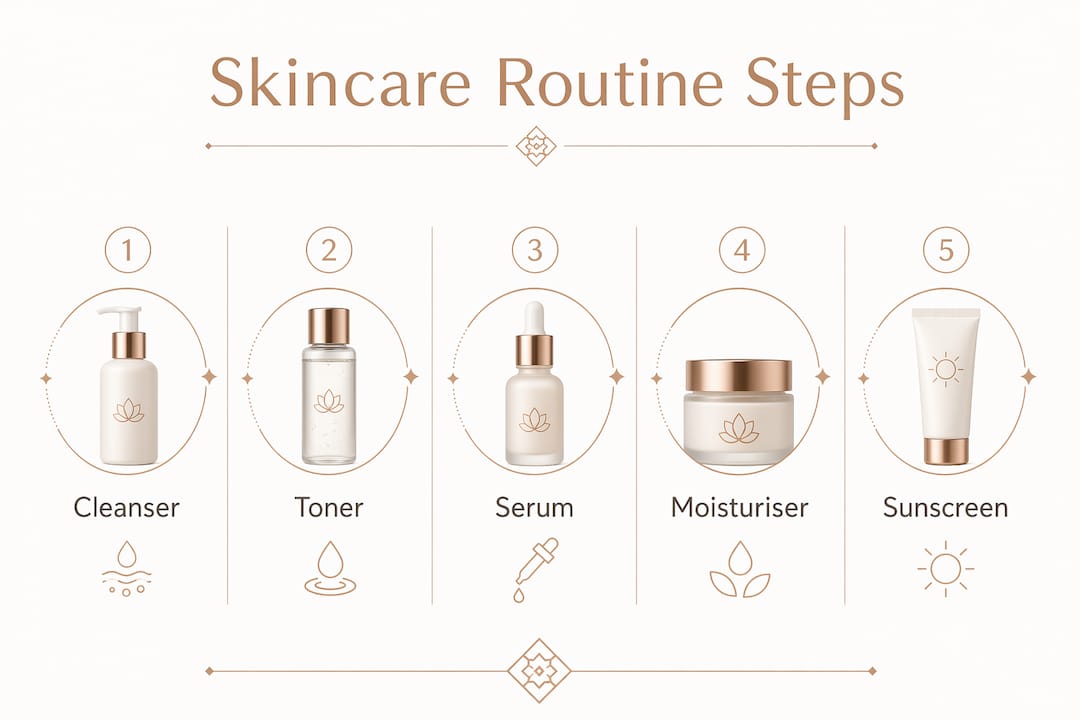
The basic morning sequence recommended by dermatologists runs in this order: cleanser, toner or essence (optional), serum, eye cream, moisturiser, and sunscreen. Each step has a specific job, and placing them correctly means each product can do that job without interference.
Here is the full sequence for both routines:
Morning routine
- Cleanser — removes overnight sebum, sweat, and any residue from night products
- Toner or essence — rebalances skin pH and preps the surface for serums
- Vitamin C serum — antioxidant protection works best on clean, bare skin
- Eye cream — applied before heavier creams so it can penetrate the delicate under-eye area
- Moisturiser — seals in serums and supports the skin barrier
- Sunscreen — applied as the final step to form an uninterrupted protective film against UV rays
Evening routine
- Cleanser (double cleanse if you wore SPF or makeup)
- Toner or essence (optional)
- Treatment serum or retinol — applied to clean skin for maximum penetration
- Moisturiser — placed after retinol to reduce dryness and support the barrier
- No sunscreen at night
The evening routine drops sunscreen entirely and introduces retinol or other treatment actives. Moisturiser placed after retinol is not optional. It reduces the dryness and irritation that retinol commonly causes, particularly for beginners.
Pro Tip: If you are new to retinol, apply your moisturiser first, then retinol on top. This “buffering” technique slows absorption slightly and significantly reduces the chance of peeling or redness in the first few weeks.
Why does applying products from thinnest to thickest matter?
The thinnest-to-thickest rule is the single most important principle in understanding how to layer skincare products correctly. Thin, water-based formulas have small molecules that penetrate the skin surface quickly. Thick, oil-based creams sit on top of the skin and form a seal. If you apply a thick cream before a thin serum, the serum cannot get through. You have essentially locked it out.
Dr Kseniya Kobets explains that product sequence alters the skin barrier and directly affects absorption, hydration levels, and the risk of irritation. This is not a minor cosmetic concern. Applying a rich moisturiser before a vitamin C serum means the serum sits on top of an oily film and never reaches the epidermis where it does its work.
“The first product you apply actively modifies the skin barrier and changes how every subsequent layer absorbs. Sequence is not just about order. It is about whether your products work at all.” — Good Housekeeping, citing Dr Kseniya Kobets
Thicker products also act as physical seals. Once a heavier formula locks in actives, it prevents them from evaporating or being displaced by the next layer. This is why moisturiser goes after serum, not before. It is not just hydration. It is a delivery mechanism.
Incorrect layering also increases irritation risk. Applying an exfoliating AHA serum on top of a thick cream means the acid sits on the surface longer than intended, increasing the chance of sensitivity. Correct order keeps actives where they belong and at the concentration your skin can handle.
How long should you wait between skincare products?
Rushing through your routine is one of the most common mistakes people make, and it genuinely undermines results. Dermatologists advise waiting 10 to 30 seconds after applying toners and serums before moving to the next step. For heavier moisturisers and treatment products, the recommended wait is one to three minutes.
The reason is straightforward. A product that is still wet on the surface has not absorbed. Applying the next layer on top of a wet product causes two problems: pilling (where products ball up on the skin) and dilution of the active ingredients. Waiting until the skin feels neither wet nor tacky is the clearest signal that absorption is complete.
Key timing guidelines to follow:
- After cleanser: pat dry, then proceed immediately
- After toner or essence: wait 20 to 30 seconds until the skin feels slightly damp but not wet
- After serum: wait 30 to 60 seconds, longer for vitamin C or retinol
- After moisturiser: wait up to 10 minutes before applying sunscreen to avoid disrupting the SPF film
- After sunscreen: do not apply anything else in the morning routine
The consequence of skipping wait times is not just pilling. Rushing between layers prevents actives from stabilising on the skin, which reduces their penetration and, over time, their visible results.
Pro Tip: Use your wait time productively. Apply your serum, then brush your teeth or make your coffee. By the time you return, your skin is ready for the next step. This removes the temptation to rush.
What are the most common skincare layering mistakes?
Most skincare problems are not caused by the wrong products. They are caused by the wrong order or too many products applied at once. These are the mistakes that dermatologists see most frequently.
- Applying sunscreen too early. Sunscreen placed beneath moisturiser cannot form the continuous film it needs to block UV radiation. It must always be the final morning step, applied after everything else.
- Stacking multiple serums. The Cleveland Clinic advises using only one serum at a time because combining actives, particularly vitamin C with AHAs or BHAs, disrupts the skin barrier and causes irritation.
- Applying eye cream after moisturiser. Eye cream is a targeted treatment with a lighter texture than most face moisturisers. It should go on before your face cream so it can absorb into the thin skin around the eyes without being blocked.
- Skipping wait times. Applying products back to back causes pilling and reduces the effectiveness of every layer in the routine.
- Overcomplicating the routine. A simplified routine of cleanser, serum, moisturiser, and SPF consistently outperforms a ten-step routine that is applied incorrectly or abandoned after two weeks.
The pattern here is clear. Simplicity and correct order beat complexity every time. A three-step routine done correctly will deliver better results than a seven-step routine done in the wrong sequence.
How to adjust your skincare sequence for your skin type
The core order of skincare essentials stays the same regardless of skin type. What changes is the texture and formulation of the products you choose at each step. The table below shows how to adapt the routine for the three most common skin types.
| Skin type | Cleanser | Serum | Moisturiser | Sunscreen |
|---|---|---|---|---|
| Oily | Gel or foaming cleanser | Niacinamide or salicylic acid | Lightweight, oil-free gel | Gel-based SPF to avoid greasiness |
| Dry | Cream or milk cleanser | Hyaluronic acid or ceramide serum | Rich, occlusive cream | Hydrating SPF with added moisturisers |
| Sensitive | Fragrance-free gel-cream | Centella asiatica or niacinamide | Barrier-repair cream | Mineral SPF with zinc oxide |
For oily skin, the goal is to keep every layer as light as possible. A gel-based sunscreen and lightweight moisturiser prevent the heavy, congested feeling that causes many people with oily skin to skip moisturiser entirely. Skipping moisturiser is a mistake. Without it, the skin overproduces sebum to compensate.
For dry skin, the priority is layering hydrating actives and sealing them in with a richer cream. Hyaluronic acid serum followed by a cream containing shea butter or squalane is the most effective combination for retaining moisture throughout the day.
Sensitive skin benefits most from a shorter routine. Fewer products mean fewer potential triggers. A fragrance-free gentle cleansing gel, a single calming serum, a barrier-repair moisturiser, and a mineral SPF is the most effective and least irritating sequence for reactive skin. Adding actives like retinol or vitamin C should happen gradually, one product at a time, to identify any triggers clearly.
For anyone building their first routine, the affordable skincare guide at M-shop is a practical starting point that covers the essentials without overcomplicating the process.
Key takeaways
The correct skincare routine order applies products from thinnest to thickest, with sunscreen always last in the morning and moisturiser always after retinol at night.
| Point | Details |
|---|---|
| Thinnest to thickest rule | Apply water-based serums before creams so lighter formulas can penetrate the skin barrier. |
| Sunscreen goes last | Sunscreen must be the final morning step to form an uninterrupted UV-protective film. |
| Wait between layers | Allow 30 to 60 seconds after serums and up to 10 minutes after moisturiser before SPF. |
| One active at a time | Avoid stacking vitamin C with AHAs or BHAs to prevent irritation and barrier disruption. |
| Simplicity wins | A three-step routine done correctly outperforms a complex routine applied in the wrong order. |
Why I think most people overcomplicate this entirely
By Krzysztof
After years of working with Polish skincare formulations and watching customers navigate their routines, the single most consistent observation I have made is this: people buy excellent products and then undermine them completely by applying them in the wrong order or all at once.
The skincare industry has a commercial interest in selling you more steps. Essences, boosters, facial oils, mists, ampoules. Each one is positioned as indispensable. The reality is that a well-chosen cleanser, one targeted serum, a good moisturiser, and a reliable SPF will outperform a fifteen-product shelf if those four products are applied correctly and consistently.
What I have seen work, time and again, is the discipline of waiting. Not the elaborate routine. Not the expensive serum. The thirty seconds between steps that most people skip because they are in a hurry. That pause is where the results actually happen.
My honest advice is to start with three products, master the sequence, and only add a new step once you are confident the existing routine is working. Skin responds to consistency far more than complexity. The best skincare routine for beginners is not the most thorough one. It is the one you will actually follow every single morning.
— Krzysztof
Build your ideal routine with M-shop

M-shop stocks a carefully selected range of Polish cosmetics designed to fit every step of a correct skincare sequence, from gentle cleansers through to targeted treatment creams. The range includes products built around natural ingredients such as collagen, algae, and hyaluronic acid, all chosen for visible results rather than marketing claims. The Dermika Energia energising mask fits neatly into the treatment step of both morning and evening routines, and the Eveline Hyaluron Clinic B5 day cream is formulated specifically for the moisturising step in an AM routine. With regular sale discounts of up to 15%, M-shop makes it straightforward to build a dermatologist-aligned routine without overspending. Browse the full range at M-shop.uk.
FAQ
What is the correct order for a morning skincare routine?
The correct morning order is cleanser, toner (optional), serum, eye cream, moisturiser, and sunscreen. Sunscreen must always be the final step to form an effective UV barrier.
Should moisturiser go before or after serum?
Moisturiser goes after serum. Serums are lighter and need to penetrate the skin first. Moisturiser then seals in the active ingredients and supports the skin barrier.
How long should you wait between skincare steps?
Wait 20 to 30 seconds after toners and serums, and up to 10 minutes after moisturiser before applying sunscreen. Rushing between steps causes pilling and reduces absorption.
Can you use vitamin C and retinol in the same routine?
No. Vitamin C is best used in the morning routine and retinol in the evening. Using both at the same time increases irritation risk and can destabilise both actives.
Is a simple skincare routine as effective as a multi-step one?
A simplified routine of cleanser, serum, moisturiser, and SPF is consistently more effective than a complex multi-step routine applied incorrectly or inconsistently. Correct order and consistency matter more than the number of products.