



Urea vs lactic acid: which is right for your skin?
Pick urea when your problem is dryness, thickening or hard skin, especially on feet, heels and elbows. Pick lactic acid when your problem is texture, dullness or pigmentation on thinner skin, particularly the face. That’s the short version, and it holds true whether you’re dealing with cracked diabetic heels or dull patches on your cheeks.
Both belong to the same broad family of “skin conditioning” ingredients, but they work through different routes. Urea is a humectant that becomes a keratolytic (skin-softening, dead-cell-loosening agent) once concentrations climb. Lactic acid is an alpha-hydroxy acid, or AHA, that dissolves the bonds between dead surface cells rather than drawing water into them.
Quick verdict by problem:
- Xerosis (dry, flaky skin) and diabetic heels → urea, typically 10–25%
- Thick calluses or very rough soles → urea, 30–40%, often occluded overnight
- Keratosis pilaris (rough “chicken skin” bumps) → urea 10–20%, or a low-strength lactic acid if urea alone feels insufficient
- Hyperpigmentation, dullness, uneven tone → lactic acid, 5–10%
- Fine lines and general resurfacing → lactic acid, with low-dose urea as a hydrating backup
They can be combined, but not carelessly. High-strength urea and strong acids on the same patch of skin, on the same night, is asking for irritation. Anyone with broken skin, severe eczema, or fragile diabetic skin should check with a pharmacist or GP before using high-strength versions of either.
Key Takeaways
Urea works best as a hydrator and keratolytic for thick or dry skin, while lactic acid works best as a gentle AHA exfoliant for texture and pigmentation on thinner skin.
| Point | Details |
|---|---|
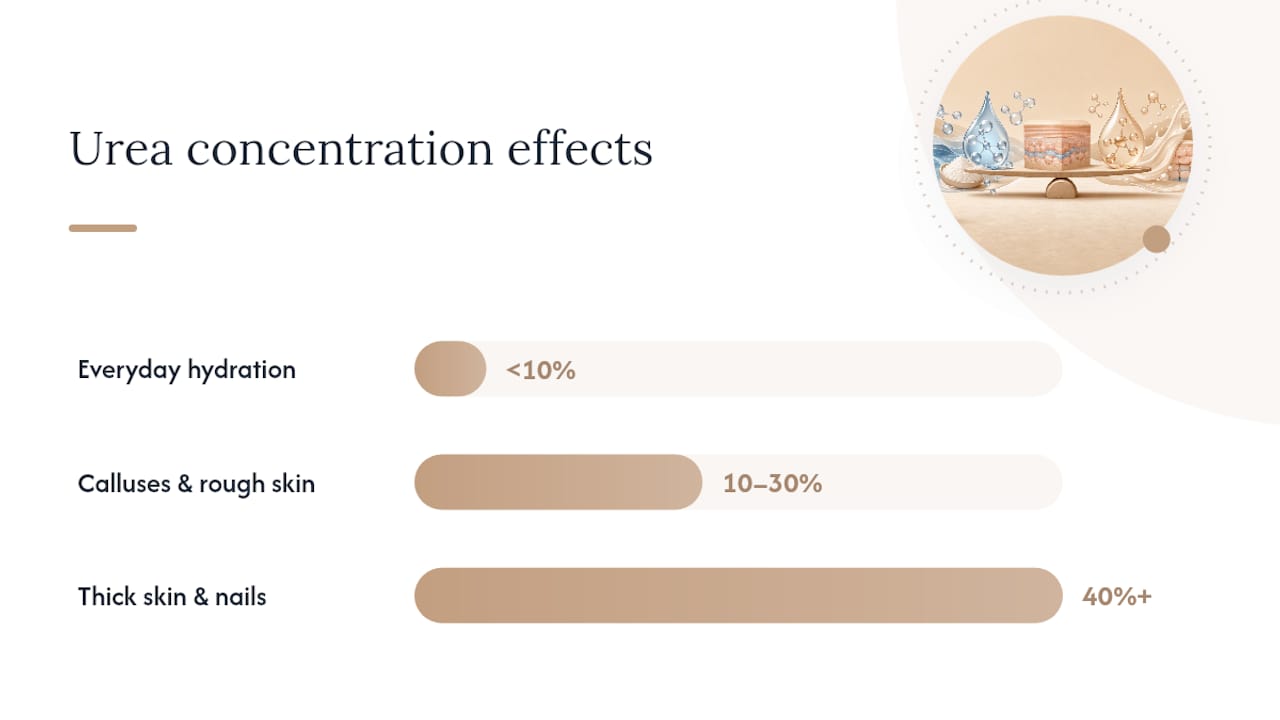
| Match strength to problem | Use under 10% urea for daily hydration, 10 to 30% for calluses and KP, and 40%+ only for severe, specialist cases. |
| Lactic acid suits the face | Stick to 2 to 12% lactic acid for pigmentation, dullness and texture, always paired with daytime sunscreen. |
| Watch for irritation signs | Stop use if you see persistent redness, sharp stinging or raw peeling, and patch test first. |
| Combine with care | Layer low-strength versions freely, but keep high-strength urea and strong acids on separate nights or separate areas. |
| Start with labelled strengths | M-shop’s Bielenda foot creams state their urea percentage clearly, making it easier to match product to problem. |
Table of Contents
- Urea vs lactic acid comparison: mechanism, uses and strength
- What is urea and how does concentration change what it does?
- What is lactic acid and where does it fit in a routine?
- Side effects and who should be careful
- How to use urea and lactic acid safely together
- Which should you choose for your specific skin concern?
- What does the clinical evidence actually show?
- Frequently asked questions
- Sources
Urea vs lactic acid comparison: mechanism, uses and strength
The two ingredients solve different problems because they physically do different things to the skin’s outer layer. Urea pulls water in and, at higher percentages, breaks down the keratin holding dead cells together. Lactic acid dissolves the same intercellular “glue” through mild acid exfoliation, working best at a lower pH.
| Factor | Urea | Lactic Acid |
|---|---|---|
| Best for | Dry, thick or hardened skin (feet, hands, elbows) | Dull, rough or pigmented skin (face, body) |
| Mechanism | Humectant; keratolytic above roughly 10% | AHA; loosens dead-cell bonds, pH-dependent |
| Typical concentrations | <10% hydrates; 10–30% softens calluses/KP; 40%+ strong keratolysis | 2–12% in most retail products; higher in professional peels |
| Irritation risk | Low at low %, can sting on broken or very thin skin at high % | Can sting depending on pH and strength; generally gentler than glycolic acid on darker skin |
| How to use | Feet, hands, elbows; daily to nightly depending on strength | Face and body; 2–4 nights a week to start |
A few things worth remembering before you shop:
- Urea’s job changes with the dose. Low concentrations mainly hydrate, while 10 to 30% relieves calluses and keratosis pilaris, and 40% or higher performs strong keratolysis.
- Lactic acid is often recommended over harsher AHAs like glycolic acid for sensitive or darker skin because it tends to cause less irritation.
- Neither ingredient is inherently “stronger”. They’re suited to different jobs, like comparing a moisturiser to an exfoliating cleanser.
What is urea and how does concentration change what it does?
Urea is your skin’s own natural moisturising factor, already present in the outer layer, which is why it’s tolerated so well even at meaningful strength. Its two jobs, hydration and exfoliation, sit on the same molecule; the dose decides which job dominates.
Below roughly 10%, urea mainly draws and holds water, useful for everyday dryness on hands, arms or the body. Between 10% and 30%, it starts breaking down the protein bonds holding dead skin cells together, which makes it genuinely useful for calluses, keratosis pilaris and rough patches. At 40% or higher, urea performs strong keratolysis and is generally reserved for thick, hardened skin or nail softening, often under professional or specialist guidance.
Dermatology-adjacent podiatric guidance recommends 20% urea for ongoing diabetic heel maintenance, moving to 20 to 40% with occlusion for tougher callus softening, which prevents the fissures that can otherwise turn into entry points for infection.
The best time to apply it is straight after a shower, while skin is still slightly damp, since urea works by binding surface water into the stratum corneum rather than sitting on top of already-dry skin. Look for it in:
- Creams for daily hand and body hydration
- Foams or lotions for lighter, faster-absorbing coverage
- Thick balms for overnight foot treatment, ideally under a sock
Pro Tip: For stubborn heel calluses, apply a 20–25% urea cream after your evening shower and pull on a pair of thin cotton socks. The occlusion traps moisture against the skin and noticeably speeds up softening within a week or two.
What is lactic acid and where does it fit in a routine?
Lactic acid is a gentle AHA that lifts away dead surface cells to reveal smoother, more even-toned skin underneath, without the aggressive peel that stronger acids can cause. It’s derived from milk sugars structurally, though most skincare versions today are synthesised rather than dairy-extracted.
Retail products typically sit between 2% and 12% lactic acid, while professional in-clinic peels go considerably higher under supervision. Activity depends heavily on the product’s pH: a lower pH means more of the acid is in its active, unionised form, which is why two products listing the same percentage can feel completely different on skin.
Lactic acid earns its reputation on the face, where it smooths texture and fades post-inflammatory marks and sun-related dullness, but it also works well as a mild body exfoliant on rougher patches like upper arms. Its comparatively large molecule size means it penetrates more slowly than glycolic acid, which is part of why it’s often positioned as the better starting AHA for melanin-rich or reactive skin.
You’ll typically find it as:
- Leave-on serums or lotions for nightly facial use
- Wash-off cleansers or masks for a lighter, lower-commitment introduction
- Body lotions for elbows, knees and rough patches beyond the face
Side effects and who should be careful
Both ingredients are considered low-risk for most people, but “low-risk” isn’t “risk-free”. Lactic acid can sting on first use, especially at higher percentages or lower pH formulas, while high-strength urea (30% and above) can cause a burning sensation if applied to skin that’s cracked or already compromised.
Watch for these warning signs and stop use if they appear:
- Persistent redness lasting beyond an hour
- Sharp stinging rather than a mild, brief tingle
- Peeling that becomes raw or painful rather than flaky
- Any rash, hives or swelling, which points to a genuine allergic reaction
Anyone with open wounds, severe or active eczema, or very fragile skin from long-standing diabetes should get advice before reaching for high-strength versions of either ingredient. Diabetic foot skin in particular can mask sensation changes, so what feels fine may still be causing damage.
Pro Tip: Patch test any new strength on the inner forearm for two nights before applying it to your face or feet. And because AHAs like lactic acid increase sun sensitivity, always follow daytime use with sunscreen, even on cloudy days.
How to use urea and lactic acid safely together
Think of maintenance and correction as two different jobs.
A sensible routine looks like this:
- Cleanse the area, removing any product buildup or debris.
- Apply your chosen product to slightly damp skin, right after washing or showering.
- Match frequency to strength: daily for low-dose urea, 2 to 4 nights a week for lactic acid, and nightly-to-occasional for high-strength urea depending on how skin responds.
- Occlude thick foot creams with a sock or dressing overnight if you’re targeting calluses.
- Finish face applications with a moisturiser and, in the morning, sunscreen.
A short do-not-mix list worth memorising:
- Don’t layer high-strength urea (30%+) and a strong AHA or retinoid on the same patch of skin the same night.
- Don’t introduce lactic acid and a retinoid simultaneously if you’re new to both; alternate nights instead.
- Don’t occlude high-strength acids the way you would urea. Occlusion intensifies acid penetration too, and that’s rarely comfortable.
A typical face routine might run low-dose urea moisturiser in the morning and lactic acid serum three nights a week in the evening.
Which should you choose for your specific skin concern?
For ageing skin and general texture, lactic acid does the heavy lifting on cell turnover, while a low-dose urea moisturiser makes a genuinely useful hydrating add-on underneath, particularly for skin that feels tight or flaky alongside fine lines.
Can you use urea and lactic acid together?
Yes, in many formulations and routines, though concentration and sequencing matter more than most people assume. Low-strength versions of both often coexist happily in the same over-the-counter product, which is exactly the combination used in a clinical formulation of 35% urea with lactic acid for foot xerosis.
Dos and don’ts:
- Do use separate, dedicated products at high strength rather than one product layered on top of another.
- Do reserve combined high-strength formulas for feet, where skin is thicker and more tolerant.
- Don’t combine two high-strength actives on facial skin without professional guidance.
Two example routines:
- Foot protocol: 25 to 35% urea and lactic acid combination cream, applied nightly to damp feet, covered with cotton socks.
- Face protocol: low-dose urea moisturiser most mornings, lactic acid serum on alternate evenings, always followed by sunscreen the next day.
What does the clinical evidence actually show?
The strongest single piece of trial evidence comes from a 4-week open-label study, where 35% urea combined with lactic acid in a water-lipid foam significantly improved redness, scaling and cracking in mild-to-moderate foot xerosis, with no adverse reactions recorded across the study group.
Separately, reviews of ammonium lactate and lactic acid formulations against other moisturisers consistently show improved xerosis outcomes, reinforcing that AHAs aren’t just cosmetic tools but genuine dry-skin treatments in their own right.
Dermatology commentary tends to frame urea as the quiet workhorse and lactic acid as the more visible “active”, but neither view holds up as a strict hierarchy. The evidence base for both is solid for common concerns; it thins out fast once you move into severe, medical-grade skin conditions, which is where a GP or dermatologist should take over.
How I’d choose between them
Start with the least aggressive option that could plausibly work, then step up only if it doesn’t.
Match the concentration to the body part you’re treating, not to how quickly you want results, and rank your priorities as comfort first, consistency second, strength third.
If you want an easy start, here’s where to begin
Rather than guessing your way through percentages on unfamiliar labels, it helps to start with products where the strength is already stated clearly on the tin.

For thick heel calluses, the Bielenda Professional Foot Softening Cream with 20% Urea sits squarely in the keratolytic range this guide recommends for diabetic heel maintenance and softening. If your feet need broader repair alongside softening, the Bielenda Professional Regenerating Foot Cream with Urea & Arginine pairs urea with arginine for added skin conditioning. Whichever strength you pick, patch test on your inner arm for two nights first, exactly as recommended earlier in this guide, before committing to a full foot or body routine.
Frequently asked questions
Is urea or lactic acid better for feet?
Can I use urea and lactic acid on the same day? Yes, provided you’re using low-to-moderate strengths. Apply urea in the morning as a moisturiser and lactic acid in the evening, keeping high-strength versions of either on separate days or separate body areas.
Which causes more irritation, urea or lactic acid? It depends on strength and skin condition rather than the ingredient itself.
Does lactic acid help with dark spots?
It can be, but it’s best reserved for thick, hardened skin like calluses or nails, and anyone with diabetes or fragile skin should check with a healthcare professional before using it regularly at that strength.
This article is general information, not a substitute for advice from a qualified doctor. Consult a qualified healthcare professional about your own circumstances before acting on anything here.
Sources
- Clinical Evaluation of 35% Urea in a Water-Lipid–Based Foam Containing Lactic Acid for Treatment of Mild-to-Moderate Xerosis of the Foot
- Urea Cream for Feet: Concentrations, Uses
- PMC article(s) and cited trials on lactic/ammonium lactate and urea formulations
Recommended
- Role of urea body lotion: how it moisturises and smooths skin – M-Shop.UK
- Bielenda Professional Face Peeling with 40% Mandelic AHA Lactobionic A – M-Shop.UK
- Bielenda Professional Regenerating Foot Cream with Urea & Arginine 500 – M-Shop.UK
- Skincare layering explained: how to get the order right – M-Shop.UK