



Why European cosmetics safety standards protect your skin
Why European cosmetics safety standards matter for UK consumers of Polish skincare
European cosmetics safety standards exist for one reason: to keep products off your skin that could harm you. For more details on the importance of these regulations, see why skincare device safety standards exist. Under EU Cosmetics Regulation (EC) No 1223/2009, every product placed on the European market must pass a science-based safety assessment before it reaches a single consumer. For UK shoppers buying Polish skincare, that means the Pharmaceris T creams, Biały Jeleń soaps, and Celia collagen ranges you find at M-shop have already cleared a rigorous legal hurdle before they were ever packaged.
Key protections built into the system:
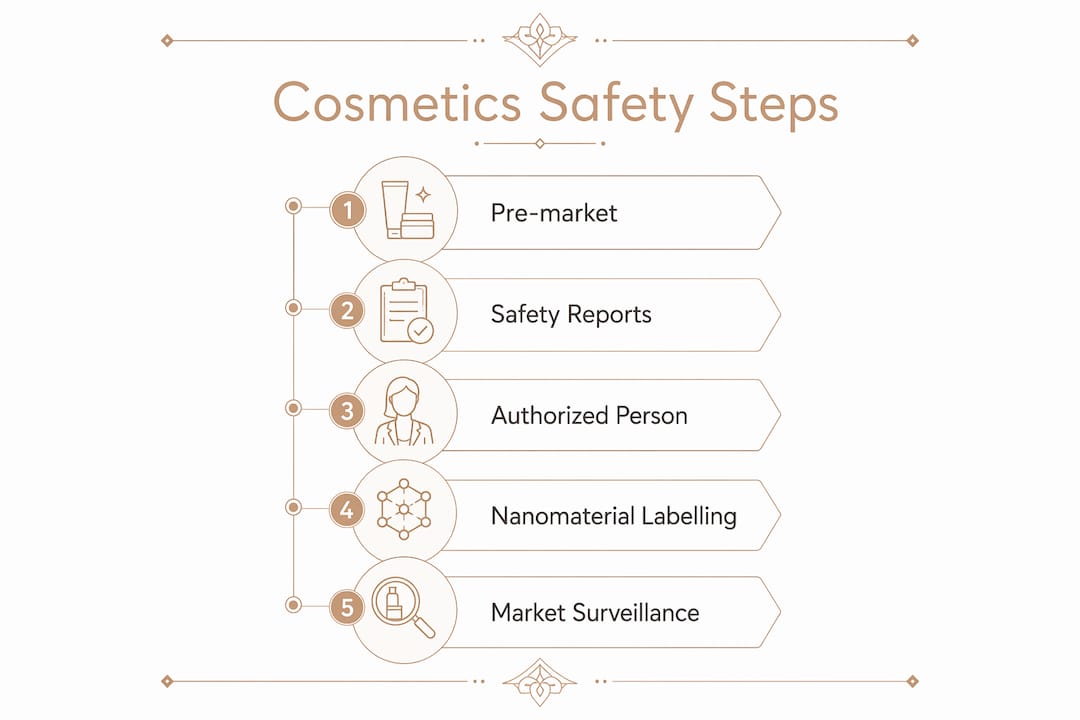
- A designated Responsible Person is legally accountable for every product’s safety, labelling, and registration
- A mandatory Cosmetic Product Safety Report, signed by a qualified toxicologist, must exist before market placement
- Nanomaterials require explicit authorisation and must be flagged in ingredient lists
- Carcinogenic, mutagenic, or reprotoxic (CMR) substances are prohibited outright
- Harmonised rules across the EU mean a Polish brand sold in the UK meets the same standard as one made in France or Germany
- Natural ingredients face the same toxicological scrutiny as synthetic ones — no exemptions
Table of Contents
- Who is the Responsible Person, and why should you care?
- How nanomaterial labelling gives you real transparency
- The EU’s pre-market system stops problems before they reach you
- Natural does not mean unregulated — the EU treats all ingredients equally
- How European cosmetics regulation developed over decades
- How does EU regulation compare with cosmetics rules elsewhere?
- What mechanisms actually enforce these standards?
- Why these standards raise the quality bar for natural skincare
- Enforcement and penalties for non-compliance
- Key takeaways
- Polish skincare that meets every EU safety standard, delivered to your door
Who is the Responsible Person, and why should you care?
Every EU cosmetic product must have a designated Responsible Person — an EU-based individual or company legally on the hook for compliance. This is not a formality. If a product causes harm, authorities know exactly who to hold accountable.
Their obligations are substantial:
- Commission and maintain the Cosmetic Product Safety Report
- Register the product in the Cosmetic Products Notification Portal (CPNP)
- Keep the Product Information File (PIF) for 10 years after the last batch is marketed, available to national authorities on request
- Ensure correct, complete labelling at all times
- Report any serious undesirable effects (SUEs) to competent authorities
The 10-year PIF obligation means safety data does not vanish once a product ships. Regulators can audit it years later. Manufacturers cannot self-certify either — a qualified safety assessor with formal toxicology credentials must sign off. That single requirement eliminates a huge category of corner-cutting.
How nanomaterial labelling gives you real transparency
Nanotechnology in cosmetics is not inherently dangerous, but it does require careful oversight. Under EU law, nanomaterials need explicit authorisation before they can be used, and they must appear in the ingredient list followed by the word “nano” in brackets — for example, Titanium Dioxide (nano).
One important clarification: only intentionally added nanomaterials carry this labelling requirement. Trace impurities from manufacturing do not trigger it, which keeps ingredient lists accurate rather than alarmist. Each nanomaterial also undergoes its own safety assessment before authorisation is granted.
For consumers seeking natural Polish skincare, this matters practically. When you pick up a Celia moisturiser or a Biały Jeleń soap from M-shop and scan the ingredients, any nano-scale component is disclosed. You are not guessing.
The EU’s pre-market system stops problems before they reach you
Most regulatory systems react to harm after it occurs. The EU’s approach is different. A mandatory Cosmetic Product Safety Report must be prepared and signed by a qualified safety assessor before a product is placed on the market. This report evaluates toxicological profiles, exposure levels, and cumulative health risks — not after a complaint, but as a condition of sale.

CMR substances (carcinogenic, mutagenic, or toxic for reproduction) are banned outright under the regulation. Heavy metals, certain preservatives, and hundreds of other substances appear on restricted or prohibited lists in the regulation’s annexes. Brands like Pharmaceris T and Celia, available through M-shop, operate within this framework — their formulations are shaped by it from the outset.
Ongoing surveillance reinforces the pre-market work. Serious undesirable effects must be reported to authorities, feeding a continuous loop of safety monitoring that can trigger ingredient reviews or product withdrawals at any point.
Natural does not mean unregulated — the EU treats all ingredients equally
There is a persistent belief that “natural” cosmetics are inherently safer than synthetic ones. EU regulation does not share that assumption. All cosmetic ingredients — plant extracts, essential oils, mineral pigments, and lab-synthesised compounds alike — undergo the same toxicological assessment process.
This matters because natural ingredients carry real risks: allergenic potential, irritant properties, and in some cases endocrine-disrupting effects. The safety assessment accounts for all of these, regardless of whether the ingredient grew in a field or was produced in a laboratory.
Key requirements that apply equally to natural cosmetics:
- Full toxicological profile for every ingredient
- Assessment of allergenic and irritant potential
- Evaluation of cumulative exposure across all sources
- Prohibition of hazardous substances regardless of natural origin
M-shop’s Polish cosmetics without parabens reflect these rules directly — formulation choices are driven by what the regulation permits and what the safety data supports.
How European cosmetics regulation developed over decades
The foundations were laid by EU Directive 76/768/EEC in 1976, which first harmonised cosmetics rules across member states. Decades of scientific advances and market growth exposed gaps in that framework, leading to a full overhaul. Regulation (EC) No 1223/2009 replaced the directive entirely, shifting from a patchwork of national transpositions to a single, directly applicable regulation across all member states. The shift to a Regulation (rather than a Directive) was deliberate: it removed the room for diverging national interpretations and created one consistent standard. Subsequent amendments have added nanomaterial provisions, updated banned substance lists, and tightened market surveillance requirements as evidence evolved.
How does EU regulation compare with cosmetics rules elsewhere?
The contrast with the United States is stark. Under the FD&C Act, cosmetic products and ingredients do not require FDA approval before going to market. The EU, by contrast, requires pre-market safety assessment, a signed toxicology report, and registration before a product can be sold. The EU has banned or restricted over 1,300 substances in cosmetics; the US has restricted far fewer. The EU also bans animal testing for cosmetics entirely — a prohibition that applies regardless of whether alternative testing methods exist. For UK consumers buying European skincare brands, that regulatory gap is a genuine reason to favour EU-compliant products.
What mechanisms actually enforce these standards?
Enforcement sits with national competent authorities in each EU member state, who conduct in-market controls through physical checks, laboratory testing, and audits of the Product Information File. Where non-compliance is found, authorities can require corrective action, withdraw products from sale, or issue recalls — with a specified time limit tied to the severity of the risk. The CPNP registration system gives authorities visibility of every product on the market before enforcement action is even needed. Counterfeit cosmetics receive specific attention under the regulation, given the health risks they carry.
Why these standards raise the quality bar for natural skincare
When every brand selling into the EU must meet the same pre-market requirements, the floor for product quality rises across the board. Brands cannot cut corners on ingredient sourcing or skip toxicology assessments and still reach the market legally. For natural skincare specifically, harmonised EU regulations mean that the collagen, algae, and chestnut extracts in Polish products like Celia and Biały Jeleń have been assessed for safety, not just marketed on the strength of their natural origin. Consumer trust follows from that — not from branding, but from a verifiable legal structure behind every product.
Enforcement and penalties for non-compliance
Non-compliant products face mandatory withdrawal or recall, with timelines set by the competent authority based on risk level. The Responsible Person bears direct legal liability, which can include financial penalties under national law. Repeated or serious violations can result in criminal proceedings in some member states. The CPNP registration requirement means unregistered products are identifiable and removable from the market quickly. This enforcement architecture is what gives the pre-market system its teeth — a safety report is only as meaningful as the consequences for not having one.
Key takeaways
European cosmetics safety standards require mandatory pre-market toxicology reports, legal accountability through a Responsible Person, and strict ingredient controls that apply equally to natural and synthetic products.
| Point | Details |
|---|---|
| Pre-market safety reports | Every EU cosmetic needs a signed toxicology report from a qualified assessor before it can be sold. |
| Responsible Person accountability | One legally named party holds 10-year liability for safety data, labelling, and compliance. |
| Nanomaterial transparency | Intentionally added nanomaterials must be labelled “nano” in ingredient lists after explicit authorisation. |
| Natural ingredients, same rules | Plant-based and synthetic ingredients face identical toxicological scrutiny under EU law. |
| M-shop’s Polish ranges | Pharmaceris T, Biały Jeleń, and Celia products sold via M-shop comply fully with these EU standards. |
Polish skincare that meets every EU safety standard, delivered to your door
If you have read this far, you already know that EU-compliant cosmetics are not just better marketed — they are better regulated. M-shop brings that assurance directly to UK consumers, with a curated selection of Polish skincare chosen by a family-run team who know these brands personally.

The range covers everything from the Pharmaceris T anti-acne day cream with SPF to the Biały Jeleń hypoallergenic chestnut soap and the Celia Collagen + Algae moisturising cream — all EU-assessed, all natural-ingredient focused, and all available with discounts during sales. Browse the full collection at M-shop.uk and find Polish skincare that has earned its place on your shelf.