



Why Eastern European cosmetics are affordable: the real reasons
Eastern European cosmetics are affordable because of lower manufacturing costs, not lower safety standards. Brands from Poland, Bulgaria, and Romania operate under the same EU regulatory framework as French or German producers, yet their production expenses are structurally lower. Understanding why eastern european cosmetics affordable comes down to three factors: labour costs, energy efficiency, and value chain control. These are production economics, not quality shortcuts. M-shop sources directly from Poland, where this cost advantage is most pronounced and best documented.
Why are Eastern European cosmetics so much cheaper?
The short answer is that price differences reflect economics, not regulatory shortcuts. Every cosmetic product sold in the EU must meet the same legal requirements regardless of where it is manufactured. A moisturiser made in Warsaw faces identical compliance obligations as one made in Paris. The cost gap comes entirely from what happens inside the factory, not from what gets skipped at the safety stage.
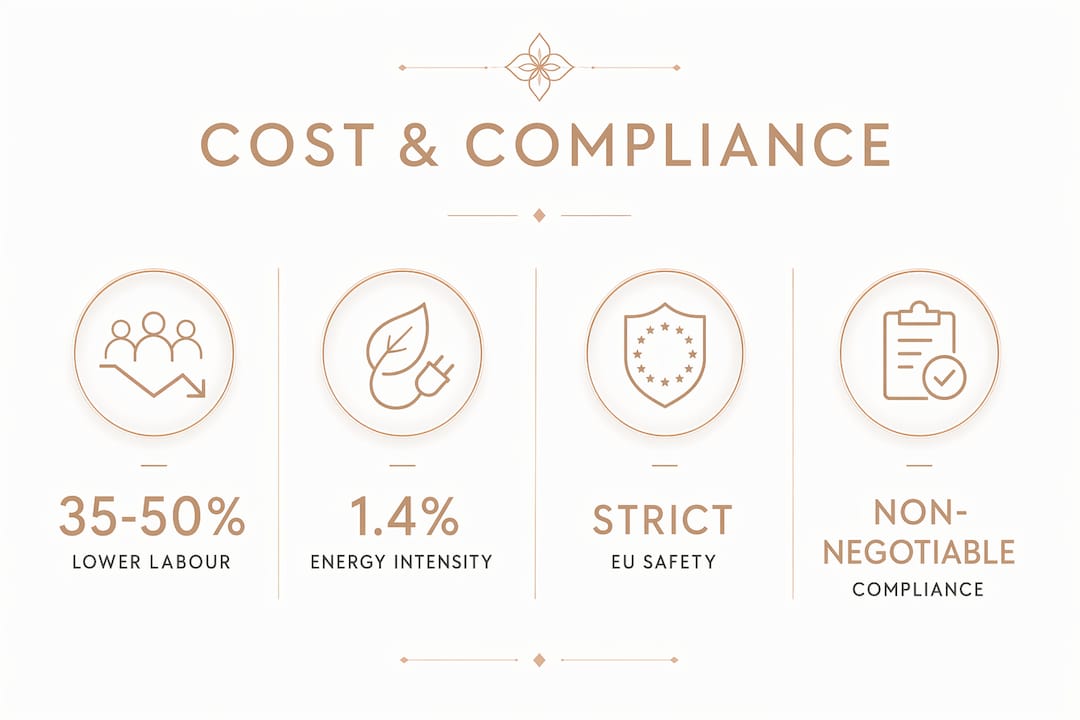
Labour is the single largest driver. Manufacturing labour costs in Eastern Europe run 35–50% below Western EU levels. Bulgaria’s manufacturing wage sits at roughly €6 per hour, Romania’s at approximately €9 per hour. Those figures translate directly into lower unit costs for every bottle, tube, and jar that leaves the production line.

Energy is the second factor. Poland’s cosmetics sector reports energy intensity of just 1.4% of total production costs. That is an exceptionally low figure for a manufacturing industry. It means Polish producers are not absorbing large energy bills that would otherwise push retail prices upward.
Pro Tip: When you see a Polish skincare product priced well below a Western European equivalent, check the ingredient list rather than assuming a quality compromise. The price gap almost always traces back to the factory floor, not the formula.
What EU regulations mean for safety and quality in Eastern Europe
EU Regulation (EC) No 1223/2009 applies uniformly across all 27 member states. There is no Eastern European exemption, no lighter version of the rules, and no grey area that allows cheaper products to skip safety steps. Every legitimate brand, wherever it operates in the EU, must produce a Product Information File and commission a Cosmetic Product Safety Report before placing a product on the market.
The requirements are specific and non-negotiable:
- The Product Information File (PIF) must be maintained for 10 years after the last batch is sold.
- The Cosmetic Product Safety Report (CPSR) must be prepared and signed off by a qualified safety assessor, covering all ingredients and their concentrations.
- A Responsible Person within the EU must be named on every product and is legally accountable for compliance.
- Full ingredient transparency is mandatory under the INCI labelling rules that apply across the single market.
These compliance costs are non-negotiable for all brands, regardless of the product’s retail price. A €5 Polish face cream and a €50 French serum both require a qualified assessor’s sign-off. Affordability cannot be achieved by skipping this stage. It can only be achieved by reducing what happens around it.
Pro Tip: Ask any Eastern European brand for their Responsible Person details. Legitimate brands list this on packaging or their website. If that information is absent, treat it as a red flag regardless of price.
How lower production costs create competitive pricing
The manufacturing cost advantage in Eastern Europe is structural, not temporary. It is built into wages, energy infrastructure, and the way leading producers have organised their supply chains over decades.
| Cost factor | Eastern Europe | Western Europe |
|---|---|---|
| Manufacturing labour (per hour) | €6–€9 (Bulgaria to Poland) | €18–€30+ |
| Energy intensity (Poland) | ~1.4% of production costs | Typically 3–6% |
| Value chain control | High: domestic brands own supply chains | Mixed: often outsourced |
| Compliance costs | Identical (EU Regulation EC No 1223/2009) | Identical |
Poland offers the clearest example of how these factors combine. Domestic brands control their value chains from raw material sourcing through to finished product, which removes the margin that would otherwise go to intermediaries. Export orientation to EU markets means production runs at scale, which reduces per-unit costs further. The result is a product that meets every EU safety requirement and still retails at a fraction of the price of a comparable Western European brand.
Packaging and fill-finish operations are particularly labour-sensitive. Labour cost savings in these stages are significant because they involve repetitive, skilled manual work. Eastern European producers absorb these costs at a structurally lower rate than their Western counterparts, and that saving passes through to the shelf price.
Eastern European vs Western European cosmetics: price and value compared
The most persistent misconception about budget-friendly beauty from Eastern Europe is that a lower price signals a weaker product. The EU’s harmonised safety framework makes that assumption structurally impossible for any compliant brand.
| Factor | Eastern European cosmetics | Western European cosmetics |
|---|---|---|
| Safety standards | EU Regulation (EC) No 1223/2009 | EU Regulation (EC) No 1223/2009 |
| CPSR requirement | Mandatory | Mandatory |
| Typical retail price driver | Labour and energy costs | Labour, energy, and brand margin |
| Brand margin philosophy | Lean, export-focused | Often includes premium positioning |
| Consumer benefit | Lower price for equivalent safety | Established brand recognition |
The key insight is that safety requirements are consistent across regions. What differs is the brand margin philosophy. Western European luxury brands price for heritage, packaging design, and retail positioning. Eastern European producers, particularly Polish brands like Bielenda, Pharmaceris, and Celia, price for market reach. Their margins are leaner because their cost base is leaner, not because their formulations are weaker.
Shoppers looking at an Eastern European cosmetic price comparison should focus on the ingredient list and the compliance signals, not the price tag alone. A product with collagen, algae, or hyaluronic acid at a competitive price point is not suspicious. It is the expected outcome of efficient production in a compliant market.
What to look for when buying Eastern European cosmetics
Identifying genuinely good-value Eastern European cosmetics requires looking past the price. Compliance signals are the most reliable indicator of a legitimate product.
- Full INCI ingredient list: Every compliant EU cosmetic lists ingredients in descending order of concentration. If this is absent, the product is not EU-compliant.
- Responsible Person details: The name and address of the EU Responsible Person must appear on the packaging. This is a legal requirement, not optional.
- Country of manufacture: Transparent labelling of origin is a positive signal. Brands that hide their manufacturing location are worth scrutinising.
- Batch code and expiry date: Both are mandatory under EU law. Their absence is a clear red flag.
- Documented safety assessor: Brands that publish their compliance credentials, or make their PIF documentation available on request, demonstrate genuine accountability.
Brands such as Pharmaceris, Bielenda, and Biały Jeleń publish full ingredient transparency and operate with named Responsible Persons in the EU. These are not budget brands cutting corners. They are established manufacturers with documented compliance histories. The affordable price reflects their production economics, not their attitude to safety. Shoppers can also use resources like M-shop’s guide on saving money buying cosmetics to identify trustworthy products at competitive prices.
Innovation and quality assurance in affordable Eastern European cosmetics
Lower costs do not mean lower investment in product development. Poland’s cosmetics sector has used its cost advantage to fund R&D and move into premium product segments while keeping core lines affordable. This is a deliberate strategy, not a happy accident.
EU compliance documentation itself drives product quality. The CPSR process requires manufacturers to assess every ingredient for safety at the concentration used. That process forces rigorous formulation discipline. Brands cannot simply add an ingredient because it sounds appealing. They must justify its inclusion with safety data. The result is that even affordable lines from Eastern European producers are built on carefully assessed formulations.
Leading Polish brands have responded to growing international demand by investing in dermatologically tested formulations, clinical trials, and specialist ingredient research. Pharmaceris, for example, positions itself in the dermocosmetics segment with products designed for sensitive and acne-prone skin. Celia targets the anti-ageing market with collagen and algae-based formulations. Both brands maintain affordable retail prices while investing in the science behind their products. The Polish cosmetics industry’s growth in EU export markets reflects this combination of quality and competitive pricing.
The trend towards premium segment offerings alongside affordable lines is also significant. Eastern European producers are not locked into the budget tier. They are building brand equity in specialist categories, which in turn validates the quality of their more accessible products.
Key takeaways
Eastern European cosmetics are affordable because of lower labour costs, reduced energy intensity, and efficient value chain control, not because of weaker safety standards or regulatory shortcuts.
| Point | Details |
|---|---|
| EU compliance is identical | All EU cosmetics, including Eastern European ones, require a PIF and CPSR before market placement. |
| Labour costs are structurally lower | Manufacturing wages in Bulgaria and Romania run 35–50% below Western EU levels, reducing unit costs directly. |
| Energy efficiency adds further savings | Poland’s cosmetics sector reports energy intensity of just 1.4% of production costs, a key competitive advantage. |
| Value chain control reduces margins | Polish brands that own their supply chains remove intermediary costs, passing savings to consumers. |
| Compliance signals verify quality | Transparent INCI lists, Responsible Person details, and batch codes confirm a product is genuinely compliant. |
Why I think the “cheap equals low quality” assumption is the most expensive mistake in skincare
I have spent years watching shoppers in the UK walk past Polish skincare products because the price felt suspicious. The logic goes: if it costs that little, something must be wrong. That logic is backwards.
The EU regulatory framework is one of the strictest in the world. A brand cannot place a product on the UK or EU market without a qualified safety assessor signing off on every ingredient. That cost is fixed. It does not shrink because the factory is in Łódź rather than Lyon. What shrinks is the wage bill, the energy bill, and the intermediary margin. The formula stays rigorous because the law requires it.
What I find genuinely interesting is that Eastern European producers have used their cost advantage not to cut corners but to invest in specialist formulations. Pharmaceris building a dermocosmetics range, Celia developing collagen and algae lines, Bielenda expanding into professional skincare: these are not the moves of brands coasting on cheap production. They are the moves of brands with ambition and a stable cost base that lets them fund real R&D.
My practical advice is simple. Check the INCI list. Find the Responsible Person on the packaging. Look for a batch code. If those three things are present, the price is a reflection of where the product was made, not what went into it. That is a distinction worth understanding before you reach for the more expensive alternative.
— Krzysztof
Trusted Polish cosmetics at competitive prices from M-shop
M-shop is a family-run business that sources directly from Poland, which means every product on the site has been personally selected for quality and compliance. The range includes brands such as Pharmaceris, Celia, Bielenda, and Biały Jeleń, all of which carry full EU compliance documentation and transparent ingredient lists.
Shoppers looking for cost-effective Eastern European cosmetics can find dermatologically tested options including the Pharmaceris T anti-acne day cream with SPF, the Celia Collagen and Algae moisturising cream for mature skin, and the Bielenda make-up remover with sweet almond extract. Many products carry up to 15% discounts during sales. The selection reflects a straightforward principle: quality Polish skincare should be accessible to everyone in the UK, not just those willing to pay a premium for a Western European label.
FAQ
Are Eastern European cosmetics safe to use in the UK?
Yes. All EU-compliant Eastern European cosmetics must meet the requirements of Regulation (EC) No 1223/2009, including a full Cosmetic Product Safety Report and Product Information File. These standards apply equally across all EU member states.
Why are Polish cosmetics cheaper than French or German brands?
Polish cosmetics benefit from lower manufacturing labour costs, reduced energy intensity in production, and efficient domestic value chains. Safety and compliance costs are identical across all EU producers, so the price difference reflects production economics, not quality differences.
How can I tell if a cheap Eastern European cosmetic is legitimate?
Check for a full INCI ingredient list, the name and address of an EU Responsible Person on the packaging, a batch code, and an expiry date. All four are legally required for any compliant EU cosmetic product.
Do Eastern European cosmetics use lower-quality ingredients?
No. EU regulations require every ingredient to be assessed for safety at its used concentration before a product reaches the market. Affordable Eastern European brands such as Pharmaceris and Celia use clinically assessed formulations with ingredients including collagen, algae, and hyaluronic acid.
Is buying Eastern European skincare online in the UK a good option?
Yes, provided the retailer sources directly from compliant manufacturers. Buying through a specialist such as M-shop, which selects products personally from Poland, reduces the risk of encountering non-compliant or counterfeit products.