



Why Polish shampoo formulas differ: a UK buyer's guide
Polish shampoo formulas differ because formulators choose different surfactant systems, conditioning chemistries, and active-ingredient levels to match distinct care philosophies. The surfactant blend determines how aggressively a product cleanses; conditioning agents and silicones shape feel and manageability; and the presence of actives like zinc pyrithione or panthenol signals whether a formula targets a specific scalp concern or simply aims for broad sensory appeal.
Quick guide for shoppers:
- Oily scalp: look for anionic surfactants (SLES, SLS) higher up the INCI list for stronger cleansing
- Dry or colour-treated hair: favour glucosides, sodium cocoyl isethionate (SCI), or isethionate-based formulas
- Sensitive scalp: seek trichological lines with mild surfactants, no artificial dyes, and minimal fragrance
- Dandruff or flaking: check for zinc pyrithione or salicylic acid in the first ten INCI ingredients
- Silicone build-up concerns: use a clarifying wash periodically rather than avoiding silicones entirely
Table of Contents
- Why Polish shampoo formulas differ: the surfactant story
- What makes shampoos feel so different from each other?
- How Polish cosmetics split into three distinct camps
- Marketing claims and how to read an INCI list properly
- How to choose the right Polish shampoo: a practical UK checklist
- Red flags and when to see a professional
- Key takeaways
- A seller’s view: what sourcing Polish shampoos actually looks like
- Authentic Polish shampoos, delivered to the UK
- Further reading and authoritative sources
Why Polish shampoo formulas differ: the surfactant story
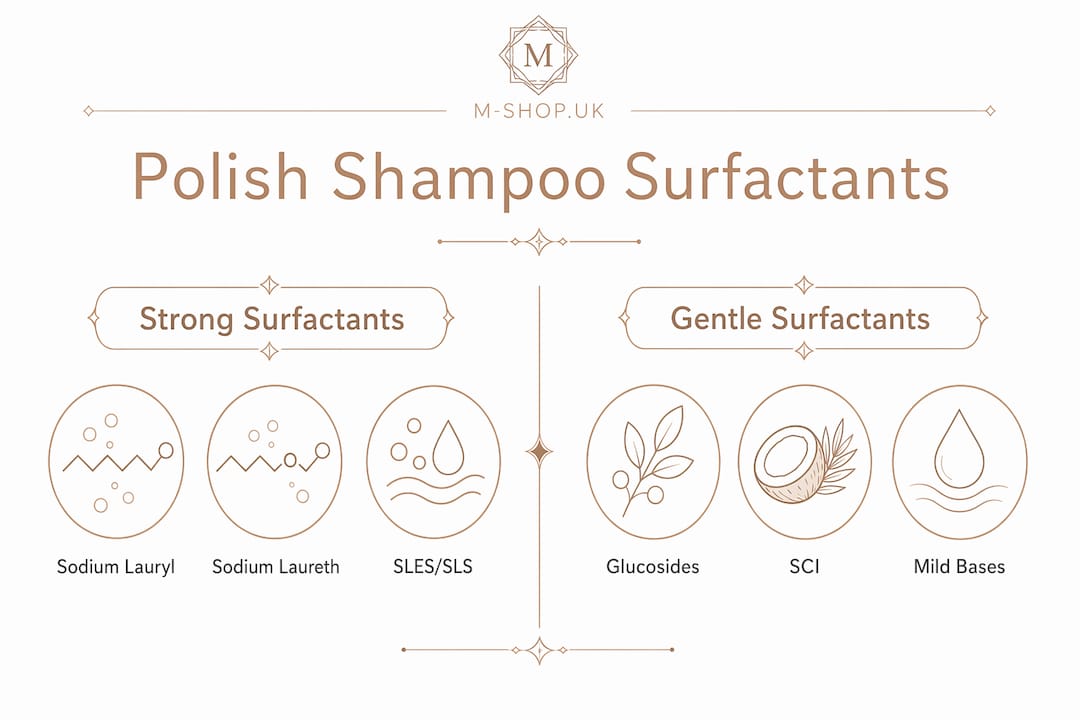
Surfactants do the actual cleaning. Shampoo science research confirms that most commercial formulas pair a primary surfactant with a secondary one (cosurfactant) to balance cleansing power, foam, mildness, and cost. Surfactants typically make up a moderate portion of shampoo by weight, while water makes up the majority of shampoo by weight and marketing additives are usually present in minimal amounts.
The primary surfactant is usually anionic. Sodium lauryl sulphate (SLS) and sodium laureth sulphate (SLES) are the most common, and they deliver strong cleansing and generous foam. SLES is ethoxylated, which makes it somewhat gentler than SLS, though that ethoxylation also reduces viscosity build-up, so formulators compensate with thickeners. Glucosides (coco-glucoside, lauryl glucoside) and sodium cocoyl isethionate are milder alternatives that appear frequently in Polish natural and trichological lines.
One label claim worth treating with scepticism: “sulphate-free.” The sulphate-free label is a marketing category, not a guarantee of mildness. Sodium C14–16 olefin sulphonate, for instance, can cleanse nearly as aggressively as traditional sulphates despite carrying no sulphate in its name.
| Surfactant | Type | Cleansing strength | Typical use |
|---|---|---|---|
| Sodium lauryl sulphate (SLS) | Anionic | High | Mass-market everyday shampoos |
| Sodium laureth sulphate (SLES) | Anionic | High–medium | Most mainstream formulas |
| Sodium C14–16 olefin sulphonate | Anionic | Medium–high | Some “sulphate-free” products |
| Coco-glucoside / lauryl glucoside | Nonionic | Low–medium | Natural and trichological lines |
| Sodium cocoyl isethionate (SCI) | Anionic | Low–medium | Solid bars, sensitive-skin formulas |
| Cocamidopropyl betaine (CAPB) | Zwitterionic | Low (cosurfactant) | Foam and mildness booster |
Pro Tip: Match surfactant strength to your scalp, not to a label. Hair science experts consistently find that oily scalps benefit from stronger anionics, while dry or sensitised hair fares better with glucosides or SCI. Chasing “sulphate-free” without reading the full INCI list often leads to a formula that is no gentler than what you left.
What makes shampoos feel so different from each other?
Cleansing chemistry explains what a shampoo removes. Everything else — the slip, the shine, the creamy lather — comes from conditioning agents, texture modifiers, and fragrance. Most perceived differences between shampoos relate to foam, viscosity, and sensory additives rather than core cleansing ability.
Conditioning agents fall into three broad classes:
- Silicones (dimethicone, amodimethicone): coat the hair shaft to reduce friction and add shine. They do not nourish the scalp, but they deliver immediate smoothness. Build-up is real, though the professional solution is a periodic clarifying wash, not permanent avoidance.
- Cationic polymers (polyquaternium compounds): deposit onto negatively charged hair, reducing static and improving combability. Common in 2-in-1 formulas.
- Fatty alcohols and esters (cetyl alcohol, behentrimonium methosulphate): add slip and softness without the occlusive weight of silicones.
Thickeners such as sodium chloride or carbomers adjust viscosity to meet consumer expectations. A thicker product feels more effective, even when the cleansing chemistry is identical to a thinner one. Pearlising agents like glycol distearate create the opaque shimmer associated with moisturising claims. Fragrance is the most immediate sensory signal of all, yet it contributes nothing to cleansing or conditioning.
Pro Tip: If a shampoo feels “rich” but your scalp is oily by day two, the culprit is usually a heavy silicone or a fatty ester that suits dry hair, not your scalp type. Try a lighter formula with cationic polymers instead.
How Polish cosmetics split into three distinct camps
Polish shampoo brands follow recognisably different philosophies, and understanding them saves time at the checkout.
Mass-market lines prioritise cost efficiency and immediate sensory appeal. SLES sits first or second in the INCI list, silicones deliver instant smoothness, and fragrance is prominent. These products work well for healthy scalps washed two or three times a week, but daily use on a dry or sensitised scalp can strip the hydrolipid barrier over time. As one Polish hair cosmetics study notes, many shampoos on the market offer little beyond good foaming, strong washing, and a pleasant smell.
Natural and plant-based lines swap SLES for glucosides or isethionates and replace synthetic fragrance with essential oils or botanical extracts. The trade-off: lower foam volume and, sometimes, a need for periodic clarifying because plant-based emollients can accumulate. Plant-based ingredients for scalp health can genuinely support the scalp microbiome, but their functional benefit depends on concentration, not just presence on the label.
Trichological lines are where Polish formulation genuinely stands apart. These are designed for scalp health first, with mild surfactant bases, high concentrations of actives (panthenol, lactic acid, probiotic ferments, caffeine), and no artificial dyes.
A trichological shampoo is not simply a “premium” version of a drugstore product. It is built around a different objective: long-term scalp health rather than immediate visual effect. The surfactant base is gentler, the active-ingredient loading is higher, and aggressive additives like synthetic dyes and heavy fragrances are typically absent. For anyone dealing with persistent flaking, irritation, or hair thinning, that difference in formulation philosophy is the reason results diverge.
Marketing claims and how to read an INCI list properly
INCI (International Nomenclature of Cosmetic Ingredients) lists ingredients from highest to lowest concentration. The first five entries account for the bulk of the formula. Everything below 1% by weight can appear in any order, which is where most marketing actives live.
Common claims decoded:
- “Sulphate-free”: means no SLS or SLES, but not necessarily mild. Check what replaces them.
- “Silicone-free”: removes build-up risk but may reduce immediate smoothness. Not inherently better.
- “Fortifying” or “strengthening”: usually signals keratin fragments or hydrolysed proteins. Functional at meaningful concentrations; cosmetic at trace levels.
- “Natural”: no regulated definition in UK cosmetics law. Read the INCI list rather than the front label.
- Vitamins and fruit extracts: cosmetics researchers note these are often present for perception rather than measurable hair benefit, particularly when they appear near the bottom of the list.
Checklist: what to read first on any Polish shampoo label
- Ingredients 1–3: identify the primary surfactant(s) and water position
- Ingredients 4–5: look for cosurfactants (CAPB, betaine) or early conditioning agents
- Scan for key actives: zinc pyrithione (dandruff), salicylic acid (scalp exfoliation), panthenol (moisture), keratin/hydrolysed proteins (strength)
- Check fragrance position: “Parfum” high on the list means a significant fragrance load — relevant for sensitive scalps
- Note preservatives: potassium sorbate and sodium benzoate are common in Polish natural lines; check for paraben-free claims if that matters to you
How to choose the right Polish shampoo: a practical UK checklist
- Identify your scalp type. Oily, dry, normal, or sensitised. This single step narrows the surfactant strength you need.
- Read the first five INCI ingredients. The surfactant system is almost always visible here.
- Match surfactant strength to need. SLES/SLS for oily scalps; glucosides or SCI for dry or colour-treated hair.
- Spot silicones and actives. Dimethicone near the top means a smoothing focus. Zinc pyrithione or salicylic acid signals a therapeutic intent.
- Check fragrance and preservatives. Fragrance-sensitive? Look for “parfum-free” or essential-oil-only formulas. Patch test any new product on your inner arm for 24 hours before full use.
- Consider UK water hardness. Hard water (common across much of England) reacts with anionic surfactants to reduce lather and leave mineral deposits. A chelating agent (EDTA, phytic acid) in the formula helps. Periodic use of a clarifying shampoo removes build-up regardless of formula type.
Pro Tip: Many Polish brands offer smaller trial sizes. If you are fragrance-sensitive or prone to contact reactions, buy the smallest available size first. A patch test costs nothing and saves you from a full bottle of something your scalp rejects.
Red flags and when to see a professional
Switching shampoos is not always the answer. See a dermatologist or trichologist if you notice:
- Severe or worsening scalp itch that does not improve after two weeks off a new product
- Visible sores, weeping, or crusting on the scalp
- Sudden or patchy hair shedding beyond normal daily loss
- Persistent flaking despite consistent use of an anti-dandruff formula containing zinc pyrithione or salicylic acid
- Swelling, hives, or a burning sensation after product contact (stop use immediately and photograph the reaction)
Before your appointment: stop the suspected product, revert to a plain, unfragranced formula, and photograph the affected area over several days. That record helps a clinician identify whether the cause is a specific ingredient (strong fragrance, essential oils, certain preservatives) or an underlying scalp condition.
Key takeaways
Polish shampoo formulas vary because surfactant choice, conditioning chemistry, and active-ingredient philosophy each pull the formula in a different direction — and reading the INCI list is the fastest way to see which direction that is.
| Point | Details |
|---|---|
| Surfactants drive cleansing strength | SLES/SLS cleanse strongly; glucosides and SCI are gentler — match to your scalp, not a label claim. |
| Silicones are a trade-off, not a flaw | They deliver smoothness but can build up; a periodic clarifying wash manages this without daily avoidance. |
| Marketing actives are often trace-level | Vitamins and fruit extracts near the bottom of the INCI list contribute little functional benefit. |
| Trichological lines work differently | Higher active concentrations and milder surfactants distinguish specialist Polish lines from mass-market options. |
| M-shop stocks authenticated Polish lines | M-shop carries both trichological and natural Polish shampoos, sourced directly from Poland for UK shoppers. |
A seller’s view: what sourcing Polish shampoos actually looks like
Sourcing Polish shampoos for a UK audience means making decisions that most shoppers never see. When M-shop selects lines for the shop, the first filter is not price or packaging — it is whether the product’s formulation philosophy matches what UK customers are actually asking for.
The most consistent requests are for fragrance-free or low-fragrance options, genuinely mild formulas for sensitised scalps, and specialist lines that go beyond the mass-market standard. Polish cosmetics have a strong tradition of trichological and natural formulation, and that tradition is precisely what makes them worth importing rather than substituting with a domestic equivalent.
Authenticity verification matters here. Products sourced directly from Polish manufacturers or authorised distributors carry the correct EU/UK INCI labelling and batch traceability. Grey-market imports sometimes do not, which creates both a safety concern and a label-reading problem for the shopper.
Authentic Polish shampoos, delivered to the UK
M-shop is a family-run UK retailer sourcing Polish cosmetics directly from Poland, which means the products arrive with full INCI labelling, correct batch codes, and no grey-market guesswork. For shoppers who have read this far and know what they are looking for, that provenance matters.
The Biały Jeleń hypoallergenic shampoo is a practical starting point for sensitive scalps: a mild surfactant base, minimal fragrance, and a clean ingredient list that is easy to verify. For a specialist skincare example of the trichological philosophy in action, the Pharmaceris range shows how Polish brands approach active-ingredient formulation at a clinical level. Fragrance-sensitive shoppers may also find the AA Oceanic atopy-friendly cleanser worth a look — fragrance-free and formulated for reactive skin.
Browse the full selection at M-shop.uk and use the INCI checklist from this guide to find the formula that fits your scalp.
Further reading and authoritative sources
- Frequency Ranking of Ingredients in Polish Hair Care Cosmetics — MDPI Cosmetics: A detailed analysis of which surfactants, conditioners, and actives actually appear most often in Polish shampoos and conditioners — essential context for understanding what “typical” Polish formulation looks like.
- Shampoo Science: A Physiochemical Review — Macromolecular Chemistry and Physics: Peer-reviewed deep dive into how surfactants, deposition polymers, and structuring polymers interact; the most technically rigorous source in this guide.
- Essentials of Hair Cleansing — International Journal of Trichology: Clinician-facing overview of why shampoo selection is more complex than it appears, and what conditioners can and cannot achieve.
- Lab Muffin Beauty Science — Shampoo and Conditioner Primer: Accessible, well-sourced explainer on surfactant types and the sulphate-free debate; good for readers who want science without jargon.
- Shampoo Formulation: Perception and Reality — Illumin Magazine (USC): Covers the gap between marketing claims and functional ingredient contributions; useful for understanding why label language and formula reality often diverge.
- Hair Care Chemistry: Surfactant and Silicone Primer — Cleange: Practical breakdown of surfactant classes and silicone types, with clear guidance on what “sulphate-free” does and does not mean.
- Trichological vs Drugstore Shampoo — Orientana: Side-by-side INCI comparison of a mass-market and a trichological Polish shampoo; illustrates the formulation philosophy difference in concrete terms.
- Plant-Based Ingredients for Scalp Health — CRISAN Beauty: Industry partner overview of plant-derived actives and their scalp applications; useful for readers exploring natural Polish lines.