



Lip balm types: choose the right balm for your lips
The main lip balm types are tinted, medicated, SPF/sun-protective, hydrating or emollient salves, organic/natural, plumping, exfoliating/treatment, and overnight masks. For most people, the right choice comes down to one question: what is your biggest lip problem right now?
Quick picks by concern:
- Sensitive lips → fragrance-free, petrolatum or shea butter base, no menthol
- Chapped or cracked lips → occlusive ointment or overnight mask (petrolatum-based)
- Sun exposure → SPF balm with zinc oxide or titanium dioxide
- Peeling or flaky lips → exfoliating/treatment balm, followed by an occlusive
- Cold-sore-prone → medicated balm with antiviral ingredient; avoid heavy fragrance
- Everyday colour → tinted balm with a hydrating base
- Sheer daily hydration → lightweight emollient stick or gloss-style balm
Table of Contents
- What are the main lip balm types and formats?
- Which ingredients actually repair lips, and which should you avoid?
- How do you choose a lip balm for your specific concern?
- How should you apply and layer lip balm for best results?
- When should a lip problem see a doctor rather than a balm?
- Why do some balms only feel good without actually repairing your lips?
- Key takeaways
- The routine I actually recommend
- M-shop’s lip care range: products matched to this guide
- Useful sources and further reading
What are the main lip balm types and formats?
Understanding the different types of lip moisturisers starts with knowing what each one is actually designed to do, because the label rarely tells the whole story. Here is a plain-English breakdown, followed by a format comparison.
Tinted balm
A tinted balm adds a sheer wash of pigment to a moisturising base. The colour payoff sits between a clear balm and a lipstick, which makes it the go-to for no-makeup days when you still want a polished look. According to Face of the Forest, tinted balms combine hydration with a cosmetic-friendly finish without the drying effect of traditional lipstick.
Glossy balm
Gloss-style balms prioritise shine over pigment. They tend to use oils and humectants to create a plumped, reflective finish. The trade-off is longevity: they slide off quickly, so reapplication is frequent.
Medicated balm
Medicated balms contain active pharmaceutical ingredients. In the UK, these typically include antiviral compounds for cold sores, or low-concentration hydrocortisone for inflammation. They are not everyday products; use them for a specific, short-term concern.
SPF/sun-protective balm
The skin on the lips is thin and lacks melanin, making it genuinely vulnerable to UV damage. Health.com’s testing recommends mineral filters—specifically, zinc oxide or titanium dioxide—for people with sensitivity, as these sit on the skin rather than absorbing into it. An SPF 30+ rating is the practical minimum for outdoor use.
Natural/organic balm
These use plant-derived waxes (carnauba, candelilla), butters, and oils in place of petroleum-derived ingredients. “Natural” does not mean hypoallergenic, though. Lanolin and propolis, both common in natural formulations, are recognised allergens for some people.
Vegan balm
Vegan balms exclude beeswax and lanolin, substituting plant waxes. The formulation can be just as effective; the distinction is ethical rather than functional.
Plumping balm
Plumping balms use mild irritants (often peppermint, ginger, or cinnamon derivatives) to temporarily increase blood flow and create a fuller appearance. The effect lasts an hour or two at most. If your lips are already sensitive, these are worth skipping.
Exfoliating/treatment balm
These combine a gentle physical or chemical exfoliant (sugar, AHAs) with a conditioning base. Use them once or twice a week to remove flaky skin before applying a richer balm. They are not a daily product.
Overnight mask or ointment
Thick, occlusive overnight balms stay in place while you sleep and create a seal that prevents moisture loss. Haute Style’s product testing found that ointment-style balms gave faster relief for chapped lips than lighter formulas, precisely because they stay put longer.
Format comparison
| Format | Best for | Hygiene | Texture control | Portability |
|---|---|---|---|---|
| Twist stick | Daily use, on the go | Good (no finger contact) | Moderate | Excellent |
| Pot/jar | Overnight masks, rich treatments | Lower (finger dipping) | High | Moderate |
| Squeeze tube | Precise application, travel | Good | High | Good |
| Gloss applicator | Sheer finish, tinted options | Good (wand applicator) | Low | Good |
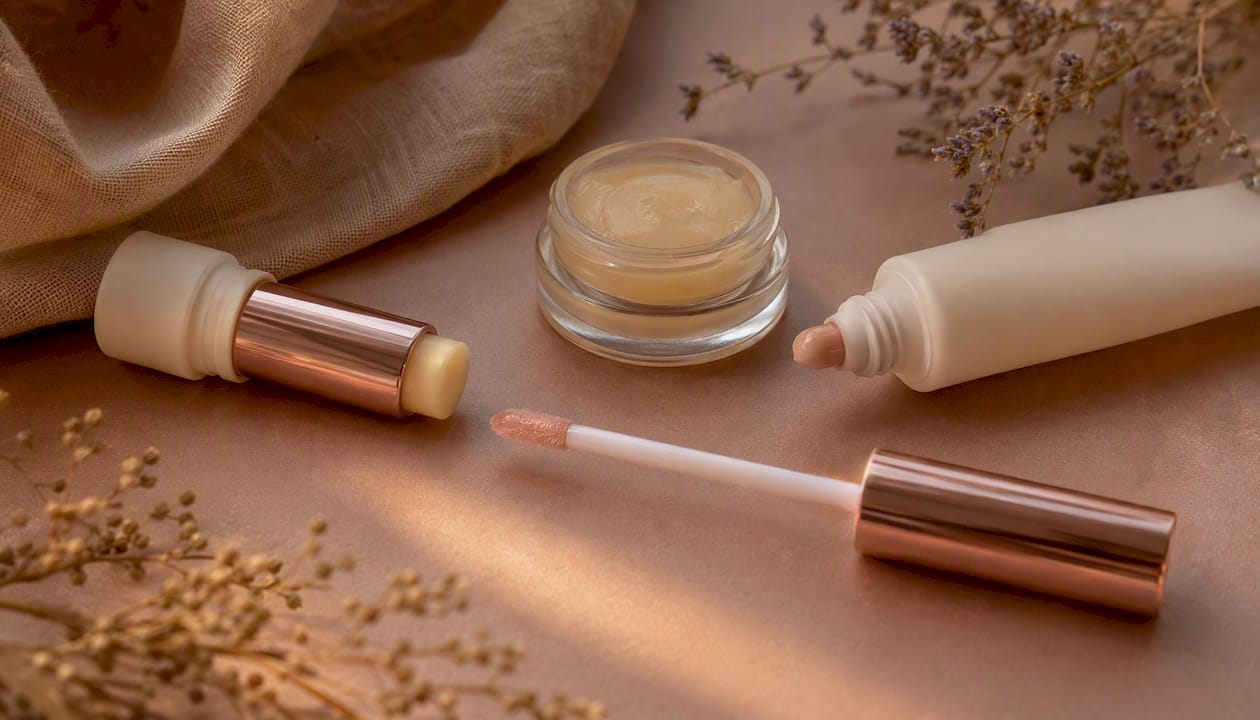
As Haute Style notes, pots offer the most product control but carry a hygiene trade-off when you dip fingers repeatedly. A twist stick is the most practical everyday format for most people.
Which ingredients actually repair lips, and which should you avoid?
Lip balm ingredients fall into three functional groups. Knowing which group does what lets you read any label in seconds.
The three functional groups
Occlusives form a physical barrier on the lip surface to prevent water loss. Petrolatum (petroleum jelly) is the gold standard here: it is inexpensive, well-tolerated, and clinically proven to reduce transepidermal water loss. Waxes (beeswax, carnauba) work similarly but with a firmer texture.
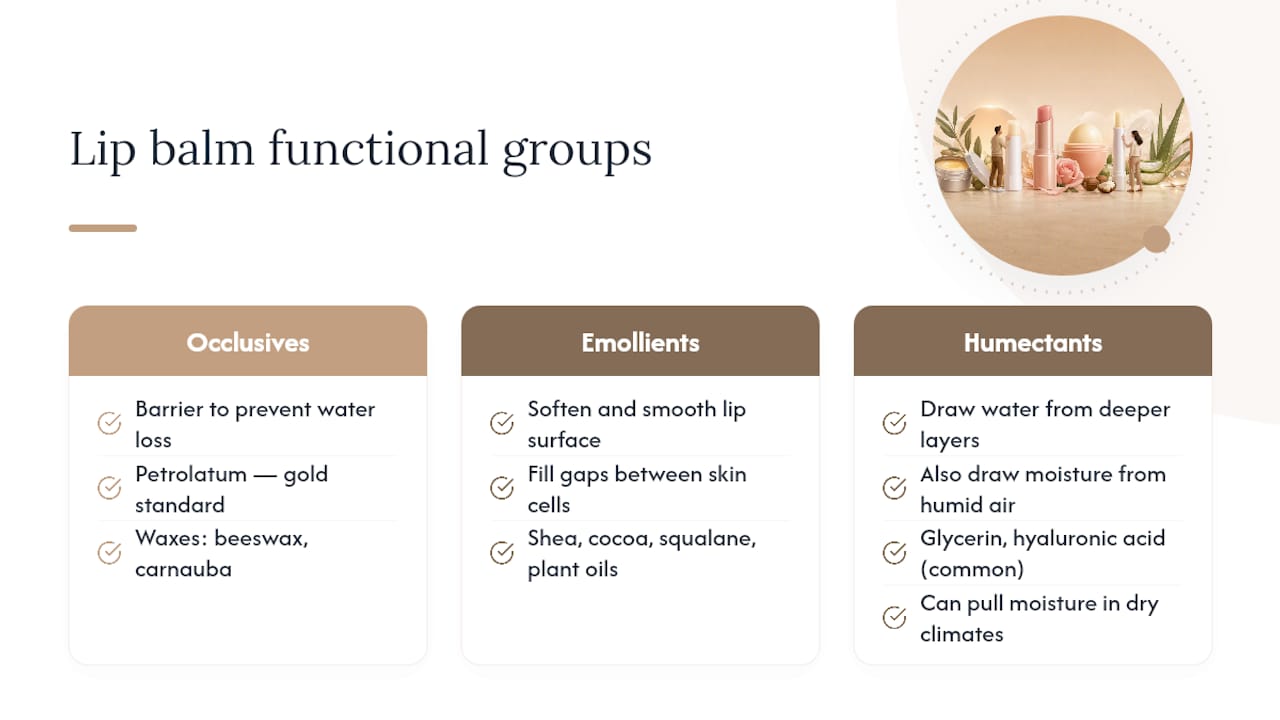
Emollients soften and smooth the lip surface by filling gaps between skin cells. Shea butter, cocoa butter, squalane, and plant oils all fall into this category. They make lips feel comfortable immediately, though they do not seal moisture in the way an occlusive does.
Humectants draw water from the deeper layers of skin (and from the air in humid conditions) up to the surface. Glycerin and hyaluronic acid are the most common. On their own in a dry climate, humectants can actually pull moisture out of the skin, so they work best when paired with an occlusive.
Ingredients worth looking for
Health.com’s testing consistently highlights petrolatum, shea butter, ceramides, and glycerin as the most reliable barrier-supporting ingredients. Ceramides deserve a mention because they mimic the lipids naturally present in skin and help rebuild the lip barrier over time rather than just coating it. Squalane is another strong pick: lightweight, non-comedogenic, and suitable for sensitive skin. For SPF balms, zinc oxide and titanium dioxide are the preferred mineral filters.
Pro Tip: If you want a simple rule for reading a label: look for petrolatum or shea butter in the first three ingredients. That positioning tells you the formula is built around barrier repair, not just flavour or fragrance.
Ingredients to moderate or avoid for sensitive lips
Menthol and camphor are the most common culprits for irritation. They create a cooling sensation that feels soothing, but they do not repair the barrier and can worsen sensitivity with repeated use. Phenol, found in some medicated balms, carries the same risk. Strong synthetic fragrance is a frequent sensitiser, and certain chemical sunscreen filters (such as oxybenzone) can cause contact reactions in people with reactive skin.
Lanolin is worth a separate mention. It appears in many “natural” and “intensive” formulas and works well as an emollient for most people, but it is a recognised allergen. If you have ever reacted to a balm you could not identify, lanolin is a logical suspect. Parabens, used as preservatives, are another ingredient some people prefer to avoid, though the evidence for harm at cosmetic concentrations remains limited.
Patch testing a new balm
Apply a small amount to the inside of your wrist or the skin just below your ear. Wait 24 hours. If you see redness, swelling, or itching, do not use it on your lips. For pot-format balms, use a clean cotton bud rather than your finger for the test. This is especially relevant if you have a history of contact dermatitis or known fragrance sensitivity. You can find more guidance on choosing simpler formulations in M-shop’s guide on why fewer ingredients benefit your skin.
Clinicians note that many popular balms prioritise sensory appeal over barrier repair. Consumers with chronic dryness should favour formulations with ceramides, fatty acids, and occlusives for lasting benefit, according to Allure’s dermatologist-backed testing.
How do you choose a lip balm for your specific concern?
The best lip balm options are the ones matched to your actual problem, not the most popular product on a shelf. Here is how to map your concern to a formula.
Sensitive lips
Go fragrance-free and avoid menthol, camphor, and essential oils entirely. A simple petrolatum or shea butter stick with minimal ingredients is the safest starting point. M-shop’s Polish sensitive skin product guide covers fragrance-free options worth considering.
Very dry or cracked lips
Reach for an ointment-style or overnight mask balm. The thicker the texture, the longer it stays in contact with the lip surface. Petrolatum-based formulas are the most effective here. Avoid anything with menthol, which will mask the dryness without addressing it.
Flaky or peeling lips
Start with a gentle exfoliating balm once or twice a week to lift dead skin, then follow immediately with a rich occlusive. Do not peel skin manually; it damages the barrier and prolongs the problem.
Sun protection
Use an SPF balm with mineral filters (zinc oxide or titanium dioxide) whenever you are outdoors for more than a few minutes. Reapply every two hours, and after eating or drinking. A cyclist or runner needs this more urgently than most: lips are directly exposed, and UV damage accumulates over years.
Cold-sore-prone lips
A medicated balm with antiviral properties is the appropriate tool when a cold sore is developing. Between outbreaks, keep lips well-hydrated with a simple emollient balm; dry, cracked lips are more vulnerable to the virus entering. Avoid heavily fragranced or tingly balms, which can irritate already-compromised skin.
Discolouration
Tinted balms can even out the appearance of uneven lip colour while providing hydration. Look for a neutral or rosy tone with a sheer finish rather than a heavily pigmented formula, which will require more precise application.
Scenario-based picks
| Scenario | Best pick | Key label signal |
|---|---|---|
| Winter commuter | Rich emollient stick, reapply after coffee | Shea butter, ceramides, no menthol |
| Beach day | SPF 30+ mineral balm | Zinc oxide or titanium dioxide |
| Desk worker in heated office | Lightweight humectant balm, keep on desk | Glycerin, hyaluronic acid |
| Cyclist or runner | SPF 30+ with occlusive base | Petrolatum + zinc oxide |
| Sensitive skin, daily use | Fragrance-free, minimal-ingredient stick | Petrolatum or shea butter, no fragrance |
The Guardian’s editorial testing reinforces the point that texture and formulation matter more than price when matching a balm to a specific need.
How should you apply and layer lip balm for best results?
Getting the most from your balm is less about the product and more about when and how you use it.
Day versus night strategy
During the day, a lightweight emollient or tinted SPF balm is the practical choice. It sits comfortably under lipstick or on its own, and it provides the UV protection your lips need outdoors. At night, switch to a thicker occlusive or overnight mask. Your lips do not need to look polished while you sleep; they need a barrier that stays in place for six to eight hours. Dermatologists consistently recommend this two-step approach: lighter care in the day, occlusive treatment at night, as confirmed by Health.com’s expert guidance.
For a broader view of where lip care fits into your full skincare routine, M-shop’s skincare routine order guide is a useful reference.
Layering with SPF and lipstick
Apply SPF balm first, let it settle for a minute, then apply lipstick over the top. This preserves the SPF film rather than disrupting it by applying lipstick directly onto bare lips. If you are wearing a tinted balm alone, no layering is needed. Remove tinted balms and lipstick before bed; sleeping in pigmented products can clog the delicate skin around the lip line.
How often to reapply
Indoors with no UV exposure: reapply when lips feel dry, typically every two to four hours. Outdoors with SPF balm: every two hours, and immediately after eating or drinking. After swimming, reapply regardless of how long you have been in the water.
When should a lip problem see a doctor rather than a balm?
Most lip dryness responds to a consistent balm routine within one to two weeks. Some symptoms, however, signal something a balm cannot fix.
See your GP or a dermatologist if you notice:
- Cracking or bleeding that does not improve after two weeks of consistent occlusive use
- Severe pain, swelling, or a spreading rash around the lips
- Blistering that recurs in the same spot (this pattern is consistent with cold sores and may warrant antiviral prescription treatment)
- White patches, persistent sores, or any lesion that does not heal within three weeks
- Signs of infection: warmth, pus, or increasing redness
Medicated balms containing topical corticosteroids are sometimes appropriate for inflammatory lip conditions such as cheilitis, but these should be used under medical guidance rather than self-prescribed. Over-the-counter antiviral balms are suitable for early-stage cold sores; if outbreaks are frequent or severe, a GP can prescribe oral antivirals.
Pro Tip: When you see your GP, bring the balms you have already tried and note how long you used each one. Mentioning specific ingredients you suspect (menthol, lanolin, fragrance) helps the clinician narrow down contact allergy as a cause quickly.
Why do some balms only feel good without actually repairing your lips?
This is the question most lip balm marketing avoids entirely.
That framing, drawn from Allure’s dermatologist-backed review process, explains why so many people feel dependent on their lip balm: the formula creates a pleasant sensation without addressing the barrier deficit that caused the dryness in the first place.
The practical fix is straightforward. For chronic dryness, build a two-step routine: a ceramide or shea-butter-based balm during the day, and a petrolatum-based ointment or overnight mask at night. Avoid anything with menthol or strong fragrance as your primary daily product. If you want to understand more about why Polish-made formulations often prioritise these functional ingredients, M-shop’s piece on why Polish lip balm ingredients matter is worth reading alongside this guide.
The Wikipedia entry on lip balm provides useful background on formulation categories for readers who want a neutral, encyclopaedic overview of composition.
Key takeaways
The most effective approach to lip care is matching your balm type to your specific concern and choosing a formula built around barrier-repair ingredients rather than sensory appeal.
| Point | Details |
|---|---|
| Match type to concern | Occlusive ointments for cracked lips; SPF balms for sun exposure; tinted balms for everyday colour. |
| Prioritise barrier-repair ingredients | Look for petrolatum, shea butter, ceramides, and glycerin in the first few label positions. |
| Avoid menthol for chronic dryness | Menthol and camphor mask dryness without repairing the barrier and can worsen sensitivity over time. |
| Use SPF outdoors | Choose an SPF 30+ balm with zinc oxide or titanium dioxide whenever you are outside for more than a few minutes. |
| M-shop for Polish-made options | M-shop stocks Polish lip care products with functional, natural ingredients suited to the concerns covered in this guide. |
The routine I actually recommend
The simplest effective routine uses two products: one for the day, one for the night.
In the morning, apply a lightweight emollient balm or a tinted SPF balm before you leave the house. If you are commuting in winter, the SPF still matters: UV reflects off snow, glass, and wet pavements. Reapply after lunch and after any hot drink. That is it for the daytime.
At night, after removing any lipstick or tinted product (a gentle micellar water works well here), apply a thick occlusive balm or overnight mask. Press it in gently rather than rubbing; you want it to stay in place, not spread across the surrounding skin.
For sensitive skin, strip the routine back further: a single fragrance-free, petrolatum-based stick morning and night. No exfoliating balm, no plumping formula, no tint until you have established that your lips are stable.
For frequent travellers, a squeeze tube is the most practical format. It survives bag pressure without cracking, the formula stays uncontaminated, and you can apply precisely without a mirror.
M-shop’s lip care range: products matched to this guide
If this guide has helped you identify what your lips actually need, M-shop makes it straightforward to find a product that fits. The store specialises in Polish lip care products sourced directly from Poland, with a focus on functional ingredients rather than heavy fragrance or marketing-led formulations.
For overnight or intensive repair, the Regenerum Regenerating Lip Serum is a strong option: it is designed to nourish and protect while you sleep, which aligns directly with the occlusive night-step routine recommended throughout this guide. For readers who want broader skincare support alongside their lip care, the Celia collagen range offers rich moisturising options built around natural actives.
M-shop is a family-run business, which means the product selection is curated with genuine care rather than driven by volume. Sales run regularly, with discounts of up to 15% on selected lines. Browse the full range at m-shop.uk and filter by concern or ingredient to find what suits your lips.
This article provides general information about lip care products and ingredients. It is not a substitute for professional medical or dermatological advice. If you have a persistent or worsening lip condition, consult a qualified healthcare professional or check current guidance from the NHS.
Useful sources and further reading
The following sources informed this guide and are worth consulting directly for additional detail:
-
Health.com: The 15 Best Lip Balms — Dermatologist-backed ingredient recommendations and product testing across a wide range of formulas, with particular depth on barrier-repair ingredients and SPF guidance.
-
Allure: 12 Best Lip Balms for Dry Lips — Clinician insight on why tingly and fragranced balms often underperform for chronic dryness, and what to look for instead.
-
The Guardian: The best lip balms — Editorial testing across price points, with practical notes on texture and formulation for different needs.
-
Haute Style: Types of Lip Balm — Practical descriptions of balm types and format trade-offs, useful for understanding stick versus pot versus tube.
-
Face of the Forest: Types of Lip Balm — Accessible overview of tinted and glossy balm options for readers interested in cosmetic-friendly hydration.
-
Wikipedia: Lip balm — Neutral encyclopaedic background on composition and formulation categories for readers who want general context without commercial framing.
-
M-shop: Polish lip care products types — M-shop’s own guide to Polish lip care categories, useful for readers exploring the store’s curated range.