



Polish foundation shades explained: your complete guide
Foundation shade matching is defined by three core components: depth, undertone, and finish. Get all three right and your foundation disappears into your skin. Get one wrong and you end up with a grey cast, an orange jaw, or a face that looks like a different person from the neck down. Polish foundation shades explained through this three-part framework give beauty enthusiasts a reliable system for finding a perfect match, especially when navigating the shade conventions used by Polish brands. Understanding these conventions matters because Polish cosmetics are formulated with Central and Eastern European complexions in mind, including the olive undertones that many Western shade systems simply ignore.
What are Polish foundation shades explained through depth, undertone, and finish?
Foundation shade matching depends on depth, undertone, and finish working together. Each element plays a distinct role, and confusing them is the most common reason a shade looks wrong on the skin.
Depth refers to how light or dark a foundation is on a scale from 1 (fair) to 6 (deep). Most Polish foundation ranges use a numerical depth system, so a shade labelled “3” sits in the medium range. Depth is the element that changes with the seasons as sun exposure darkens the surface tone.
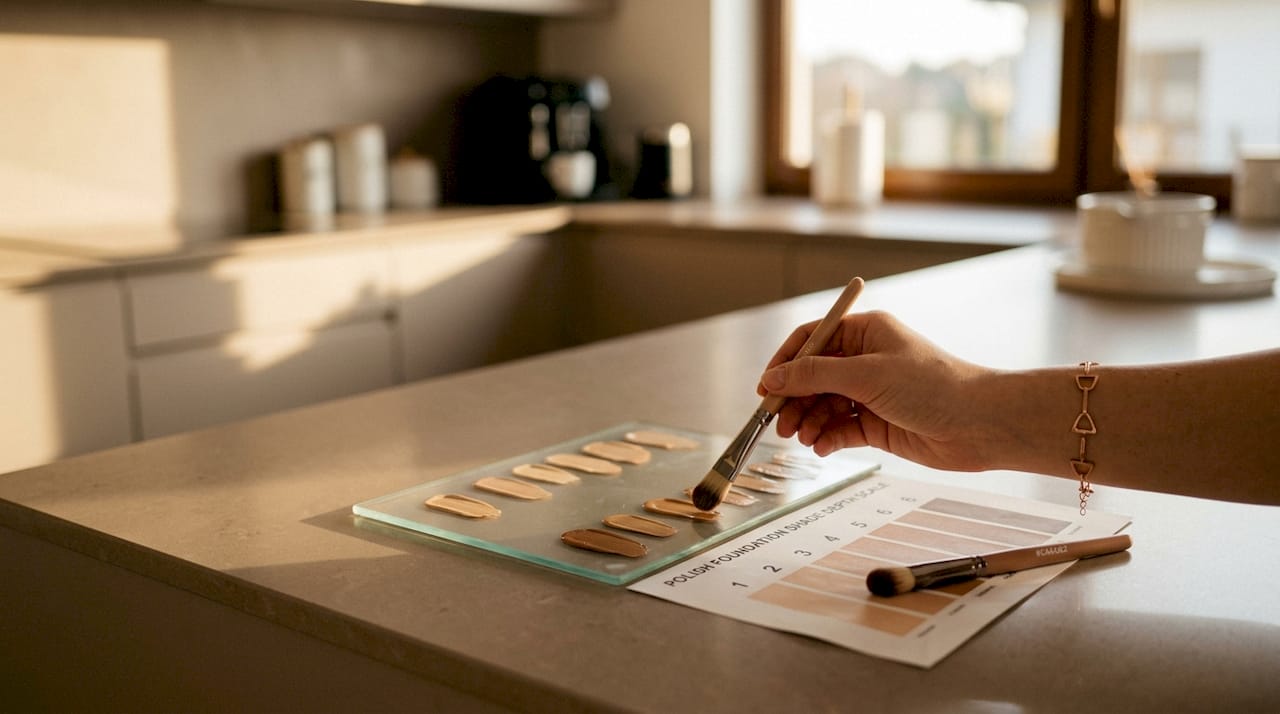
Undertone is the permanent hue beneath the skin’s surface. It does not change with a tan or fade in winter. The four recognised undertone categories are warm (yellow, golden, peach), cool (pink, red, blue), neutral (a balanced mix), and olive (greenish or grey-gold). Olive undertones are particularly common across Central and Eastern Europe, and they require specific attention because a standard warm or cool shade often reads as sallow or ashy on olive skin.
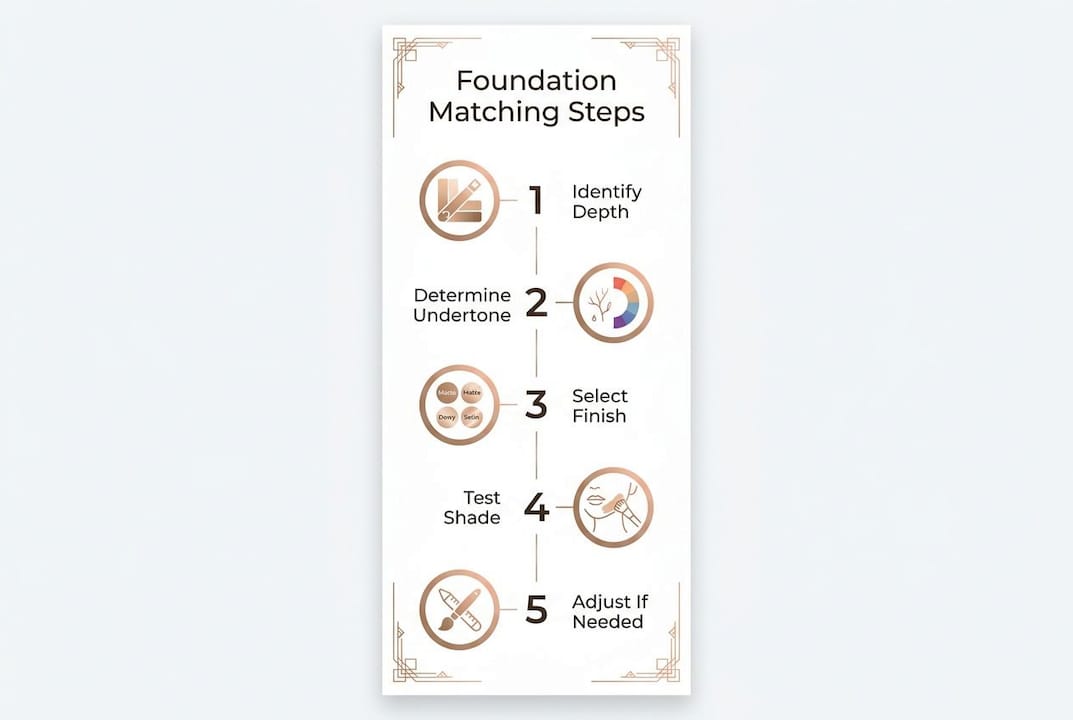
Finish determines how the foundation reflects light once applied. Matte finish suits oily skin and long-wear occasions, dewy finish suits dry skin and delivers a natural glow, and satin sits between the two. Choosing the wrong finish does not cause a colour mismatch, but it does affect how natural the skin looks overall.
How do you identify your undertone accurately?
Undertone identification is the step most beauty enthusiasts skip or rush, and it is the single biggest cause of foundation mismatches. Three reliable tests exist, and using more than one gives a clearer result.
The vein test
Look at the inside of your wrist in natural light. Blue or purple veins indicate a cool undertone, green veins indicate warm, and a mix of both indicates neutral. This test works best on fair to medium skin where veins are visible.
The white paper test
Hold a plain white sheet of paper next to your bare face in natural daylight. If your skin looks yellowish or golden against the white, your undertone is warm. If it looks pink or rosy, your undertone is cool. If it looks grey or greenish, your undertone is likely olive.
The jewellery test
Gold jewellery flatters warm and olive undertones. Silver flatters cool undertones. If both look equally good, your undertone is neutral.
Pro Tip: Do all three tests on the same day in the same lighting. Artificial light distorts colour perception and can push a neutral result toward warm or cool incorrectly.
Olive undertones are frequently misidentified as either warm or neutral, which leads to foundations that look sallow or ashy. The tell-tale sign of an olive undertone is a greenish or muted grey-gold cast to the skin, not a straightforward yellow warmth. If standard warm shades always look slightly off, olive is likely the correct category.
Accurate undertone identification is the foundation of a natural-looking result. A foundation that matches your undertone but is slightly lighter or darker than your depth will blend far better than one that matches your depth but clashes with your undertone.
How does shade depth work, and what about finish?
Shade depth in Polish foundations is measured on a numerical scale, typically running from 1 (fair or ivory) through to 6 (deep or ebony). Most Polish brands cluster their ranges around depths 1 to 4, reflecting the lighter to medium complexions most common in Poland and Central Europe. Depths 5 and 6 are available in broader ranges but less frequently stocked in smaller collections.
Seasonal changes affect surface tone depth but never the undertone. A person who is a depth 2 in january may be a depth 3 by september after summer sun exposure. The practical solution is to keep two foundation shades, one for winter and one for summer, both sharing the same undertone letter in the shade code.
- Depth 1: Fair, ivory, or porcelain tones with minimal melanin
- Depth 2: Light tones, often with visible pink or golden cast
- Depth 3: Light to medium, the most common range for Polish complexions
- Depth 4: Medium, suits warmer or olive complexions at their baseline
- Depth 5–6: Medium deep to deep, less common in Polish ranges but present in broader lines
Testing depth correctly requires applying the shade to the jawline, not the hand or wrist. Jawline testing allows you to compare the shade against both the face and the neck simultaneously, which is the only way to confirm a true match. The wrist is often a different depth from the face due to sun exposure differences.
Pro Tip: After applying a test shade to your jawline, wait 5–10 minutes before judging the result. Many foundations oxidise slightly on the skin, meaning they darken or shift warmer after contact with air and skin oils.
Finish choice comes down to skin type and occasion. Matte foundations control shine and last longer through the day, making them the practical choice for oily skin or humid conditions. Dewy foundations add luminosity and work well on dry or mature skin where a flat finish can emphasise texture. Satin finishes are the most versatile and suit normal or combination skin without looking flat or overly shiny. Skin texture also plays a role: rough or uneven skin texture can affect how any finish sits, so addressing texture before choosing a foundation finish gives a more accurate result.
How do Polish foundation shade codes work?
Polish foundation brands use alphanumeric shade codes to communicate depth, undertone, and sub-variant in a single label. Once you understand the structure, reading a shade code takes seconds.
A typical shade code like ‘3W1’ breaks down as follows: the number indicates depth (3 = medium), the letter indicates undertone (W = warm), and the final number indicates the sub-variant within that category (1 = the first warm medium option). This system is consistent across many Polish and European foundation lines.
| Code element | What it means | Example |
|---|---|---|
| Depth number | Lightness to darkness on a 1–6 scale | 2 = light |
| Undertone letter | W = warm, C or P = cool/pink, N = neutral, G = golden | W = warm |
| Sub-variant number | Distinguishes shades within the same depth and undertone | 1 = first variant |
| Surface descriptor | Descriptive name like Ivory, Sand, or Opal | Ivory = fair surface |
Surface descriptors such as Ivory, Sand, Opal, and Beige describe the visible surface tone rather than the undertone. Ivory typically signals a fair depth with a neutral to cool surface. Sand suggests a light to medium depth with a warm or golden surface. These names are useful for visualising the shade but should never replace reading the undertone letter in the code.
Undertone code letters take priority over depth numbers when comparing shades across different brands. A shade coded 3W from one Polish brand and 3N from another may look identical in the bottle but produce very different results on skin. Always match the undertone letter first, then adjust depth.
Polish brands increasingly standardise their shade coding to help beauty enthusiasts decode their ranges independently. M-shop stocks Polish foundations with clear shade classifications, including the Paese foundation range, which uses structured codes to indicate depth and undertone precisely.
What are the best foundation shade matching tips for Polish products?
Choosing the right Polish foundation shade requires a clear process rather than guesswork. The following steps produce reliable results across all skin types and depths.
- Test on the jawline. Apply a stripe of foundation along the jawline and blend lightly. The correct shade disappears into the skin without a visible line at the jaw or neck.
- Use natural daylight. Artificial lighting in shops or bathrooms distorts colour. Step outside or stand near a window to judge the match accurately.
- Wait for oxidation. Give the shade 5–10 minutes on the skin before deciding. Oxidation can shift a shade noticeably warmer or darker.
- Prioritise undertone over depth. A shade that is slightly too light or too dark but matches your undertone will blend far better than the reverse.
- Account for olive undertones specifically. Olive undertones need foundations with a greenish or grey-gold cast rather than a straightforward warm or cool formula. Look for shades labelled G (golden) or check for olive-specific lines within the range.
- Keep two shades for seasonal changes. Maintain a lighter shade for winter and a deeper shade for summer, both with the same undertone letter. Mixing the two in a 50/50 ratio during transitional months produces a smooth result.
- Use virtual tools as a starting point only. Virtual shade finders require consistent, neutral lighting and pre-existing undertone knowledge to give accurate results. They narrow the options but do not replace in-person testing.
Pro Tip: If you are between two depths, choose the lighter shade for a natural finish and use a bronzer to add warmth. Going darker than your natural depth creates a mask effect that is much harder to correct.
Polish cosmetics are formulated with Central European skin tones in mind, which means the shade ranges reflect the warm, neutral, and olive complexions most common in the region. This makes Polish foundations particularly well-suited to beauty enthusiasts who have struggled to find a match in ranges calibrated primarily for pink-neutral Western European tones.
Key takeaways
Undertone matching is the single most important step in finding a Polish foundation shade that looks natural on the skin.
| Point | Details |
|---|---|
| Undertone comes first | Match your undertone letter before comparing depth numbers across any brand. |
| Olive needs specific shades | Olive undertones require foundations with a grey-gold or greenish cast, not standard warm or cool formulas. |
| Test on the jawline | Apply foundation to the jawline and wait 5–10 minutes to account for oxidation before judging the match. |
| Keep two seasonal shades | Use a lighter shade in winter and a deeper shade in summer, both with the same undertone code. |
| Decode the shade code | The alphanumeric code (e.g., 3W1) tells you depth, undertone, and sub-variant in one label. |
Why undertone knowledge changed how I think about Polish foundations
By Krzysztof
The most common complaint I hear from beauty enthusiasts who have tried Polish foundations and been disappointed is that the shade “just looked wrong.” Nine times out of ten, the problem is not the product. It is that the person matched depth and ignored undertone entirely.
Polish brands fill a genuine gap in the market. They account for the olive undertones that are common across Central and Eastern Europe but largely absent from the shade systems of many Western brands, which tend to calibrate around pink-neutral ranges. When a beauty enthusiast with an olive complexion finally tries a Polish foundation coded for golden or olive undertones, the reaction is almost always the same: “This is the first foundation that has ever looked like my actual skin.”
The seasonal mixing approach is something I advocate strongly. Keeping two shades and blending them through spring and autumn is not a complicated technique. It takes thirty seconds and produces a result that no single shade can match year-round. Most beauty enthusiasts resist it because it sounds like extra effort, but once they try it, they never go back to a single shade.
My honest view is that undertone education should come before any product recommendation. No shade guide, virtual tool, or quiz replaces knowing your own undertone category. Once you know it, choosing between Polish foundation shades becomes straightforward rather than a process of trial and error.
— Krzysztof
M-shop’s Polish foundation range: where to start
M-shop brings a curated selection of Polish foundations directly from Poland to beauty enthusiasts across the UK, with shade ranges that reflect the depth and undertone diversity of Central European complexions.

Every foundation in the M-shop range comes with clear shade coding so you can apply the depth-undertone-sub-variant system immediately. The team at M-shop offers personal guidance on undertone matching, drawing on direct knowledge of the Polish brands they stock. Prepping your skin before foundation application also makes a significant difference to how any shade wears: the Pharmaceris T Sebostatic Day cream normalises sebum production and creates an even base, which helps foundation sit truer to its shade throughout the day. For a broader look at what Polish cosmetics offer, the M-shop Polish cosmetics guide is a strong starting point before you browse the foundation range.
FAQ
What are the main undertone categories in Polish foundations?
Polish foundations use four undertone categories: warm (yellow, golden, peach), cool (pink, red, blue), neutral (balanced), and olive (greenish or grey-gold). Olive is particularly relevant for Central and Eastern European complexions.
How do I read a Polish foundation shade code?
A shade code like 3W1 means depth 3 (medium), W for warm undertone, and 1 for the first sub-variant in that category. The undertone letter is the most important element to match.
Should I match foundation to my face or my neck?
Test foundation on the jawline rather than the hand or wrist. The jawline sits between the face and neck, so a shade that disappears there will blend across both.
Does my foundation shade change in summer?
Your depth may shift with sun exposure, but your undertone stays constant year-round. Keeping a lighter and a deeper shade with the same undertone letter and mixing them seasonally is the most reliable approach.
Why does my warm-toned foundation look ashy on my skin?
Ashy results on skin that appears warm often signal an olive undertone rather than a true warm one. Olive undertones need foundations with a grey-gold or greenish cast, which standard warm shades do not provide.