



See Spirulina Skincare Results in 4–12 Weeks for UK Skin: Use Extracts
Spirulina supports skin hydration, antioxidant defence and calmer, less inflamed skin when it’s delivered through a properly formulated product, not just stirred into a smoothie. The evidence is real but modest: small clinical trials and in vitro studies, not large-scale dermatology trials. The active compounds doing the work are phycocyanin, carotenoids and proteins, and most people need four to twelve weeks of consistent use before they notice a genuine difference.
TL;DR:
- Formulated spirulina extracts like Elixspir® provide antioxidant, anti-inflammatory, and hydration benefits without staining or stability issues seen with raw biomass.
- Clinical trials show improvements in skin hydration and moisture retention over four weeks, especially in older skin, but large, long-term studies are still lacking.
- Spirulina benefits include supporting collagen transparency, reducing UV damage, and calming skin conditions like acne, but it should complement, not replace, established treatments.
- Use a product with at least 0.1% spirulina extract applied twice daily over four to twelve weeks, avoiding DIY masks that risk staining or irritation.
- Ensure sourcing from reputable suppliers that test for microcystins and provide stability to avoid contamination and degradation risks.
Table of Contents
- What spirulina contains and how it acts on skin
- What does the research say about spirulina and skin?
- Which skin concerns does spirulina actually help?
- How should you actually use spirulina on your skin?
- Is spirulina skincare safe, and what are the risks?
- Why does M-shop feature spirulina in its skincare curation?
- Practical verdict: who should try spirulina and how to start
- A publisher’s honest take on spirulina in skincare
- Where to start with spirulina skincare from M-shop
- Sources
What spirulina contains and how it acts on skin
Spirulina isn’t actually spirulina, technically speaking. The blue-green algae sold under that name is usually Arthrospira platensis, reclassified in some scientific literature as Limnospira, though the commercial world never gave up the old name. That naming quirk matters less than a more practical distinction: whole dried biomass (the powder you’d stir into a shake) behaves very differently on skin than a purified extract designed for topical formulations.
The biomass is a blunt instrument. It carries everything the organism produces, including plant cell debris, chlorophyll, and enough blue pigment to stain a white flannel permanently. An extract isolates and concentrates the compounds that actually do something for skin, while stripping out the parts that just make a mess. That’s the difference formulators care about, and it’s the difference that should guide what you buy.
The four compounds doing the real work:
- Phycocyanin — the blue pigment and spirulina’s headline active. It has measurable antioxidant and anti-inflammatory activity in cell studies, and researchers have linked it to lower sebum output and early signs of collagen support, though Healthline’s overview of the evidence is careful to flag that human trials remain limited.
- Carotenoids — pigments related to beta-carotene that absorb UV-generated free radicals before they damage skin cells, giving spirulina a supporting role in photoprotection (never a replacement for sunscreen).
- Proteins and peptides — spirulina is roughly 60-70% protein by dry weight, and some of those protein fragments appear to stimulate fibroblasts, the cells responsible for producing new collagen.
- Polysaccharides — sugar chains that sit on the skin’s surface and pull in moisture, contributing to the hydration effect seen in formulated products.
A 2025 review in PMC ties these compounds to several linked actions worth knowing the names of, even if you never repeat them to anyone: antioxidant and anti‑inflammatory activity in eco‑friendly cosmetic formulations, inhibition of matrix metalloproteinases (enzymes that break down collagen as skin ages), and inhibition of tyrosinase, the enzyme that triggers melanin production and, when overactive, causes dark spots.
Pro Tip: If a spirulina product turns your palm faintly teal within seconds, it’s almost certainly using raw biomass rather than a refined extract, worth knowing before you put it anywhere near a white pillowcase.
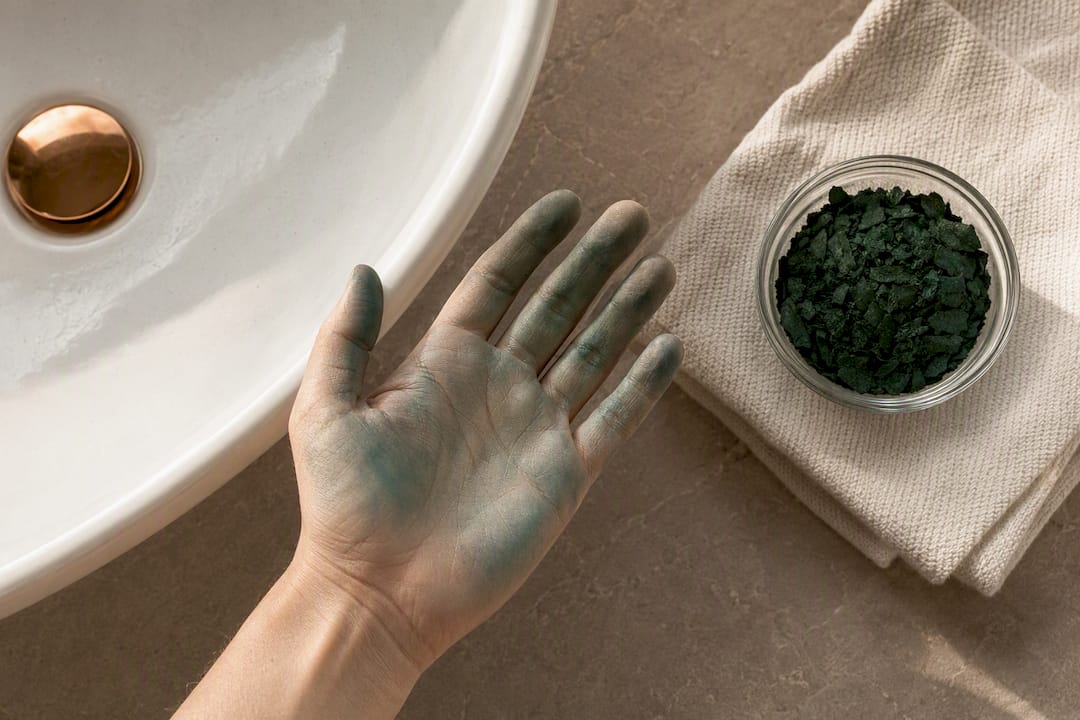
That staining problem is exactly why formulation technology has moved on. Encapsulation and nanoemulsion techniques now protect the bioactive compounds during manufacturing and improve how well they penetrate the outer skin layer, addressing three problems at once: colour, stability, and absorption. A newer extract called Elixspir®, tested in both 2D cell cultures and 3D reconstructed skin models, reduced intracellular oxidative stress, inhibited tyrosinase and cut UV-induced DNA fragmentation, all while staying pale enough not to discolour a cream base, according to research on the Elixspir® extract published in the International Journal of Molecular Sciences. That’s the trajectory the whole category is on: away from crude blue powder, towards refined, light-coloured extracts that do the job without the mess.
What does the research say about spirulina and skin?
The honest summary is this: the in vitro signal is consistent and the small human trials that exist point the same direction, but nobody has run a large, long-term clinical trial on spirulina skincare the way they have for retinoids or niacinamide. Treat it as a well-supported adjunct, not a proven standalone treatment.
Cell-level studies are where the clearest results sit. Fibroblast assays, the standard lab method for testing whether a compound encourages collagen-producing cells to actually produce collagen, have shown measurable increases in collagen output when exposed to spirulina extracts, alongside improved wound-healing markers in keratinocyte cell lines, the cells that make up the skin’s outer barrier. That data comes from formulation studies examining spirulina’s effects on skin cells, and it’s the kind of controlled, repeatable result that gives the ingredient real scientific footing, even before you get to human skin.
Human trials are smaller but not absent. The most frequently cited regimen in the literature uses a facial gel-cream containing 0.1% spirulina extract, applied twice daily for four weeks. In that setup, researchers recorded improved stratum corneum water content and reduced transepidermal water loss, the two standard metrics dermatology researchers use to measure how well skin holds onto moisture and how much it loses through the surface. Notably, the effect showed up more strongly in older participant groups than younger ones, suggesting spirulina’s hydration benefit may matter most for skin whose natural barrier function has already started declining.
| Study type | What was tested | Key measurement | Typical duration |
|---|---|---|---|
| In vitro fibroblast assay | Collagen production response | Collagen output vs untreated control | Days (cell culture) |
| 2D/3D skin model | Elixspir® extract, UV exposure | ROS levels, tyrosinase activity, DNA fragmentation | Single/short exposure |
| Small clinical trial | 0.1% extract gel-cream, twice daily | Stratum corneum water content, TEWL | 4 weeks |
| Keratinocyte cell line study | Wound-healing formulation | Re-epithelialisation rate | Days (cell culture) |
Where confidence runs thinnest is sample size. Most human trials involve small volunteer groups, sometimes a few dozen participants, over a matter of weeks. That’s enough to detect a hydration signal worth reporting, but not enough to make sweeping claims about anti-ageing reversal or long-term structural skin change. A 2021 review covering formulation approaches to spirulina in cosmetics, including commercial extracts like NatPure APX and Spiruline AP®, reached a similar conclusion: the clinical and formulation evidence supports moisturising, anti-wrinkle and anti-acne actions, but calls for larger trials before the ingredient earns claims stronger than “supportive”.
What the evidence supports with reasonable confidence:
- Improved skin hydration and reduced water loss over a 4-week topical regimen
- Antioxidant activity that neutralises free radicals at the cellular level
- Photoprotective and tyrosinase-inhibiting effects in lab and skin-model testing
- Early-stage collagen support in fibroblast cell studies
Which skin concerns does spirulina actually help?
Spirulina’s relevance shifts depending on what you’re trying to fix, and it’s worth being precise about where the evidence is strongest versus where it’s simply plausible.
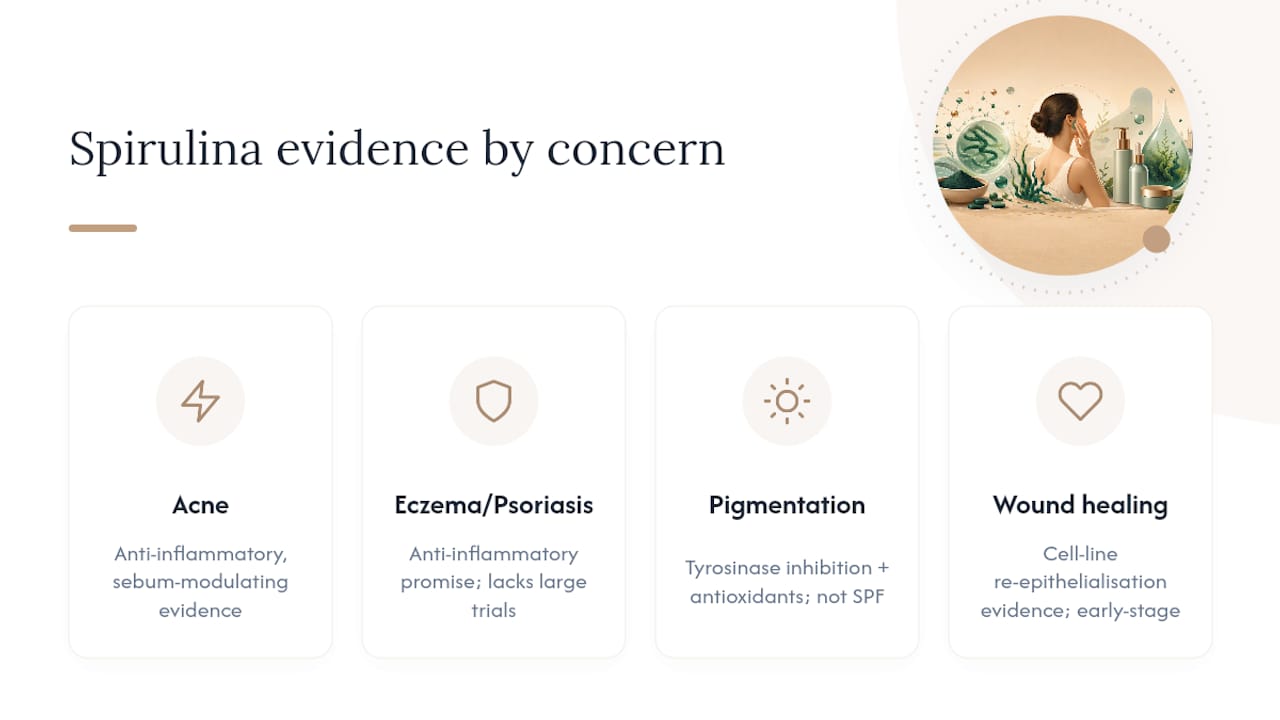
Acne. The rationale here rests on phycocyanin’s anti-inflammatory action and some evidence of sebum-modulating effects, the idea being that calmer inflammation and reduced oil production both help prevent new breakouts. Formulation studies back this up enough that spirulina appears in anti-acne product lines, but it works best paired with established acne actives rather than instead of them; a normalising SPF-containing cream that already targets sebum is a more sensible base than a spirulina serum alone.
Eczema and psoriasis. The anti-inflammatory mechanism is genuinely promising on paper, given how central inflammation is to both conditions. What’s missing is the large clinical trial data that would let anyone recommend spirulina as a primary treatment. Use it, if at all, as a gentle addition alongside whatever a dermatologist has already prescribed, never as a replacement.
Photodamage and hyperpigmentation. Tyrosinase inhibition gives spirulina a legitimate role in reducing dark spot formation, and the antioxidant activity from carotenoids and phycocyanin helps counter some UV-related cellular stress. None of this replaces daily sunscreen. Spirulina supports the skin’s defences; it doesn’t block UV rays the way an SPF formula does.
Wound healing. This is where the cell-line data is most encouraging. Keratinocyte studies have shown accelerated re-epithelialisation, the process by which new skin cells migrate across a wound to close it, when exposed to spirulina-containing formulations. It’s early-stage evidence, mostly from cell cultures rather than people with actual wounds, but it’s consistent enough to explain why spirulina shows up in recovery-focused skincare lines.
How should you actually use spirulina on your skin?
Start with the product form, because it decides almost everything else. A crude powder mixed at home behaves nothing like a stabilised extract in a lab-tested cream, and the two shouldn’t be judged by the same standard.
- Choose a formulated extract over raw powder for daily use. Look for “Spirulina extract” or “C-phycocyanin” on the ingredients list rather than plain “Spirulina” or “algae powder”, since extracts give you consistent dosing without the staining or grit of whole biomass.
- Apply a spirulina cream or serum twice daily. This mirrors the regimen used in the clinical hydration studies, and it’s a realistic habit to build into an existing morning and evening routine rather than treating spirulina as a separate ritual.
- Reserve DIY masks for one or two applications a week. A homemade spirulina mask (powder mixed with a base like yoghurt or honey) can offer a short hydration boost, but it’s not a substitute for a formulated leave-on product, and it carries a real staining risk on fabric and, temporarily, on paler skin tones.
- Give it four to twelve weeks before judging results. The clinical hydration data comes from four-week trials, but visible changes to fine lines or overall texture, if they happen at all, tend to sit at the longer end of that window.
- Pair it with, rather than swap it for, your established actives. Spirulina works as a support ingredient alongside retinoids, vitamin C or niacinamide, not as a replacement for any of them.
If you’re mixing your own mask, keep the concentration modest and patch-test first; raw biomass is far more likely to irritate sensitive or barrier-impaired skin than a formulated product that’s already been through stability testing. Skip DIY entirely if your skin is actively compromised, inflamed, or reacting to other products, and reach for a finished formulation instead. Curated gift sets built around algae-based masks, like the ones from Sayhey Gifting, are a low-risk way to trial the ingredient in a properly formulated, single-use format before committing to a full routine.
Pro Tip: If a recipe or product doesn’t specify a percentage of spirulina extract, assume it’s using whole powder, and treat any staining on your towel as confirmation, not a fluke.
Is spirulina skincare safe, and what are the risks?
The biggest overlooked risk with spirulina isn’t irritation, it’s sourcing. Spirulina cultivated in poorly controlled conditions can carry microcystins, toxins produced by certain contaminating cyanobacteria that share the same growing environment. This is a supplement-industry concern more than a topical-skincare one, since ingestion carries higher exposure risk than skin contact, but it’s still worth checking that any product, topical or oral, comes from a supplier that tests for contamination and states it on the label or website.
Beyond contamination, the practical risks are smaller and easier to manage:
- Allergy. Spirulina is, technically, a food product, and anyone with a known algae or seafood-related sensitivity should patch-test on the inner arm before applying it to the face.
- Staining. Raw powder and unrefined extracts contain enough phycocyanin pigment to temporarily tint pale skin and permanently mark light-coloured fabric; refined, light-coloured extracts like Elixspir® are specifically designed to avoid this.
- Pregnancy and breastfeeding. Evidence on topical spirulina use during pregnancy is limited rather than reassuring or alarming, so speak with a doctor before adding it to a routine during this period.
- Formulation stability. Phycocyanin degrades with heat and light exposure, which is why well-made products use opaque packaging and why homemade masks should be mixed fresh rather than stored for later use.
None of this makes spirulina a high-risk ingredient. It sits closer to “check the label and patch-test” than “proceed with caution”, provided you’re buying from a supplier that takes sourcing seriously.
Why does M-shop feature spirulina in its skincare curation?
Products are selected for the UK market with one filter above all others: does the formulation back up its claims with something more than marketing copy. The curation process runs on personal accountability rather than a faceless buying algorithm, and algae-based actives, spirulina included, have earned a place in the catalogue on that basis.
That standard shows up in results, not just selection criteria. Internal testing on M-shop’s own algae face mask range recorded a 27% hydration increase within 15 minutes of application, a fast, measurable result that lines up with the broader research on algae-derived actives supporting the skin’s water content.
A handful of catalogue products reflect the mechanisms covered earlier in this guide:
- Algae-based hydrating masks, suited to anyone chasing a quick moisture boost without committing to a full routine change.
- Collagen and algae moisturising creams, which pair collagen support with algae-derived hydration for a combined anti-ageing approach.
- Anti-acne creams with SPF, relevant for readers dealing with breakouts who also need daily photoprotection built in rather than layered on separately.
Product selection like this only works when it’s grounded in what the ingredient actually does, not what a label promises. That’s the standard M-shop applies before anything reaches the shelf.
Practical verdict: who should try spirulina and how to start
Spirulina skincare makes the most sense for a specific set of people: anyone dealing with mild dehydration and a compromised moisture barrier, skin showing early oxidative stress or dullness, or readers who want a gentle anti-inflammatory support ingredient alongside an existing acne or ageing routine. It’s a weaker fit for anyone expecting it to replace retinoids, vitamin C, or a dedicated SPF, because the evidence simply doesn’t support that role.
Before buying anything, run through a short checklist:
- Check the ingredients list for “Spirulina extract” or “C-phycocyanin”, not just “spirulina” or “algae”, since that distinction separates a dosed active from a marketing footnote.
- Look for a stated concentration where the brand provides one; the clinical hydration data used 0.1% extract in a twice-daily gel-cream over four weeks, which gives you a real benchmark to compare against.
- Favour suppliers that mention stability testing or opaque, light-blocking packaging, since phycocyanin degrades under light and heat.
- Research the supplier’s sourcing standards, particularly around contamination testing, given the microcystin risk tied to poorly controlled cultivation.
- Patch-test on the inner arm for 48 hours before applying anything new to the face.
A sensible four-week starter routine looks like this: introduce one spirulina-containing product, ideally a moisturiser or serum, and apply it twice daily without adding anything else new at the same time. That isolation matters, since it’s the only way to know whether any change in your skin is actually down to the spirulina and not something else you introduced the same week. Reassess hydration and texture at the four-week mark, the same interval used in the clinical trials, and extend to twelve weeks if you’re watching for finer lines or tone evenness. Consult a dermatologist before starting if you have active eczema, psoriasis, or any diagnosed skin condition currently under treatment, since spirulina should sit alongside a prescribed regimen, not replace it.
A publisher’s honest take on spirulina in skincare
Spirulina earns its place in a well-curated routine, but not for the reasons most marketing copy suggests. It’s not a miracle anti-ageing ingredient, and treating it as one sets people up to be disappointed within a fortnight. What it actually offers is steadier: real antioxidant and hydration support, backed by consistent lab data and a handful of well-designed small trials, working quietly in the background alongside whatever else is doing the heavier lifting in a routine.
The ingredient’s biggest problem has never been efficacy. It’s presentation. Years of grainy blue powder and staining homemade masks gave spirulina a reputation for being messy and unrefined, when the real story is that formulation technology has simply caught up with the science. A well-made extract behaves nothing like the powder your gran might have stirred into a smoothie in 2015.
…
— Krzysztof
Where to start with spirulina skincare from M-shop
The advantage is not a bigger catalogue, but a smaller, better-checked one, chosen with care and attention to formulation data before stocking. That matters most with an ingredient like spirulina, where the gap between a properly dosed extract and a marketing gimmick is easy to miss unless someone’s paying attention on your behalf.

If acne and photoprotection are your priority, the Pharmaceris T Sebostatic Day anti-acne cream with SPF combines sebum-normalising action with daily sun defence, a sensible pairing given that spirulina supports but never replaces SPF. For anyone focused on barrier repair and gentle daily hydration, the Celia Collagen + Algae moisturising cream pairs collagen support with algae-derived actives in a lightweight formula suited to daily use. And if sensitivity is more your concern than ageing, the Biały Jeleń hypoallergenic chestnut soap offers a gentler entry point for reactive skin.
Whichever you choose, patch-test first and introduce one new product at a time, the same rule that applies to any active ingredient worth taking seriously. Browse the full range at M-shop and start with the product that matches the concern you actually have, not the one with the shiniest packaging.
Sources
- Comprehensive review of the latest investigations of the health‑enhancing effects of selected properties of Arthrospira and Spirulina microalgae on skin
- Unveiling the skin anti‑aging potential of the novel Spirulina platensis extract Elixspir®
- Spirulina as a key ingredient in the evolution of eco‑friendly cosmetics
- Spirulina for skin care: a bright blue future
- Does Spirulina Have Benefits for Skin Care?