



Pielęgnacja ciała: what it means in English
Pielęgnacja ciała means body care in English. That is the direct, dictionary-grade translation, confirmed by the Cambridge Dictionary’s Polish-English entries. If you have seen the phrase on a Polish cosmetics label, a care plan, or a beauty blog, “body care” is the safe, neutral equivalent to reach for.
Quick synonyms, each with a nuance tag:
- Body care — neutral, universally understood; the closest match
- Bodycare — one word, common on product packaging and retail sites
- Personal care — broader; includes hygiene and grooming beyond skin
- Skincare — narrower; focuses specifically on skin treatment
For verification, Reverso and bab.la both list “body care” and “bodycare” as standard English equivalents.
Key takeaways
Pielęgnacja ciała translates directly to “body care” in English, with grammar, pronunciation, and cultural nuance that make it richer than a bare two-word swap.
| Point | Details |
|---|---|
| Direct translation | Pielęgnacja ciała means “body care”; “bodycare” is the common one-word retail variant. |
| Grammar note | Ciała is genitive singular of ciało; the pattern repeats in pielęgnacja twarzy, pielęgnacja włosów. |
| Pronunciation | Learner-friendly: pyeh-LEG-nats-ya CHAH-wah; stress on the second-to-last syllable. |
| Choosing the right term | Use “body care” generally, “personal care” in clinical documents, “skincare” only for skin-specific contexts. |
| Cultural nuance | Pielęgnacja implies a sustained, nurturing routine, not a single action. |
Table of Contents
- What do “pielęgnacja” and “ciała” each mean?
- Which English equivalent should you use?
- Polish example sentences with English translations
- How do you pronounce “pielęgnacja ciała”?
- When do you use “pielęgnacja ciała” and what related phrases should you know?
- The etymology of “pielęgnacja”: more than maintenance
- A brief note from the editor
- Sources
What do “pielęgnacja” and “ciała” each mean?
Pielęgnacja is a feminine noun derived from the verb pielęgnować, which carries the sense of tending, nurturing, or caring for something with regular attention. Think of it less as a one-off action and more as an ongoing practice.
Ciała is the genitive singular of ciało (body). Polish noun phrases are often built with a noun followed by a genitive, so pielęgnacja ciała literally reads as “the care of the body.” The same pattern produces related phrases: pielęgnacja twarzy (face care), pielęgnacja włosów (hair care). Bab.la confirms that pielęgnacja is grammatically feminine, which affects adjective agreement when you expand the phrase in Polish.
Which English equivalent should you use?
Context decides. Here is a practical comparison:
| English term | Typical context | Scope |
|---|---|---|
| Body care | Product labels, beauty writing, general use | Skin, body, routine hygiene |
| Bodycare | Retail packaging, e-commerce categories | Same as above, one-word variant |
| Personal care | Healthcare, pharmacy, caregiving | Broader: hygiene, grooming, toiletries |
| Skincare | Beauty editorial, dermatology | Skin only |
“Body care” covers the widest everyday ground and maps most directly to pielęgnacja ciała. “Skincare” is too narrow if the original Polish context includes bathing or nail care. “Personal care” is the right choice in a healthcare or caregiving document. Reverso’s bodycare entry lists cleanliness, hygiene, and skincare as related concepts, which shows how fluidly the terms overlap.
Pro Tip: On a product label or an e-commerce site, “bodycare” (one word) is the most common retail convention in the UK. In a clinical or care-plan document, write “personal care” instead.
Polish example sentences with English translations
Reverso Context supplies authentic sentence-level usage. Here are five examples across everyday, beauty, and clinical registers:
- Pielęgnacja ciała jest ważna każdego dnia. — Body care is important every day.
- Kupiłam nowe produkty do pielęgnacji ciała. — I bought new body care products.
- Jej codzienna pielęgnacja ciała obejmuje nawilżanie i peeling. — Her daily body care routine includes moisturising and exfoliating.
- Pielęgnacja ciała pacjenta wymaga szczególnej uwagi. — The patient’s body care requires special attention.
- Pielęgnacja ciała (literal: “care of the body”) — in natural English you would simply say “body care routine” rather than the word-for-word rendering.
How do you pronounce “pielęgnacja ciała”?
IPA: /pjɛˈlɛɡnat͡sja ˈt͡ɕawa/
Learner-friendly phonetic: pyeh-LEG-nats-ya CHAH-wah
Syllable breaks: pie-lęg-na-cja cia-ła. Stress falls on the second-to-last syllable in both words, which is the standard Polish stress pattern.
Two common pitfalls for English speakers: the nasal ę in pielęgnacja sounds roughly like “en” before a consonant, not a plain “e”; and cia in ciała is a soft “cha” sound, not “see-ah.” Practise the two words separately before joining them.
When do you use “pielęgnacja ciała” and what related phrases should you know?
The phrase appears across several registers:
- Daily hygiene and bathing — closely linked to higiena osobista (personal hygiene); the Wielki słownik języka polskiego places both terms in the same everyday cleanliness context
- Beauty and cosmetics — product labels, brand descriptions, beauty blogs
- Caregiving and clinical settings — where Law Insider’s body care definition and Washington State administrative code both restrict the term to non-sterile tasks such as applying lotions or basic skin inspection, excluding specialised medical procedures
Related Polish phrases worth recognising:
- Higiena osobista — personal hygiene (broader, more clinical)
- Pielęgnacja skóry — skincare
- Pielęgnacja włosów — hair care
- Pielęgnacja twarzy — face care
In informal speech, Poles often shorten to just pielęgnacja with context making the body reference clear.
The etymology of “pielęgnacja”: more than maintenance
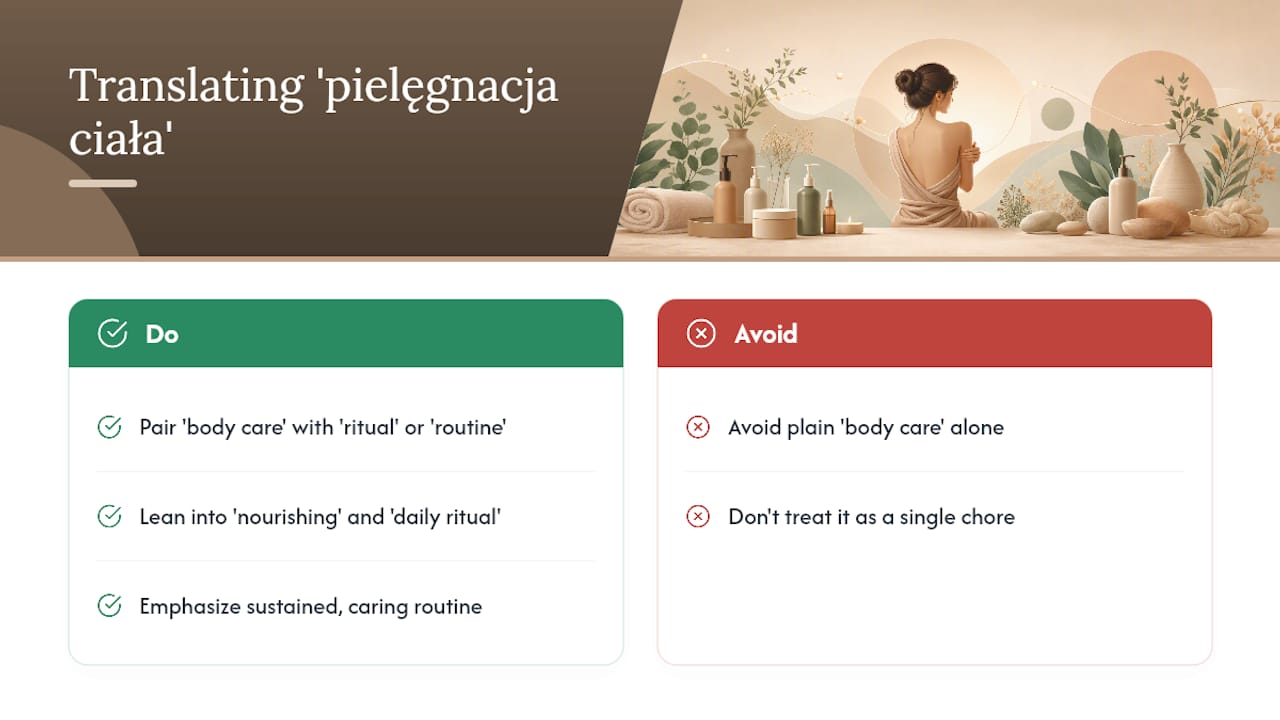
The verb pielęgnować carries a nurturing, proactive connotation, as the Wielki słownik języka polskiego’s entry for pielęgnować illustrates with examples of tending flowers and caring for the sick. That root meaning shapes how Polish speakers understand pielęgnacja ciała: not a single chore but a sustained, caring routine.
This matters when translating product descriptions. “Body care” in English can sound transactional; pielęgnacja ciała in Polish implies regularity and genuine attention. If you are writing copy for a Polish audience, lean into words like “routine,” “nourishing,” or “daily ritual” to carry that nuance across.
Pro Tip: When translating Polish beauty product descriptions into English, pair “body care” with a word like “ritual” or “routine” to preserve the nurturing connotation of pielęgnacja.
A brief note from the editor
Understanding pielęgnacja ciała as “body care” is straightforward once you see the grammar. What I find genuinely useful is recognising that the Polish term implies a habit, not a product. That distinction shapes which English phrase fits best in any given context.
If you want to explore authentic Polish body care products, M-shop stocks a curated range sourced directly from Poland, including the Celia Collagen + Algae Lightweight Moisturising Cream and the Biały Jeleń Hypoallergenic Natural Soap. Both are good examples of what pielęgnacja ciała looks like in practice: gentle, ingredient-led, and built for regular use. You can also read more about Polish skincare traditions to see how these routines fit into a broader cultural context.

Sources
- PIELĘGNACJA in English - Cambridge Dictionary
- Wielki słownik języka polskiego (wsjp) — ‘higiena’ entry
- bab.la — pielęgnacja
- Dictionary
- Reverso Context — pielęgnacja translations
- Body care Definition | Law Insider
- WAC 246-335-310 (body care definition)