



Lip balms explained: what they are and how they work
Lip balm is a wax-based product applied directly to the lips to seal in moisture, protect the delicate skin from environmental damage, and relieve dryness or chapping. Most formulas work through three ingredient classes: occlusives (which form a physical barrier), humectants (which draw water in), and emollients (which soften the surface). Dermatologists recommend using lip balms with sun protection during the day, and they flag fragrances and menthol as common culprits behind reactions that make lips worse rather than better. The sections below cover how balms actually work, which ingredients to seek or avoid, how to choose one in the UK, and when a pharmacist visit makes more sense than another layer of balm.
Key takeaways
Lip balms work best when they combine an occlusive to seal, a humectant to attract moisture, and an emollient to soften, with SPF 30 or above added for any daytime use.
| Point | Details |
|---|---|
| Three-ingredient rule | Look for an occlusive, a humectant, and an emollient in every balm you buy. |
| Avoid common irritants | Fragrance, menthol, camphor, and oxybenzone can worsen lips; choose fragrance-free formulas for sensitive skin. |
| SPF matters during the day | Lip skin is thin and UV-vulnerable; use SPF 30 or higher on any balm worn outdoors. |
| Apply thin layers, 2–4 times daily | A thick coat is not more effective and is more likely to be licked off; a richer balm works better at night. |
| M-shop for Polish lip care | M-shop stocks fragrance-free, ingredient-led Polish lip-care products available in the UK. |
Table of Contents
- What are lip balms and how do they protect your lips?
- Which ingredients should you look for, and which can cause irritation?
- How do lip balm variants differ from each other?
- When should you use lip balm, and when should you see a pharmacist?
- Why do some balms make lips drier over time?
- How to choose a lip balm in the UK
- How to apply lip balm correctly
- When are medicated lip balms the right choice?
- A candid note on keeping it simple
- Gentle lip care, sourced from Poland
- Sources
What are lip balms and how do they protect your lips?
A lip balm is, at its simplest, a wax-like substance applied to moisturise and relieve chapped or dry lips. Common ingredients include beeswax, carnauba wax, petrolatum, lanolin, and various plant oils. That combination sounds straightforward, but the mechanism behind it is worth understanding, because it explains why some balms work brilliantly and others seem to do nothing.
Lip skin has no oil glands and is far thinner than the skin on the rest of your face. It cannot produce its own protective layer, so it loses moisture quickly, especially in cold, windy, or dry conditions. A balm compensates by sitting on top of the lip surface and slowing that water loss down.
The three ingredient roles each do something distinct:
- Occlusives (beeswax, petrolatum, carnauba wax) form a physical film over the lip surface. They do not add moisture; they trap what is already there.
- Humectants (glycerin, hyaluronic acid) attract water molecules from the air and from deeper skin layers, drawing hydration toward the surface.
- Emollients (plant oils, squalane, shea butter) fill the tiny gaps between skin cells, smoothing the surface and making lips feel soft rather than just sealed.
Dermatologists recommend formulas that combine all three for effective long-term lip health, rather than a product that relies on one class alone. A balm heavy on occlusives but light on humectants, for instance, seals well but does little to actively rehydrate.
One important limitation: balms work with the moisture already present in your lips. They are not a substitute for drinking enough water, and they will not permanently cure chronic dryness if the underlying cause (mouth breathing, nutritional deficiency, certain medications) is not addressed.
Pro Tip: Apply balm to lips that are slightly dry rather than wet, as putting balm on damp lips can reduce how well it seals.
Which ingredients should you look for, and which can cause irritation?
The short answer: look for products that combine an occlusive, a humectant, and an emollient. Avoid anything with added fragrance, menthol, or camphor if your lips are already sensitive or reactive.
| Ingredient category | Typical examples | What it does | Common cautions |
|---|---|---|---|
| Occlusives | Petrolatum, beeswax, carnauba wax | Forms a barrier to reduce water loss | Generally well tolerated; lanolin can cause reactions in some people |
| Humectants | Glycerin, hyaluronic acid | Draws moisture toward the lip surface | Rarely irritating; very high glycerin concentrations can feel sticky |
| Emollients | Shea butter, squalane, plant oils | Softens and smooths the lip surface | Nut-derived oils (shea, coconut) may cause reactions in those with nut sensitivities |
| Fragrances and flavourings | Vanilla, citrus, mint, menthol | Added for scent or taste | Common contact allergens; menthol and camphor can cause stinging and worsen dryness |
| SPF filters | Zinc oxide (physical), oxybenzone (chemical) | Protects against UV damage | Oxybenzone is a known contact allergen for some people; zinc oxide is generally better tolerated |
| Reparative extras | Ceramides, niacinamide, vitamin E | Support skin barrier repair | Usually beneficial; check for added fragrance in the same formula |
Understanding why Polish lip balm ingredients matter can help you read labels more confidently and spot the difference between a formula built around real skin science and one that is mostly fragrance and filler.
Dermatologists warn that fragranced or cooling ingredients — menthol, flavourings, certain preservatives — can trigger allergic reactions that make lips feel worse despite regular balm use. Switching to a plain, fragrance-free petrolatum is often enough to break the cycle. AP News
A note on SPF: Lip skin is particularly vulnerable to UV damage because it is thin and largely unpigmented. Using SPF lip balm during the day for sun protection is recommended. Physical filters such as zinc oxide are generally better tolerated than chemical filters like oxybenzone, which dermatologists flag as a potential contact allergen worth avoiding if you have reactive lips.
How do lip balm variants differ from each other?
The right type depends on what you actually need: basic protection, a cosmetic finish, sun defence, or targeted treatment.
Lip balm differs from plain petroleum jelly because formulated balms add waxes, oils, flavourings, and sometimes SPF on top of the occlusive base. Petroleum jelly (such as Vaseline) is a pure occlusive. It seals extremely well and is one of the least irritating options available, but it does nothing to actively hydrate and has no sun protection. For someone with severely chapped, reactive lips, plain petrolatum is often the best starting point precisely because it contains so little else.
Here is how the main variants compare:
- Plain petroleum jelly: Maximum occlusion, minimal ingredients, no SPF, no cosmetic finish. Best for very sensitive or reactive lips, or as a night treatment.
- Formulated lip balm: Combines occlusives, humectants, and emollients. May include SPF, flavouring, or reparative extras. The everyday choice for most people.
- Tinted balms: Add pigment for a cosmetic effect while still providing moisture. Not the same as a lipstick, which typically contains less occlusive content and more pigment. Useful if you want a hint of colour with hydration.
- SPF balms: Contain physical or chemical UV filters. Recommended for outdoor use, skiing, or any extended time in sunlight. Check that the SPF is at least 30.
- Medicated balms: Contain active pharmaceutical ingredients. Covered separately below.
For a deeper look at how these types compare, the lip balm types guide on M-shop breaks down the variants and what each one is best suited for.
When should you use lip balm, and when should you see a pharmacist?
Reach for a balm when lips feel dry, tight, or slightly flaky — before going outside in cold or windy weather, before applying lipstick (it helps colour adhere more evenly), and as a nightly repair treatment. That covers the vast majority of everyday lip care.
Some situations call for more than a balm, though.
Pro Tip: If your lips have been sore for more than two weeks despite switching to a fragrance-free balm, book an appointment with your GP rather than trying another product. Persistent lip irritation can signal contact dermatitis, angular cheilitis, or, rarely, something that needs a clinical eye.
Red flags that warrant a pharmacist or GP visit:
- Cracks that bleed or are too painful to eat or speak comfortably
- Stinging or burning that continues even after stopping fragranced products
- Blistering, crusting, or weeping that suggests infection
- Sores at the corners of the mouth (angular cheilitis, which often needs antifungal or antibacterial treatment)
- Cold sores that recur frequently or are unusually severe (antiviral treatment is available from a pharmacist without a prescription for mild cases, but a GP can prescribe systemic antivirals for frequent recurrence)
Before seeing a clinician, it is worth trying one simple step: switch entirely to plain, fragrance-free petrolatum for a week. If the irritation clears, a product ingredient was likely the cause. If it does not, that information is useful for whoever you see next.
Why do some balms make lips drier over time?
Balms can help, but certain ingredients and habits create a cycle that worsens the very problem they are meant to solve.
Allergic contact dermatitis from lip products is more common than most people expect. Reactions to flavourings (vanilla, citrus, mint), preservatives, and lanolin can develop gradually, meaning a product you have used for months without issue can eventually start causing problems. The delay makes it hard to identify the culprit without a process of elimination.
The lip-licking habit compounds the issue. Saliva evaporates quickly and, as it does, it pulls moisture from the lip surface, leaving lips drier than before. Dermatologists note that breaking the licking habit and using an occlusive-rich balm is one of the most effective steps for chronically dry lips. The behavioural fix is simple: when you feel the urge to lick, apply balm instead.
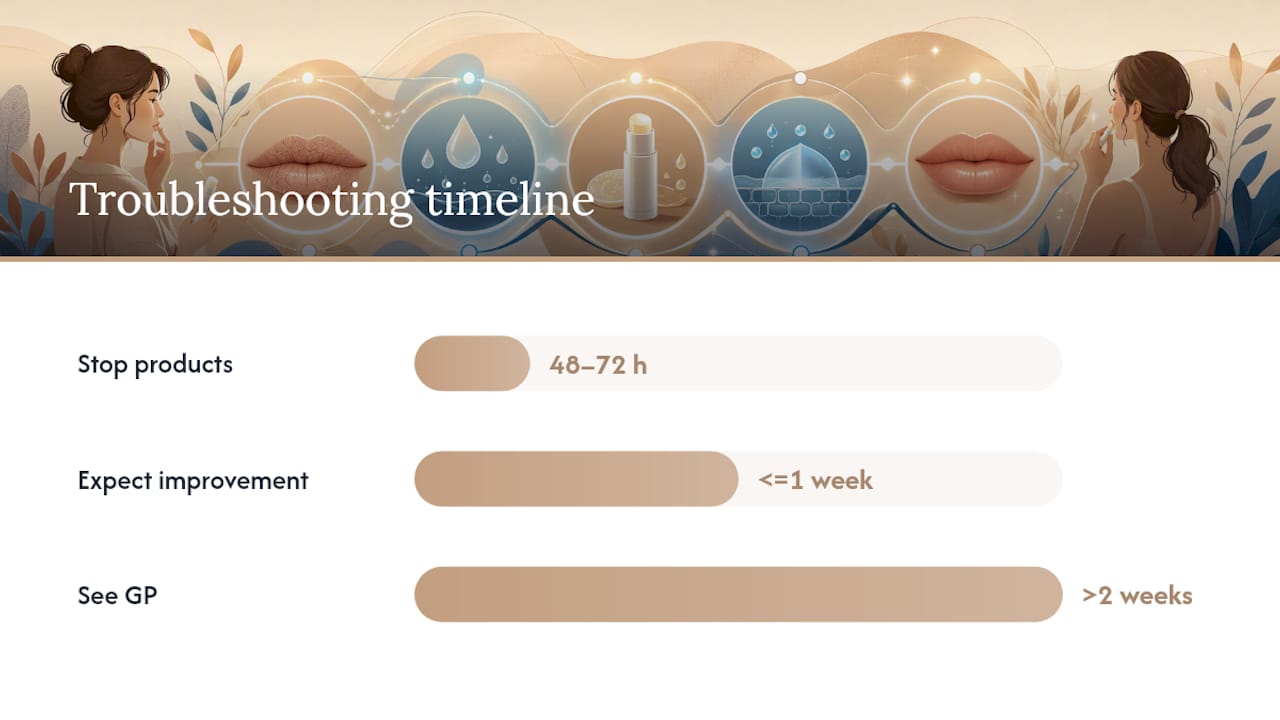
A quick troubleshooting checklist if your lips are not improving:
- Stop all current lip products for 48–72 hours
- Switch to plain, unfragranced petrolatum only
- Avoid licking lips; apply petrolatum whenever the urge arises
- If symptoms clear within a week, reintroduce products one at a time
- If symptoms persist beyond two weeks, see a GP
How to choose a lip balm in the UK
The core rule: pick a balm that combines an occlusive, a humectant, and an emollient. Add SPF 30 or higher for anything worn during the day.
What to look for on the label:
- Petrolatum or beeswax as a primary occlusive
- Glycerin or hyaluronic acid as a humectant
- Shea butter, squalane, or a plant oil as an emollient
- SPF 30+ for daytime use, preferably with zinc oxide as the filter
- “Fragrance-free” clearly stated, not just “unscented” (unscented products can still contain masking fragrances)
When to choose fragrance-free or lanolin-free:
- Sensitive or reactive lips
- History of eczema, psoriasis, or contact dermatitis
- Lips that sting or feel worse after using flavoured balms
Practical hygiene notes:
- Replace your balm every 6–8 months, or sooner if the texture changes or it develops an off smell
- Avoid sharing balms, which can transfer bacteria and viruses including the cold sore virus
- Pot balms applied with a finger carry a higher contamination risk than stick formats; use a clean cotton bud if you prefer pots
For a UK-focused overview of Polish lip-care options, the Polish lip care products guide on M-shop covers what to look for and which formulas suit different needs. You can also find dermatologist-recommended picks across skincare categories if you want a broader reference point for safe ingredient choices.
How to apply lip balm correctly
Correct application is simple but makes a real difference. A thin, even layer works better than a thick coating, which can feel greasy and is more likely to be licked off.
Daytime routine:
- Apply a thin layer of SPF balm before going outside
- Reapply after eating, drinking, or wiping your mouth
- Press lips together gently to spread the product; do not rub
- Aim for 2–4 applications per day rather than constant reapplication
Night routine:
- Use a thicker, richer balm with strong occlusives and reparative emollients
- Apply to dry lips, not immediately after washing your face while skin is still damp
- A product like the Regenerum Regenerating Lip Serum works well as an overnight treatment, combining moisturising and protective properties
Pro Tip: If flakes are building up and preventing the balm from absorbing properly, a brief, gentle exfoliation once or twice a week helps. Use a soft toothbrush or a small amount of sugar mixed with a drop of oil, work it gently over the lips, then apply balm immediately after.
When are medicated lip balms the right choice?
Medicated balms are for specific conditions, not everyday hydration. They contain active pharmaceutical ingredients that target pain, infection, or viral activity, which a cosmetic balm cannot do.
Common medicated options available in the UK:
- Mild local anaesthetics (such as benzocaine): reduce pain from severe cracking or ulcers; not for long-term use
- Antiseptic ingredients (such as cetylpyridinium chloride): help control bacterial load in minor infections
- Antiviral creams (such as aciclovir 5% cream): available over the counter for cold sores; most effective when applied at the first tingle, before a blister forms
Pro Tip: Antiviral creams for cold sores are not the same as lip balm. Apply them to the affected area only, not across the whole lip, and follow the pharmacist’s or package instructions on duration. Using them for longer than directed does not improve outcomes and can cause local irritation.
A pharmacist is the right first stop for cold sores, signs of infection, or persistent pain. If cold sores recur more than six times a year, a GP can consider suppressive antiviral therapy. Avoid using potent medicated products as a substitute for a standard balm on healthy lips.
A candid note on keeping it simple
Most people overcomplicate lip care. The marketing around lip products is relentless, and it pushes complexity: multi-step routines, exotic actives, limited-edition flavours. The dermatology evidence points in the opposite direction. The simpler the formula, the less likely it is to cause a reaction, and the more reliably it does its job.
What actually works for the majority of people is a short ingredient list anchored by petrolatum or beeswax, glycerin, and a plant oil. Fragrance-free. SPF 30 or above during the day. Applied consistently rather than obsessively.
At M-shop, the focus is on Polish cosmetics built around this kind of ingredient transparency. The brands stocked tend to use recognisable, functional ingredients rather than long lists of additives. For anyone with sensitive lips who has been through the cycle of trying product after product, that simplicity is genuinely useful.
Gentle lip care, sourced from Poland
If you have been reading this guide because your lips are persistently dry, reactive, or just not responding to what you have tried so far, the answer is almost always the same: go simpler, go fragrance-free, and look for a formula with a clear occlusive and humectant base.
M-shop stocks a curated range of Polish lip-care and skincare products chosen for ingredient quality and gentleness, including fragrance-free options suited to sensitive skin. Polish cosmetic brands have a strong tradition of functional, ingredient-led formulations, and many of the products on the site carry that approach through to their lip-care lines. Browse the M-shop lip and skincare range to find a formula that fits your routine, or check the Regenerum Regenerating Lip Serum as a starting point for overnight repair.
Sources
- Chapped lips: Causes and treatment | Geisinger
- Does lip balm help chapped lips? Here’s what to know | AP News
- Lip balm — Wikipedia
- Does lip balm help chapped lips? Dermatologists explain | NBC Boston
- How to apply lip balm correctly (Without making common mistakes) | The Deconstruct