



Affordable dupes for high-end serums: UK buyer's guide
You can get most of a luxury serum’s benefits for a fraction of the cost by matching the active ingredients and checking stability. Ingredient-parity dupes genuinely deliver for the majority of skin concerns, and the gap between a high-end SkinCeuticals C E Ferulic and a well-formulated budget vitamin C serum is often smaller than the price suggests.
Three things to do before buying any dupe:
- Check the INCI list for the hero active (L-ascorbic acid, retinol, niacinamide, hyaluronic acid) and confirm it appears near the top, not buried after the preservatives.
- Confirm the packaging protects unstable actives: dark glass or opaque airless pump for vitamin C and retinoids; avoid clear plastic bottles.
- Patch test for a couple of days on the inner arm before applying to your face, even when the ingredient lists look identical.
Pro Tip: Prioritise saving money on hyaluronic acid and niacinamide serums — these actives are stable, well-understood, and easy to replicate cheaply. Hold onto the original when a product carries long-term peer-reviewed clinical data or a patented delivery system you cannot find elsewhere.
Table of Contents
- How do you know if a budget serum is a genuine dupe?
- Affordable UK alternatives mapped to common luxury serums
- When should you keep the original serum?
- How these matches were chosen, and what experts say
- What is a ‘dupe’ and how does it work?
- Do affordable dupes actually work as well as luxury serums?
- How to layer affordable dupes in your skincare routine
- Common myths about dupes and luxury serums
- Key takeaways
- Why ingredient-first skincare is the only honest approach
- Polish skincare alternatives, delivered to the UK
- Useful sources and further reading
How do you know if a budget serum is a genuine dupe?
Ingredient parity is the only reliable test. Marketing language, packaging aesthetics, and brand heritage tell you nothing about what a serum will actually do to your skin.
Step-by-step checklist:
- Compare the INCI hero active. Find the luxury serum’s key ingredient (e.g. L-ascorbic acid, retinol, palmitoyl tripeptide-1). Open the dupe’s INCI list and confirm the same active, or an accepted derivative, appears in the first third of the list.
- Look for concentration clues. Brands are not legally required to disclose percentages in the UK, but many now do. If the luxury original states 15% L-ascorbic acid, look for a dupe that matches or comes close. Where percentages are absent, check for clinical claims or dermatologist-tested badges.
- Assess the pH where it matters. L-ascorbic acid works at pH 2.5–3.5. A vitamin C serum with no pH information and a watery texture is a yellow flag. Stable vitamin C derivatives such as ascorbyl glucoside or sodium ascorbyl phosphate are less pH-sensitive and easier to formulate affordably.
- Check the delivery system and supporting actives. The classic SkinCeuticals C E Ferulic formula pairs L-ascorbic acid with vitamin E (tocopherol) and ferulic acid for synergistic stability. A true dupe needs all three, not just one.
- Examine the packaging. Volatile actives degrade in light and air. Opaque, airless, or dark-glass packaging is a positive signal. A clear plastic dropper bottle for a retinol or L-ascorbic acid serum is a red flag regardless of price.
Beyond the label, look for user reviews that mention texture consistency over time and whether the product discolours quickly. A vitamin C serum that turns orange within two weeks of opening has oxidised and lost most of its efficacy. INCI-comparison databases like SkinSkool can cross-reference hundreds of products by ingredient overlap and filter for fragrance-free or vegan formulations, saving significant research time.

Affordable UK alternatives mapped to common luxury serums
The pairings below cover the five serum types most frequently searched for dupes. Prices are approximate retail in GBP and reflect typical UK availability.
Vitamin C serums
The SkinCeuticals C E Ferulic is the benchmark. Independent ingredient comparisons confirm that several budget products replicate the vitamin C + E + ferulic acid trio, though stability and pH calibration vary. Analysis of 10 million verified reviews on Hwahae found only three Korean serums that consistently pass a four-point dermatology framework for pH, derivative quality, and stability — a reminder that most so-called dupes fail on at least one criterion.
The Q+A Vitamin C Brightening Serum (around £10, widely available at Boots and ASOS) has been reviewed favourably against pricier options for brightening results. The Ordinary Ascorbyl Glucoside Solution 12% (around £9) uses a stable derivative rather than L-ascorbic acid, which means less irritation risk and a longer shelf life, though the brightening timeline is slower.
Retinol and retinoid serums
Drunk Elephant A-Passioni Retinol Cream retails at around £74. The Ordinary Retinol 0.5% in Squalane (around £8) delivers the same parent retinol at a lower concentration, which suits beginners and sensitive skin. For those who want a step up, the Glow Recipe Banana Soufflé Moisture Cream contains encapsulated retinol alongside soothing actives; a comparable budget approach is to pair a low-concentration retinol serum with a ceramide moisturiser.
Peptide serums
Augustinus Bader The Serum (around £265) is built around the brand’s proprietary TFC8 complex. No affordable dupe replicates that specific complex, and this is one case where the original’s clinical investment is genuinely difficult to match on ingredients alone. For general peptide benefits (firming, barrier support), peptide-focused affordable formulations using palmitoyl tripeptide-1 and palmitoyl tetrapeptide-7 deliver real results at a fraction of the cost. The Ordinary Buffet (around £14) remains one of the most ingredient-dense peptide serums at any price point.
Hyaluronic acid serums
This is the easiest category to dupe reliably. Hyaluronic acid is stable, inexpensive to manufacture, and well-understood. The Ordinary Hyaluronic Acid 2% + B5 (around £7) matches the hero active in most luxury HA serums. Aldi Lacura Hyaluronic Acid Serum (around £4, seasonal availability) has been widely praised in UK beauty communities for its multi-weight HA formula.
Brightening and niacinamide serums
Niacinamide is another straightforward active to dupe. The Ordinary Niacinamide 10% + Zinc 1% (around £5) is the standard reference. For an antioxidant overnight oil alternative, the Vis Plantis Secret Garden Regenerating Oil Serum sold by M-shop combines plant-based actives in a format that suits dry and mature skin, with UK shipping and regular discounts.
| Serum type | Hero active match | Best for | Approx. price (GBP) | UK availability |
|---|---|---|---|---|
| Vitamin C (L-ascorbic acid) | Q+A Vitamin C Brightening Serum | Brightening, dullness | ~£10 | Boots, ASOS |
| Vitamin C (stable derivative) | The Ordinary Ascorbyl Glucoside 12% | Sensitive skin, gradual brightening | ~£9 | ASOS, Cult Beauty |
| Retinol | The Ordinary Retinol 0.5% in Squalane | Anti-ageing, beginners | ~£8 | ASOS, Boots |
| Peptides | The Ordinary Buffet | Firming, barrier support | ~£14 | ASOS, Cult Beauty |
| Hyaluronic acid | Aldi Lacura HA Serum | Hydration, plumping | ~£4 | Aldi (seasonal) |
| Niacinamide | The Ordinary Niacinamide 10% + Zinc 1% | Pores, oiliness | ~£5 | Boots, ASOS |
| Antioxidant oil | Vis Plantis Secret Garden Regenerating Oil Serum | Dry/mature skin, overnight repair | ~£12 | M-shop.uk |
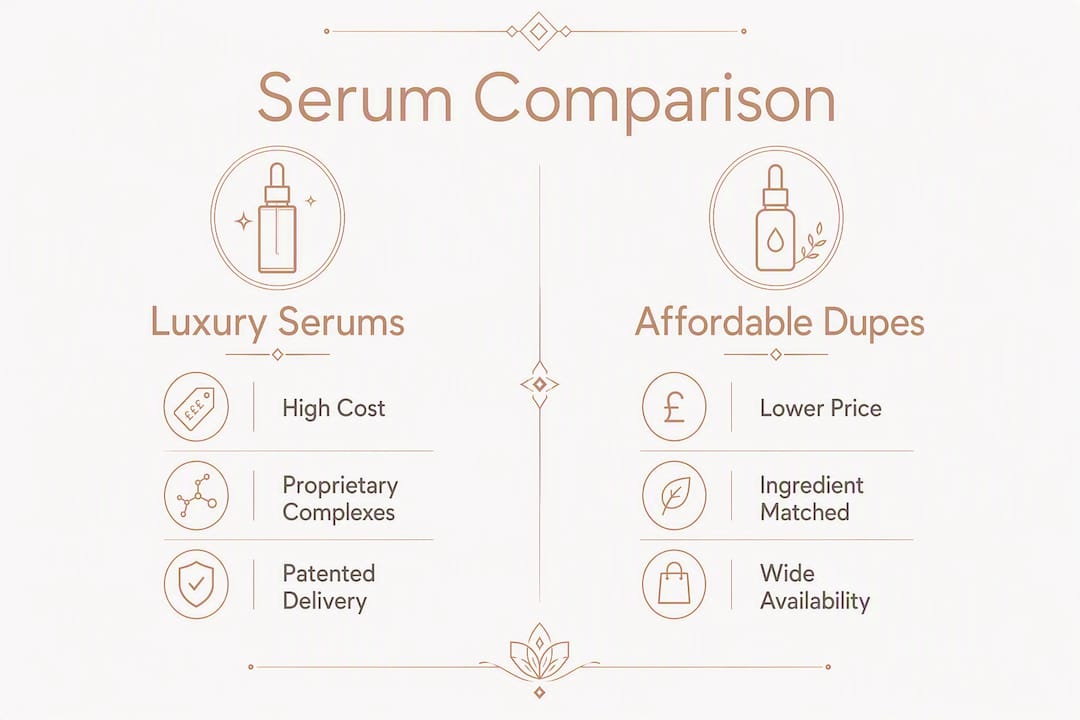
Pro Tip: Hyaluronic acid and niacinamide serums are the easiest and safest to dupe — stable actives, simple formulations, and minimal packaging requirements. L-ascorbic acid serums are the hardest: pH sensitivity, oxidation risk, and the need for a specific supporting trio make cheap versions a gamble.
When should you keep the original serum?
Safety first: even when two INCI lists look nearly identical, the excipients, preservatives, and emulsifiers differ. Always patch test a new serum for at least 48 hours on the inner arm before applying it to your face.
Safety checklist before switching to a dupe:
- Check for fragrance (parfum) in the INCI list. Fragrance is the most common contact sensitiser in skincare and is unnecessary in a serum.
- If you use prescription actives (tretinoin, azelaic acid at prescription strength), confirm the dupe contains no ingredients that increase irritation risk when layered.
- Look for known sensitisers: high-percentage AHAs without buffering, essential oils, and certain preservatives (methylisothiazolinone, for example).
- Cross-check for allergens if you have known sensitivities. INCI databases let you filter by allergen-free status.
When the original is worth the price:
Augustinus Bader’s TFC8 complex and SkinCeuticals’ patented C E Ferulic formula both carry long-term peer-reviewed clinical data that no budget brand has replicated in full. If you have a specific, clinically documented concern (post-procedure recovery, significant photodamage with documented improvement in trials), the original may be the better investment. The same applies to prescription-strength retinoids: no over-the-counter dupe matches tretinoin.
Storage and oxidation:
L-ascorbic acid serums should be stored in a cool, dark place, ideally refrigerated. The primary oxidation cues are colour (a clear or pale yellow serum turning orange or brown) and scent (a metallic or rancid note). Once either appears, the serum has degraded and should be discarded. Retinoids degrade similarly under UV exposure; keep them away from windowsills.
Pro Tip: Apply a small drop of your vitamin C serum to a white tissue. A pale yellow tint is normal; orange or brown means oxidation has already begun. Discard the bottle.
How these matches were chosen, and what experts say
Every pairing in this article was selected using a consistent methodology:
- Ingredient-list comparison: hero active confirmed present in the dupe’s INCI, ideally in the same or equivalent form.
- Concentration clues: percentage disclosed by the brand, or inferred from clinical claims and position in the INCI list.
- Packaging assessment: stability-appropriate packaging confirmed before inclusion.
- UK availability check: product confirmed purchasable in the UK at the time of writing, via mainstream retailers or specialist online stores.
- Price-per-mL calculation: total cost divided by volume to allow fair comparison across bottle sizes.
- User-review signal filtering: reviews screened for mentions of texture consistency, oxidation, and irritation rather than packaging aesthetics.
SkinSkool and SkinSort are the most practical INCI-comparison tools for UK shoppers. Both allow ingredient-overlap searches and flag fragrance-free or vegan status. Macherre weights shared retinoids, exfoliants, and peptides more heavily than bulk humectants, which produces more functionally meaningful matches.
One important limitation: ingredient-list matching cannot reveal proprietary complexes, exact pH, or the precise ratio of actives when percentages are undisclosed. A dupe that lists the same three actives may still differ in the ratio that drives clinical results. This is why testing protocols that evaluate dozens of formulas across actives, dosage, texture, and tolerability remain more reliable than label-reading alone for high-stakes decisions.
What is a ‘dupe’ and how does it work?
A dupe is not a counterfeit. It does not copy packaging, branding, or trade dress. A genuine skincare dupe replicates the function of a luxury product by matching its hero active ingredients and, where possible, the formulation context that makes those actives work.
The word entered mainstream beauty vocabulary through social media, but the concept is older: pharmacists and cosmetic chemists have long known that the same active ingredient, at the same concentration, in a comparable delivery system, will produce comparable results regardless of the brand name on the bottle. As price-and-performance research confirms, modern drugstore and budget brands have invested significantly in formulation technology, and the gap between a £5 serum and a £150 one is now often a matter of marketing spend and clinical trial investment rather than raw ingredient quality.
What dupes do not replicate: proprietary delivery systems, patented complexes, and the clinical trial data that validates a specific formula. This distinction matters most for post-procedure skincare and prescription-adjacent actives. For everyday brightening, hydration, and anti-ageing maintenance, ingredient parity is usually sufficient. Understanding why price and packaging are poor proxies for efficacy is the single most useful shift in perspective for anyone building an affordable routine.
Do affordable dupes actually work as well as luxury serums?
The honest answer is: often yes, sometimes no, and it depends entirely on which active and which concern you are targeting.
Drugstore serum roundups drawing on dermatologist input consistently find that modern budget formulations rival expensive options on actives and delivery for hydration, niacinamide, and basic retinol. For hyaluronic acid serums, the evidence strongly favours dupes: the active is inexpensive, stable, and well-understood, and a £4 Aldi Lacura serum can plausibly match a £60 luxury equivalent on the ingredient that matters.
Vitamin C is more complicated. Independent side-by-side comparisons show that several budget products match the vitamin C + E + ferulic acid ratio of classic luxury formulas, but stability and pH calibration are harder to guarantee at lower price points. A budget vitamin C serum that oxidises within three weeks delivers far less than its INCI list promises.
Peptide serums sit in the middle. Generic peptides like palmitoyl tripeptide-1 are available to any brand, and affordable formulations using them do show firming and barrier benefits. Proprietary peptide complexes with clinical backing, like those in Augustinus Bader, are a different matter entirely.
User reviews, when filtered for mentions of texture consistency and long-term results rather than first impressions, are a useful secondary signal. Budget-friendly skincare roundups that track price-to-performance trade-offs over time tend to confirm that the best affordable serums punch well above their price on hydration and brightening, with more variable results on anti-ageing actives.
How to layer affordable dupes in your skincare routine
The layering rules for dupes are identical to those for luxury serums: thinnest to thickest, water-based before oil-based, and actives before occlusives.
A practical morning routine with affordable dupes: cleanser, niacinamide serum (wait 30 seconds), vitamin C serum (wait 30 seconds), moisturiser, SPF. Do not layer niacinamide and L-ascorbic acid simultaneously if either is at a high concentration; the combination can cause temporary flushing in sensitive skin, though the reaction is not harmful.
Evening routine: cleanser, hyaluronic acid serum, retinol serum (on dry skin, to reduce irritation), moisturiser. If you are using the Vis Plantis Secret Garden Regenerating Oil Serum as an overnight treatment, apply it as the final step before sleep, after your moisturiser, to seal in the layers beneath.
A few practical points worth knowing:
- Retinol and AHAs should not be used on the same evening until your skin has built tolerance to both.
- Vitamin C serums work best in the morning, where they reinforce SPF protection against UV-induced oxidative damage.
- Hyaluronic acid applied to damp skin (not soaking wet) absorbs more effectively. Pat it in rather than rubbing.
- Building an affordable skincare routine in the UK is easier when you start with one active at a time and introduce a second only after four to six weeks of tolerance.
Common myths about dupes and luxury serums
“Luxury serums use better ingredients.” Not categorically. The same cosmetic-grade L-ascorbic acid, hyaluronic acid, or niacinamide is available to any brand. What luxury brands sometimes invest in is a more stable formulation, more rigorous clinical testing, or a patented delivery system. The ingredient itself is rarely exclusive.
“If the INCI lists match, the products are identical.” Close, but not quite. Concentration ratios, pH, and the order of manufacturing steps all affect the final product. Two serums with the same INCI list can behave differently on skin. This is why patch testing and a trial period matter even when the label comparison looks perfect.
“Cheap serums are more likely to irritate.” The opposite is often true. Many luxury serums contain fragrance, essential oils, and botanical extracts that are common sensitisers. Budget brands, particularly those targeting sensitive skin, frequently produce cleaner, more minimal formulations. The Ordinary’s entire range is built on this premise.
“Dupes are just for people who can’t afford the original.” Ingredient-first skincare is a rational choice at any budget. Paying £180 for a vitamin C serum when a £10 alternative matches the active trio is not a compromise; it is good formulation literacy. The savings can be redirected to SPF, which has stronger evidence for skin health than almost any serum on the market.
Key takeaways
Ingredient-matched dupes deliver most of the benefits of luxury serums for a fraction of the cost, provided you verify active parity, stable packaging, and UK availability before buying.
| Point | Details |
|---|---|
| Check INCI first | Confirm the hero active appears near the top of the ingredient list, not buried after preservatives. |
| Easiest actives to dupe | Hyaluronic acid and niacinamide are stable, cheap, and reliably replicated; L-ascorbic acid is the hardest. |
| Safety before switching | Patch test for 48 hours and check for fragrance or sensitising ingredients before adding any new serum. |
| When to keep the original | Retain luxury serums backed by long-term clinical trials or patented delivery systems with no affordable equivalent. |
| M-shop for vetted alternatives | M-shop stocks Polish-made serums and skincare, including the Vis Plantis Secret Garden Regenerating Oil Serum, with UK shipping and regular discounts. |
Why ingredient-first skincare is the only honest approach
The beauty industry has a long history of charging for aspiration rather than actives. A frosted glass bottle and a French-sounding name add nothing to the efficacy of a niacinamide serum. What matters is the concentration, the pH, the packaging stability, and whether the formula has been tested on real skin.
My editorial position at M-shop is straightforward: recommend what works at the price point that makes sense for the concern. For hyaluronic acid and niacinamide, budget alternatives are almost always the right call. For post-procedure recovery or clinically documented photodamage, the original may justify its price. For everything in between, the INCI list is your best guide.
Polish skincare brands, many of which M-shop carries, have a strong tradition of formulating with natural actives, collagen, and algae at prices that reflect ingredient cost rather than marketing spend. The Vis Plantis range is a good example: a regenerating oil serum with plant-based actives, available in the UK, at a price that makes daily use genuinely sustainable. That is the kind of affordable European skincare worth recommending.
Polish skincare alternatives, delivered to the UK
M-shop brings vetted Polish cosmetics directly to UK shoppers, with a focus on natural-ingredient formulations that deliver results without the luxury markup. The Vis Plantis Secret Garden Regenerating Oil Serum is a standout: a plant-based antioxidant oil serum suited to dry and mature skin, available with UK shipping and regular discounts of up to 15%.
For readers building a fuller routine, the Celia Collagen + Algae Lightweight Moisturising Cream pairs well with a serum step, combining collagen and algae in a format designed for daily use. M-shop’s range is curated by a family-run team with direct sourcing from Poland, which means consistent quality and no grey-market uncertainty.
Browse the full range at M-shop.uk and use the sale section to find current discounts on serums and complementary skincare.
Useful sources and further reading
The sources below informed the ingredient comparisons, methodology, and product examples in this article.
- The 6 Best Vitamin C Serums — Wirecutter — Blinded testing panel across 60 formulas evaluating actives, dosage, texture, and tolerability.
- The 8 Best Drugstore Serums — Byrdie — Dermatologist-informed roundup confirming modern budget brands now rival expensive options on actives and delivery.
- Why price doesn’t reflect quality in cosmetics — M-shop — M-shop editorial on why packaging and price are poor proxies for skincare efficacy.