



Why price doesn't reflect quality in cosmetics
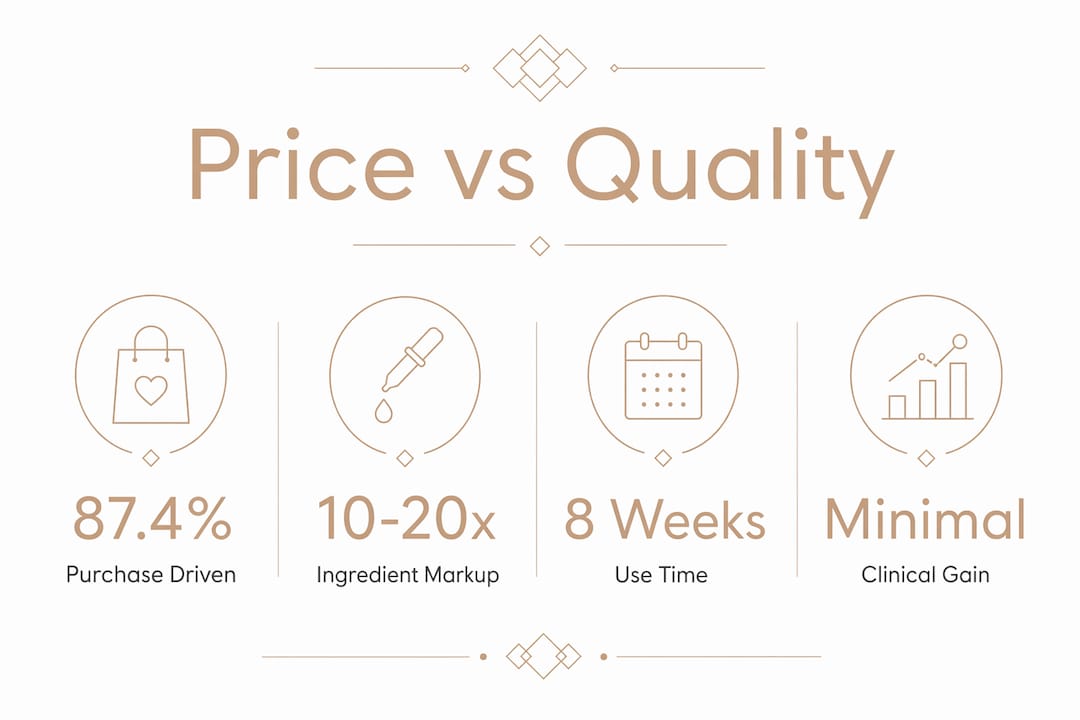
Price is not a dependable measure of cosmetic quality. Research shows that 87.4% of cosmetic purchase decisions are driven by a combination of price and perceived quality, not actual performance. That distinction matters enormously. The cosmetics industry is built on the gap between what a product costs to make and what it costs to buy. Understanding why price not reflect quality cosmetics is the first step to spending your money on what genuinely works for your skin.
Why does price not reflect quality in cosmetics?
The short answer is that formula costs represent a small fraction of what you pay at the till. Premium beauty brands typically apply ingredient-to-retail markups of 10 to 20 times. That means for every £100 you spend on a luxury moisturiser, as little as £5 to £10 may cover the actual ingredients inside. The rest pays for packaging, advertising, celebrity endorsements, and the prestige of the name on the label.
This is not a niche observation. It is the standard business model across the beauty sector. Cosmetic price vs quality diverge because the industry prices products based on what the market will bear, not on what the formula contains. A beautifully designed glass jar with a foil-stamped logo signals luxury to the brain before a single drop touches your skin.
Consumer psychology reinforces this gap. Studies confirm that people perceive expensive products as more effective even when the formulas are chemically identical to affordable versions. The brain interprets a higher price as a signal of higher value. That is a powerful marketing tool, and the industry uses it deliberately.
How do ingredients and formulation affect real performance?
Formulation is where genuine quality differences can exist, but they are rarer than marketing suggests. The key variable is not which ingredients appear on the label. It is whether those ingredients appear at concentrations high enough to actually work.
Ingredient concentrations must meet minimum effective levels. Below those thresholds, actives are decorative. A product can legally list retinol, hyaluronic acid, or niacinamide on its packaging while containing amounts too small to produce any measurable effect. This practice is common across all price tiers, but it is especially misleading in mid-range products that borrow the language of clinical skincare without the concentrations to match.
Where expensive products can legitimately justify their cost is in delivery technology. Encapsulation and airless pump systems protect ingredient potency by reducing oxidation and degradation. A vitamin C serum in an airless pump retains its efficacy far longer than the same formula in a jar exposed to air and light. pH optimisation also matters. Certain actives, such as AHAs and vitamin C, only absorb effectively within a narrow pH range. Formulating to that range adds cost and expertise.
- Active concentration: Check that key ingredients appear near the top of the list, not buried after fragrance and thickeners.
- Delivery systems: Airless pumps, encapsulated actives, and opaque packaging protect potency and can justify a modest price premium.
- pH optimisation: Products formulated at the correct pH for their actives deliver measurably better results.
- Ingredient sourcing: Higher-grade raw materials cost more, but the difference rarely scales to a 10x price gap.
- Stability testing: Rigorous stability data ensures actives remain effective throughout the product’s shelf life.
Pro Tip: Read the ingredient list from top to bottom. Cosmetic ingredient lists are regulated to list components in descending concentration order. If your hero active appears near the bottom, it is likely present in amounts too small to matter.
What actually drives luxury cosmetic prices?
Brand prestige, packaging, and sensory experience account for the majority of luxury pricing. Price reflects “cosmetic elegance” far more often than ingredient efficacy. Texture, fragrance, the weight of a jar, and the ritual of application are what luxury brands are genuinely selling. That is not inherently dishonest. But it is not skincare science.
The factors that inflate cosmetic prices without improving performance include:
- Celebrity and influencer endorsements: These campaigns cost millions and feed directly into the retail price.
- Luxury packaging: Heavy glass, magnetic closures, and embossed logos add cost without adding efficacy.
- Fragrance: Added scent increases manufacturing cost and, for sensitive skin, increases irritation risk.
- Retail location: Counter space in a department store carries a premium that the consumer ultimately pays.
- Brand heritage: Decades of marketing investment create emotional associations that justify higher prices psychologically.
Many luxury products have minimal clinical advantage over affordable versions. What they offer is a superior sensory experience and the social signal of the brand. For some people, that experience has genuine value. The problem arises when consumers assume the price signals better skin results, because the evidence does not support that assumption.
Luxury skincare often relies on emotional branding and prestige to justify high prices rather than marked ingredient superiority. Skincare is a technological market. Consistent ingredient performance is expected at every price point. Luxury products supplement that baseline with branding and experience, not with categorically better biology.
Do cheaper cosmetics actually work as well?
The evidence is clear. Basic skincare products priced as low as £8 can perform equivalently to luxury versions costing five to ten times more, when they contain similar active ingredient concentrations. Dermatologists routinely recommend products based on ingredient profiles, not price tags. The clinical outcome for well-formulated affordable products is comparable to their expensive counterparts in the majority of cases.
The table below illustrates where price differences are and are not justified:
| Factor | Affordable products | Premium products |
|---|---|---|
| Active ingredient concentration | Often equivalent | Sometimes higher, not always |
| Delivery technology | Basic but functional | Occasionally superior (encapsulation, airless) |
| Sensory experience | Functional | Typically superior |
| Clinical skin results | Comparable in most cases | Rarely significantly better |
| Packaging protection | Variable | Generally better |
| Price per effective dose | Lower | Higher |
The one area where premium products can pull ahead is delivery technology. Encapsulated retinol or stabilised vitamin C in an airless format genuinely performs better than an unstabilised version in a jar. But this is the exception, not the rule, and it does not justify a 10x price gap on its own.
Consistency of application and correct product matching to your skin type matter more than price for long-term results. A well-chosen £10 product used daily outperforms a £100 product used occasionally. This is the most underrated insight in skincare, and the one most aggressively ignored by luxury marketing.
Pro Tip: Before switching to a more expensive product, give your current one a full 8 weeks of consistent use. Most actives require that window to show measurable results. If you want to explore affordable European skincare with strong formulations, the options are broader than most people realise.
How to judge cosmetic quality beyond the price tag
Reading an ingredient list is the single most reliable way to assess a cosmetic product. It requires no specialist knowledge, just a few minutes and a clear framework.
- Check active placement. The ingredient you are paying for should appear in the first half of the list. If niacinamide, retinol, or hyaluronic acid appears after the preservatives, the concentration is likely below effective levels.
- Identify filler ingredients. Water, glycerin, and emollients form the base of most products. Their presence is not a problem, but a long list of fillers before the actives is a warning sign.
- Look for delivery technology signals. Terms like “encapsulated,” “liposomal,” or “time-release” indicate formulation investment that can justify a modest premium.
- Watch for fragrance. Fragrance listed high on a label increases irritation risk, particularly for reactive skin. Its presence adds cost without adding efficacy.
- Match to your skin needs. A product formulated for oily skin will not perform well on dry skin regardless of price. Skin compatibility drives results more than brand prestige.
Understanding how to test new beauty products before committing to a full-size purchase is a practical skill that saves money and reduces the risk of reactions. Patch testing and trial sizes are your best tools.
Dermatological research consistently supports ingredient-led purchasing decisions over price-led ones. The science of skin absorption, barrier function, and cellular turnover does not change based on the brand name on the packaging.
Pro Tip: When in doubt, cross-reference a product’s ingredient list against a reliable cosmetic ingredient database. This takes under five minutes and tells you more than any marketing claim.
Warning signs of an overpriced or underperforming product include: vague claims like “boosts radiance” with no named active, fragrance listed in the top five ingredients, actives listed after preservatives, and packaging that exposes the formula to air and light.
Key takeaways
Price in cosmetics reflects branding, packaging, and sensory experience far more reliably than it reflects the quality or efficacy of the formula inside.
| Point | Details |
|---|---|
| Price signals perception, not performance | 87.4% of purchase decisions are driven by price-perception combinations, not proven results. |
| Markups dwarf ingredient costs | Premium brands apply 10–20x markups, meaning formula cost is a minor part of what you pay. |
| Affordable products often match luxury | Products at a fraction of the price frequently contain equivalent active concentrations. |
| Delivery technology is the real differentiator | Encapsulation and airless packaging justify modest premiums by protecting ingredient potency. |
| Consistency beats cost | Daily use of a well-matched affordable product outperforms occasional use of an expensive one. |
What I have learned after years of watching people spend on skincare
The most persistent myth in skincare is that spending more is a form of self-care. I understand the appeal. A beautifully packaged cream feels like an investment in yourself. But after years of observing how people actually respond to products, I have come to a firm conclusion: the gap between what people believe expensive products do and what they actually do is the beauty industry’s most profitable product.
What I find genuinely interesting is how Polish beauty traditions and Eastern European formulation culture approach this differently. The focus tends to be on functional ingredients, proven concentrations, and straightforward packaging rather than aspirational branding. The results speak for themselves, and the prices reflect the formula rather than the fantasy.
The future of cosmetics is transparency. Ingredient education is growing, and consumers who understand INCI lists are already making better decisions than those who rely on price as a proxy for quality. My advice is to spend your budget on consistency and compatibility, not on prestige. A product that suits your skin and that you use every day is worth more than any luxury formula sitting on a shelf.
— Krzysztof
Quality Polish skincare at M-shop: ingredient-led, not price-led
M-shop brings carefully selected Polish cosmetics to the UK, chosen for their formulations rather than their marketing budgets. The range includes products built around proven actives like collagen, algae, and natural plant extracts, at prices that reflect the formula rather than the packaging.
The Pharmaceris T Sebostatic Day cream is a strong example: a dermatologically developed formula with SPF protection, designed for oily and acne-prone skin, available at a fraction of what a comparable luxury product would cost. For mature skin, the Celia Collagen and Algae cream delivers targeted hydration with active concentrations that appear where they should on the ingredient list. M-shop also offers regular discounts of up to 15%, making ingredient-led skincare genuinely accessible.
FAQ
Does a higher price mean better cosmetic ingredients?
No. Premium brands apply markups of 10 to 20 times the ingredient cost, meaning most of what you pay covers packaging, marketing, and brand prestige rather than superior actives.
Can affordable skincare products work as well as luxury ones?
Yes. Products at a fraction of the price frequently contain equivalent active ingredient concentrations and deliver comparable clinical results when used consistently.
What is the most reliable way to assess cosmetic quality?
Read the ingredient list. Cosmetic regulations require ingredients to be listed in descending concentration order, so actives appearing near the top are present in meaningful amounts.
Are there any cases where expensive cosmetics are worth the cost?
Delivery technologies like encapsulation and airless pumps can justify a modest premium by protecting ingredient potency. Beyond that, luxury products primarily offer a superior sensory experience rather than better skin results.
Does consistency of use matter more than product price?
Yes. A £10 product used daily will outperform a £100 product used sparingly. Skin responds to sustained exposure to actives, not to the price on the label.