



Collagen Peptides in Skincare: What They Do and How to Use Them
Collagen peptides in skincare are best understood as a hydrating, smoothing and signalling ingredient, not a replacement for the collagen your skin makes itself. Used in a well-made cream, morning and night, they can leave skin more comfortable and plumper-looking within days, with firmer-looking skin building over roughly eight to twelve weeks. That is the realistic promise, and it is a good one. Our Polish collagen creams, including the Celia range, are made for exactly this kind of routine, and we ship them from Poland to the UK.
TL;DR
- Collagen peptides are short chains of amino acids. In a cream they hydrate, form a soft film on the surface and, depending on the peptide, may signal skin cells to behave more youthfully.
- Expect better hydration and smoother texture first, then a modest softening of fine lines over about eight to twelve weeks of regular use.
- Peptides and retinol do different jobs. Many people use both: retinol at night, a collagen cream for comfort and moisture.
- Judge a product by its whole formula and your own skin over several weeks, not by the word “peptide” on the label.
- Apply to clean skin daily, add new actives one at a time, and wear sunscreen in the morning.
Table of Contents
- What collagen peptides actually are
- What the research says you can expect
- Collagen peptides or retinol?
- Collagen cream or collagen supplement?
- How to use collagen peptide skincare well
- How to choose a product that is worth buying
- Collagen creams from Poland, delivered in the UK
- Our view
- FAQ
- Sources
What collagen peptides actually are
Collagen is the main structural protein in the dermis, the middle layer of skin that gives it firmness. Peptides are short chains of amino acids, the building blocks of proteins such as collagen, elastin and keratin. Skincare uses the word loosely, so it helps to know that the peptides in a jar are not all the same thing.
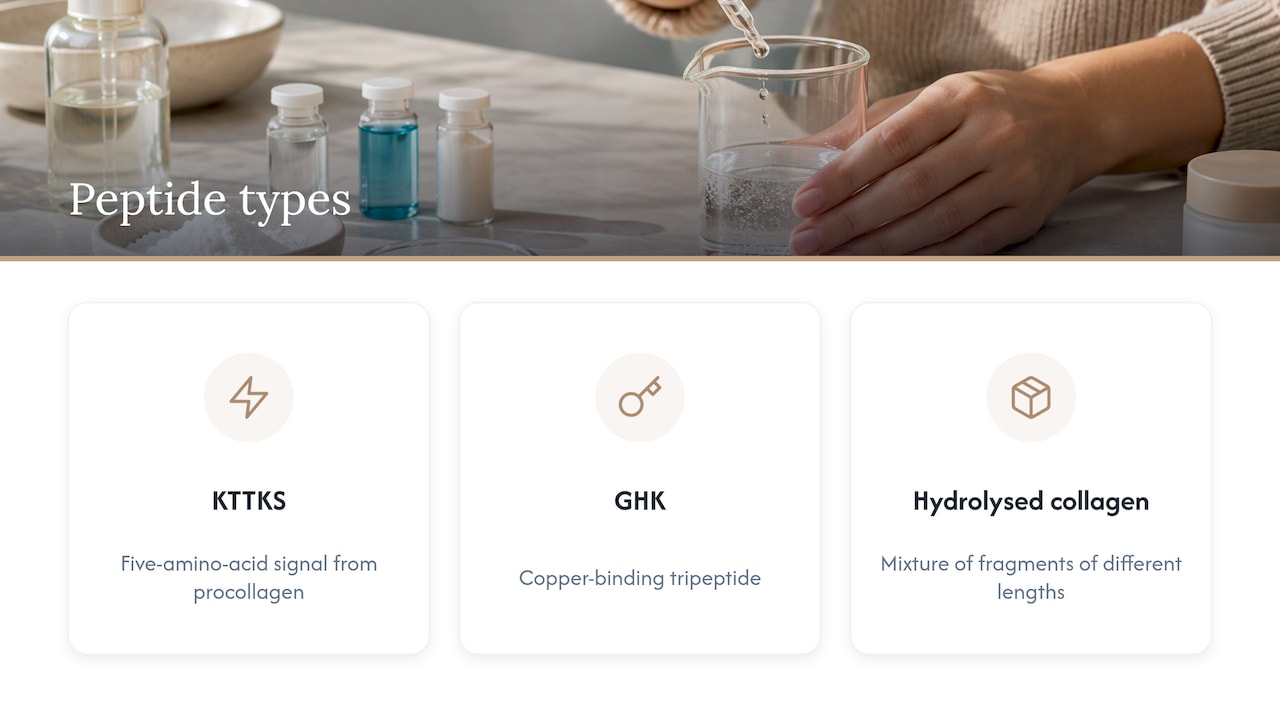
A 2026 academic review of peptides in aesthetic dermatology sorts them into distinct types that are not interchangeable. KTTKS is a five-amino-acid signal derived from procollagen. GHK is a copper-binding tripeptide. Hydrolysed collagen is a mix of fragments of different lengths. The practical lesson from that review is that results belong to a particular product, not to the whole “peptide” category.
Signal peptides and the “matrikine” idea
Many topical peptides work as matrikines. These are small fragments that the body naturally produces when the skin’s supporting framework breaks down, and they act as messages telling cells to make more of that framework. A British Journal of Dermatology review on skin ageing and topical rejuvenation names Matrixyl (palmitoylated KTTKS) as the most common example, with the fatty palmitoyl part helping it cross the skin barrier.
Hydrolysed collagen on the surface
Collagen in a cream behaves differently. A 2025 review of collagen-based products explains that intact collagen is too large to enter the skin, and that much of the plumping effect people notice comes from collagen’s water-binding film. That film temporarily softens the look of fine lines and supports the skin’s moisture barrier. This is why a good collagen cream feels so comfortable on dry, tight skin: the benefit is real, and it happens at the surface where the cream actually sits.
What the research says you can expect
The most useful recent overview is a March 2026 systematic review and meta-analysis of 19 randomised trials with 1,341 participants. It found that peptides improved skin hydration and brightness, with a modest overall effect on wrinkles and minimal adverse events. A 2024 systematic review found studies where topical peptides improved the look of fine lines and wrinkles and skin texture, and none of the human studies it assessed reported negative side effects.
A UK GP, Dr Caroline Warden, summarises the trial picture in her guide to peptides in skincare. Peptides improve the appearance of fine lines, hydration and texture modestly over eight to twelve weeks, and the formulation matters more than the peptide on its own. Her strongest example is a 2005 split-face trial of palmitoyl pentapeptide-4 (Matrixyl) in 93 women aged 35 to 55, which showed significant fine-line improvement over 12 weeks.
A realistic timeline
| Time | What most people notice |
|---|---|
| First days | Skin feels softer and less tight as hydration improves |
| 2 to 4 weeks | Smoother texture, a more even-looking glow |
| 8 to 12 weeks | Fine lines look softer, skin looks firmer |
The timeline lines up with the eight to twelve weeks in the trials above. Our own guide to collagen face cream benefits sets out the same pattern: hydration in days, firmness over eight to twelve weeks.
What collagen creams are best at
- Dry or dehydrated skin. The surface film and the moisture barrier support are where collagen creams shine.
- Fine lines, especially around the eyes. A dedicated collagen eye cream targets the thinnest skin on the face.
- Skin that does not enjoy strong actives. A gentle cream you will actually use every day beats a strong one you abandon after a week.
Collagen peptides or retinol?
This is the question we hear most from readers comparing routines, and the best answer is that they are not rivals. Retinol and other retinoids are the best-studied anti-ageing ingredients in dermatology. The British Journal of Dermatology review calls tretinoin the clinical gold standard for skin rejuvenation, and notes that retinol and related forms are not classed as drugs and are sold over the counter in the UK. Peptides work through a gentler route.
Dr Warden describes peptides as a complement to a retinoid, and a sensible choice when a retinoid is not comfortable: sensitive or reactive skin, a stressed barrier, pregnancy or breastfeeding. If you are pregnant or breastfeeding, or you are unsure whether retinol suits you, speak to your GP or pharmacist before starting it.
| Collagen peptide cream | Retinol | |
|---|---|---|
| Main job | Hydration, softer-looking lines, comfort | Rejuvenation of texture, lines and pigmentation |
| Typical timeline | Days for hydration, 8 to 12 weeks for firmness | Longer, with a gradual build-up of use |
| Feel on skin | Soothing and moisturising | Can cause dryness or stinging at first |
| Best time | Morning and night | Night |
Retinoids commonly cause redness, stinging and flaking at the start, which usually settles, and emollients help the barrier recover, according to the same BJD review. That is where a collagen cream earns its place in the routine: it is the moisturiser that keeps skin comfortable while it adjusts. Dr Warden’s advice for introducing a retinoid is to go slowly, one or two nights a week with moisturiser, and to increase only as skin tolerates it. For a deeper look at the pairing, read our guide to retinol versus collagen.
Collagen cream or collagen supplement?
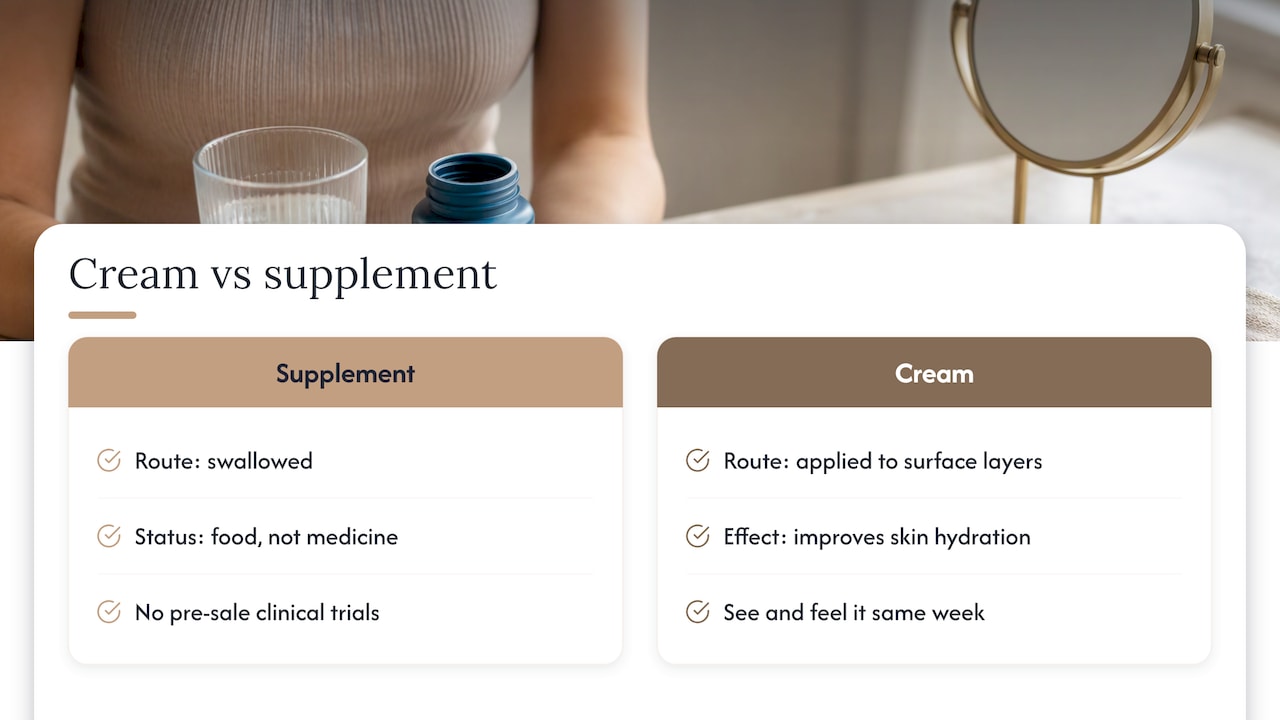
They are different products with different routes. A supplement is swallowed and counts as food in the UK, not as a medicine, so it does not need clinical-trial evidence before sale, as a UK pharmacy guide explains. A cream works where you apply it, on the surface layers, and the same guide notes that topical collagen improves skin hydration. If your goal is a more comfortable, hydrated, smoother-looking complexion, a cream targets that directly and you can see and feel it the same week.
For mature skin, where dryness and loss of density tend to show first, see our piece on collagen for mature skin after 35.
How to use collagen peptide skincare well
- Start with clean skin. Cleanse gently. A cream applied to clean, slightly damp skin spreads better and holds more moisture.
- Apply a thin, even layer morning and night. Include the neck and jawline. Use a specific eye product around the eyes.
- Add one new product at a time. Wait a couple of weeks before adding the next active. If something irritates, you will know which product it was.
- Keep retinol to the evening. If you use it, apply your collagen cream before or after it, as your skin prefers. Introduce retinol slowly.
- Finish with sunscreen in the morning. Dr Warden’s evidence summary for fine lines is sunscreen plus a retinoid, so a daily SPF is the habit that protects your results.
- Give it twelve weeks. Take a photo in the same light at the start. Firmness is a slow change, and a photo shows it better than a mirror.
Peptides are not known for causing trouble: adverse events in the trials were minimal. Still, any new cream can irritate. Patch-test behind the ear or on the inner forearm for a day or two first. If you have a skin condition, or a reaction persists, see your GP or a dermatologist.
How to choose a product that is worth buying
The 2026 review of peptides in dermatology stresses that a formulation’s results depend on the whole product, including the base it is mixed into, not on the peptide alone. So read the whole label, not just the front.
- Look at the full formula. Collagen sits best alongside moisturising and soothing ingredients. Our Celia range pairs collagen with aloe, algae or vitamins.
- Match the cream to your skin. A light gel-cream suits combination skin. A richer one suits dry skin in a British winter.
- Match the cream to your age and concern. Some are made for 40+ skin, others for eyes, necks or masks.
- Be wary of dramatic promises. Reviewers of collagen products note that hype often outruns the science. A steady, modest improvement is the honest expectation, and it is worth having.
If you also want to understand how it stacks up against other hydrators, our comparison of hyaluronic acid and collagen shows what each does, and our article on peptides in affordable skincare looks at getting good formulas without luxury prices.
Collagen creams from Poland, delivered in the UK
Polish brands have long been known for formulas built around collagen, algae and soothing plant extracts, and many Polish households in the UK grew up with them. We are a family-owned shop and we bring our products directly from Poland. Among them:
- Celia Collagen with Aloe: a soothing, hydrating collagen cream.
- Celia Collagen + Algae 40+: a lightweight moisturising collagen cream.
- Celia Collagen + Vitamins 40+: a rich anti-wrinkle cream for dry skin.
- Celia Collagen + Eyebright mask: an anti-wrinkle mask for the face, neck and décolleté.
Many items carry discounts of up to 15% during our sales, so a full routine does not need a luxury budget. You can browse everything at M-Shop.UK.

Our view
Polish cosmetics have taught us that a good cream does not have to be an expensive one. Collagen is a clear example. A cream that hydrates deeply, feels lovely and is used every single day will do more for your skin than a costly one that sits unopened.
When we choose what goes in the shop, we start from what people actually use: a collagen cream for the evening, an eye cream for tired mornings, a mask for the weekend. We pick products directly from Poland because we know the brands and we know what our customers, many of them Polish families in the UK, ask us for.
Our advice is simple. Choose a collagen cream that suits your skin type, use it morning and night, wear sunscreen, and give it twelve weeks. Add a retinol at night if you like, and let the collagen cream keep your skin comfortable around it.
Krzysztof
FAQ
Do collagen peptides work for skin?
Yes, for hydration, texture and the softened look of fine lines. A 2026 meta-analysis of 19 trials found improved hydration and brightness with minimal side effects. Results build gradually, usually over eight to twelve weeks of regular use.
Can I use collagen peptides with retinol?
Yes, and many people do. Use retinol in the evening, introduce it slowly, and keep a collagen cream in your routine to moisturise. Dr Warden suggests a gentle start of one or two nights a week with moisturiser. If you are pregnant or breastfeeding, ask your GP or pharmacist before using retinol.
Are there downsides to collagen peptides?
The trials report minimal adverse events, and a 2024 review found no negative side effects in the human studies it assessed. As with any new cream, patch-test first and introduce one product at a time. See your GP if you develop a persistent rash or irritation.
How long before I see results?
Hydration shows within days. Smoother texture follows in a few weeks, and a firmer look in about eight to twelve weeks. Photograph your skin at the start so you can compare.
Is collagen cream different from collagen supplements?
Yes. Supplements are swallowed and sold as food supplements in the UK. A cream works on the skin’s surface, where it hydrates and softens the look of lines, which is why many people choose both a good cream and a daily sunscreen.
Sources
- Peptides in Aesthetic Dermatology: Classification (2026)
- Skin ageing and topical rejuvenation strategies, British Journal of Dermatology (2023)
- Collagen-Based Products in Wound, Skin, and Health Care (2025)
- Oral and topical peptides for skin ageing: systematic review and meta-analysis (2026)
- Topical peptides systematic review (2024)
- Do Peptides in Skincare Work? A GP Explains the Evidence
- Will Collagen Help Hair Loss? UK Evidence and Treatments