



Why less ingredients are better for your skin
Minimalist skincare is defined as using fewer, carefully chosen ingredients to support skin health rather than overwhelming it with unnecessary compounds. Dermatologists consistently recommend a core routine of cleanser, moisturiser, and broad-spectrum sunscreen as the foundation for all skin types, with one active ingredient added only when tolerated. This approach, often called “skinimalism” in dermatology circles, directly addresses the risks of over-layering: barrier disruption, increased transepidermal water loss (TEWL), and chronic irritation. The evidence is clear. Fewer ingredients in skincare means less interference with the skin’s own repair mechanisms, and that produces better long-term results.
Why less ingredients are better for skincare: the skin barrier explained
The skin barrier is the outermost layer of the epidermis. Its job is to lock moisture in and keep irritants out. When it functions well, skin feels calm, plump, and resilient. When it breaks down, you get redness, stinging, and sensitivity that can persist for weeks.
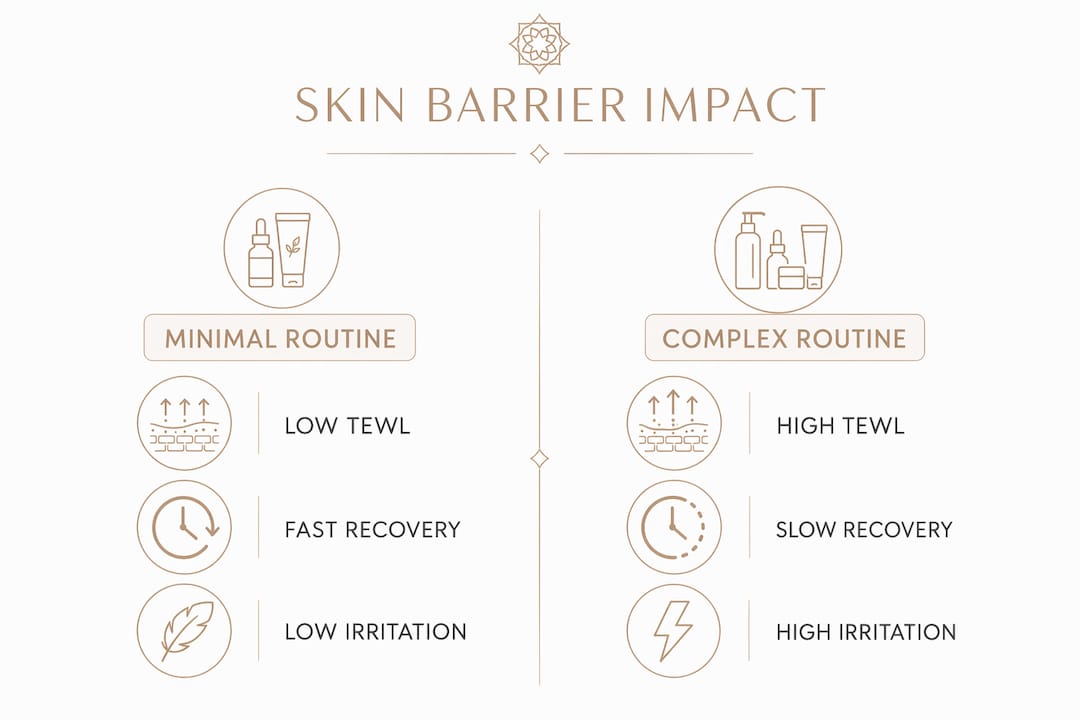
Over-exfoliation and layering multiple actives directly disrupt this barrier by raising transepidermal water loss, the rate at which moisture escapes through the skin. Higher TEWL means a weaker barrier. Dermatologists measure TEWL to assess how well a routine is working, and the data consistently shows that complex, multi-active routines push TEWL upward. Paring back to a gentle cleanser, a moisturiser, and sunscreen allows TEWL to normalise within weeks.
A critical insight that most skincare articles miss: many people mistake an over-treated, damaged barrier for innate sensitive skin. They assume their skin is simply reactive by nature. In reality, the products themselves are causing the problem. Removing the excess often resolves the “sensitivity” entirely.
| Routine type | Typical TEWL impact | Barrier recovery time | Risk of irritation |
|---|---|---|---|
| Minimal (cleanser, moisturiser, SPF) | Low | Days to weeks | Low |
| Moderate (3–4 actives) | Moderate | Several weeks | Moderate |
| Complex (10+ products, multiple actives) | High | Weeks to months | High |
Pro Tip: If your skin stings when you apply water or a plain moisturiser, your barrier is likely compromised. Strip your routine back to a fragrance-free cleanser and a simple moisturiser for two weeks before reintroducing anything else.
Does a simpler routine actually improve consistency?
Complex skincare routines are often too difficult to maintain, which leads to poor habits and inconsistent use. Inconsistency is the single biggest reason skincare products fail to deliver results. A routine you actually follow every day beats a ten-step programme you abandon by Wednesday.

Decision fatigue is real in skincare. When you face a shelf of twelve products every morning, the mental load of remembering the correct order, the waiting times between layers, and the compatibility rules between actives is genuinely exhausting. Simplified routines reduce this fatigue and improve adherence compared to complex multi-step regimens. That consistency is what produces visible, lasting change in skin health.
The financial and environmental case is equally strong. Minimalist skincare reduces environmental waste and costs significantly less than extensive multi-product regimens. Fewer products mean less packaging, less chemical runoff, and a smaller monthly spend. For anyone building an affordable skincare routine, cutting the product count is the fastest way to cut the cost without sacrificing results.
Practical benefits of adopting a minimal routine include:
- Easier irritant identification. When a reaction occurs, you know exactly which product caused it.
- Lower monthly cost. Three quality products cost far less than twelve average ones.
- Reduced environmental impact. Less packaging and fewer synthetic compounds entering waterways.
- Better skin monitoring. You can hear what your skin actually needs rather than masking signals with layers of product.
- Improved consistency. A short routine is a routine you will actually complete morning and evening.
Pro Tip: Track your skin’s condition in a simple notes app for two weeks after simplifying. You will notice patterns, such as which days your skin is calmer, far more clearly when there are fewer variables.
What common mistakes do people make when simplifying skincare?
The most dangerous mistake in minimalist skincare is overcorrection. Some people hear “fewer products” and interpret it as “no products.” Dropping sunscreen, skipping moisturiser, or abandoning a dermatologist-prescribed active in the name of minimalism causes real harm. The goal is intentional simplicity, not neglect.
Frequent product switching and over-exfoliation prevent the skin from stabilising. Every time you introduce a new product before the previous one has had time to work, you reset the clock. Skin needs consistency to show results, and constant switching guarantees you will never see them. Dr. Sharma notes that most cases of persistent sensitivity improve by cutting back products and allowing the skin space to stabilise.
A numbered approach to safe simplification prevents these errors:
- Stop all non-essential products immediately. Keep only your cleanser, moisturiser, and SPF for a minimum of two weeks.
- Assess your skin’s baseline. Note whether redness, stinging, or dryness improves without the removed products.
- Reintroduce one active at a time. Wait at least two weeks between each new addition to isolate its effect.
- Never skip SPF. Broad-spectrum sunscreen is non-negotiable regardless of how minimal your routine becomes.
- Consult a dermatologist before reintroducing prescription-strength actives. Retinoids and acids require careful spacing and should not be layered without professional guidance.
The skin’s barrier function measurably improves when active use is restricted and the routine is simplified. That improvement is the signal to proceed carefully, not to rush back to complexity.
How to build an effective minimal ingredient skincare routine
Dermatologists recommend a core routine of cleanser, moisturiser, daily broad-spectrum sunscreen, and only one active ingredient if tolerated. This is not a compromise. It is the evidence-backed foundation that dermatology has endorsed for decades. Everything beyond this core is optional and should earn its place through demonstrated results on your skin.
Choosing your core three products
Your cleanser should be gentle and fragrance-free. Harsh foaming cleansers strip the skin’s natural oils and raise TEWL before you have even applied anything else. Dr. Whitney Hovenic highlights that fragrance-free, gentle staples are better for maintaining a healthy skin barrier than complex, expensive formulas. A simple gel-cream cleanser designed for sensitive or atopic skin, such as the AA Oceanic fragrance-free cleansing gel, fits this requirement precisely.
Your moisturiser should support the barrier rather than overwhelm it. Look for formulations built around a small number of proven ingredients: glycerin, ceramides, hyaluronic acid, or collagen. The Polish face cream tradition of using targeted, natural actives like collagen and algae in clean formulations is a strong model for this approach.
Your sunscreen must be broad-spectrum and rated SPF 30 or above. This is the one product where you should not compromise on quality or skip on overcast days.
Adding one active ingredient
Reintroducing actives one at a time with spacing helps isolate tolerance and avoid conflicting reactions. If your skin is stable on the core three, you can consider adding a single active. Retinoids address ageing and texture. Vitamin C targets pigmentation and dullness. Niacinamide calms redness and supports the barrier. Choose one based on your primary concern, introduce it twice weekly, and increase frequency only if your skin shows no signs of irritation after four weeks.
Tips for reintroducing actives safely:
- Start with the lowest available concentration of any active.
- Apply on dry skin to reduce penetration speed and irritation risk.
- Use actives in the evening where possible to avoid photosensitivity.
- Always follow an active with a plain moisturiser to support the barrier.
- If irritation appears, reduce frequency before abandoning the ingredient entirely.
Dr. Pat Nicolas stresses that simple routines are often more effective than complicated ones, with intentionality being the goal rather than trend-following. That word, intentionality, is the key. Every product in your routine should have a specific, understood purpose. If you cannot state why a product is there, it probably should not be. You can also find further guidance on ingredient list clarity and why it matters for long-term skin health.
Key takeaways
Fewer ingredients in skincare produce better results because they protect the skin barrier, improve routine consistency, and make it easier to identify what your skin actually needs.
| Point | Details |
|---|---|
| Protect the skin barrier | Reducing actives and harsh ingredients lowers TEWL and allows the barrier to repair itself. |
| Stick to the core three | Cleanser, moisturiser, and broad-spectrum SPF form the evidence-backed foundation for all skin types. |
| Introduce actives one at a time | Adding one active with a two-week gap between introductions prevents conflicting reactions and isolates tolerance. |
| Consistency beats complexity | A simple routine followed daily outperforms a complex one used sporadically. |
| Simplicity reveals true skin needs | Fewer products reduce interference and allow you to monitor your skin’s genuine responses. |
Skinimalism is not a trend. It is just good dermatology.
I have watched the skincare market grow more complicated every year. New actives, new layering rules, new ten-step routines presented as the solution to every concern. And I have watched people’s skin get worse as a result. That is not a coincidence.
The honest truth is that most people do not need more products. They need fewer, better ones. When I simplified my own routine to three products and reintroduced actives one at a time, the persistent redness I had attributed to “sensitive skin” cleared up within three weeks. It was not my skin. It was the overload.
What I find most compelling about skinimalism is that it is not restrictive. It is clarifying. When you remove the noise, you finally hear what your skin is telling you. That information is worth more than any serum. The skincare routine order matters far less than the quality and simplicity of what you are actually applying.
My advice: resist the urge to add. Give your skin two weeks of calm before you reach for anything new. The results will tell you everything you need to know.
— Krzysztof
Quality Polish skincare built for minimal routines
M-shop stocks a carefully selected range of Polish skincare products that align naturally with a minimalist approach. These are not complicated formulations. They are clean, effective products built around proven ingredients like collagen, algae, and natural plant extracts, sourced directly from Poland and available at prices that make a quality routine genuinely accessible in the UK.

The Pharmaceris T Sebostatic Day cream with SPF is a strong example: a targeted, minimal-ingredient face cream with built-in sun protection, designed for acne-prone skin. The Celia Collagen + Algae moisturiser delivers barrier support through a short, focused ingredient list without unnecessary additives. M-shop’s family-run selection means every product on the site has been chosen with care, not just listed for volume. Browse the full range at M-shop to find the core products your routine actually needs.
FAQ
What is minimalist skincare?
Minimalist skincare, also called skinimalism, is a dermatology-endorsed approach that uses a small number of targeted products: typically a cleanser, moisturiser, and broad-spectrum sunscreen, with one optional active ingredient.
How many products should a minimal skincare routine include?
Dermatologists recommend three to four products as the ideal number. A cleanser, moisturiser, and SPF form the core, with one active added only if the skin tolerates it.
Can fewer skincare products really improve skin health?
Yes. Reducing product overload lowers transepidermal water loss, allows the skin barrier to repair, and resolves many cases of reactive or sensitive skin that were caused by over-treatment rather than innate skin type.
Is it safe to skip actives entirely in a minimal routine?
Skipping actives is safe and often beneficial during a barrier-repair phase. The one product you should never skip is broad-spectrum sunscreen, regardless of how minimal your routine becomes.
How do I know which products to keep when simplifying?
Keep your cleanser, moisturiser, and SPF without question. For any additional product, ask whether it has a specific, understood purpose for your skin. If it does not, remove it and monitor whether your skin improves.